
How I Saved $4,500 by DIY-ing My VW Sportwagen IS12 Turbocharger – Part 2: Understanding the Turbocharger
In my last post (“How I Saved $4,500 by DIY-ing My VW Sportwagen IS12 Turbocharger“), I showed you how I saved $4,500. In this post, I will set the stage and walk you through the different parts of an IS12 turbocharger.
Quick Recap of My Last Post
In the previous post, I compared the quote I received from the VW dealer to fix my Volkswagen Sportwagen turbocharger with how I saved almost $4,500 by doing the repair as a DIY in my home garage. Refer to the following link to my previous post.
I also promised in that post to show you step by step how I did the DIY. But I thought it would be better to first explain the structure of the turbocharger and its different components.
Coming Up Next
Then I will write another post to list all the different tools needed to perform the repair, especially the two-way OBD (VCDS system).
The Big Picture
Completing this post and the next one will set the stage for a deep dive into the repair post.
Please keep in mind as a disclaimer that these posts represent my own experience while I repaired my Volkswagen Sportwagen 1.8T and do not represent in any way a repair guide.
Where is the turbocharger located?
The first question I am going to start with — and the first question I actually asked myself when I decided to DIY my car and opened my Sportwagen engine bay — was: where is the turbocharger? Where is it located? The answer is: the IS12 sits at the top back left side when you face the car (on the passenger side). For clarity, see Picture 1 below.

Main IS12 Turbocharger Components
Picture 2
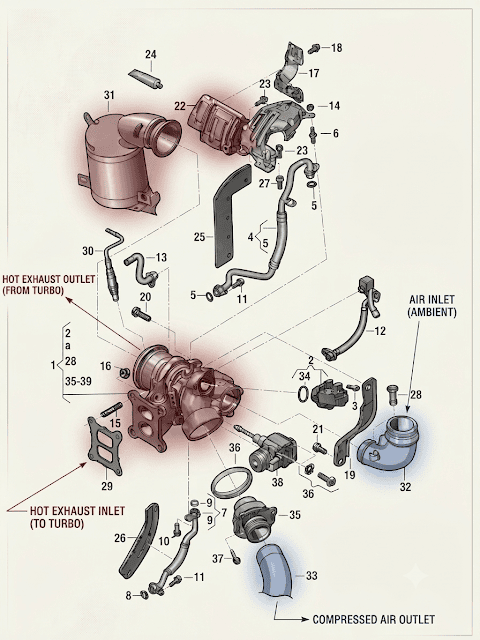
Below represents an exploded diagram of the IS12 turbocharger that the Volkswagen Sportwagen 1.8T uses.
For the complete list of all parts in picture 2 and their associated name and OEM part number refer to table 1 at the bottom of this post.
Where to buy these components?
Before You Buy: Know the Terms
Before I tell you where to buy these items, let’s clear up some terminology first.
OEM: The Gold Standard
OEM stands for Original Equipment Manufacturer. The original manufacturer approved by VW makes the part. These are the most coveted parts, and for good reason.
Aftermarket: Proceed with Caution
The second type is aftermarket. These parts may work, but they don’t always match the exact specifications of an OEM part.
A Real-Life Example: My Turbo Mounting Nut Problem
Let me give you a real example. When I tried to remove my IS12 turbo, I ran into trouble. The Turbo Mounting Nut (WHT007210 – item 16 in the diagram above) holds the turbo to the engine block through the Turbo Stud (N91231701 – item 15). After several attempts with a socket, that nut rounded off on me. So I had to replace it.
Why I Recommend OEM
First, I bought an aftermarket stud. Honestly? It looked just like the original. But the threads were different. It didn’t fit. That’s why I strongly advise sticking with OEM parts. And whenever possible, buy them from a certified VW dealer.
What is the role of the Wastegate Actuator?
The turbocharger is an electronic device that receives an electronic signal from the ECU. That signal translates into translational movement, which controls the wastegate flapper opening and closing. This way, the wastegate controls the amount of compressed exhaust that bypasses the compressor turbine.
What is the role of the Compressor Recirculation Valve (CRV)?
When you press the gas pedal, the turbo pushes compressed air toward the throttle valve. But when you let off the gas, the throttle valve closes — and the compressor doesn’t just stop instantly. That compressed air has nowhere to go, so it slams back against the throttle valve. Over time, that back pressure can damage it.To prevent this, the Diverter Valve (sometimes called a CRV) opens up. It recirculates that trapped air safely, so pressure never gets a chance to build up and hurt anything.
What is the turbocharger’s gas flow path?
Pressurized exhaust gases from the engine cylinders enter through Item 29 (Exhaust Manifold Gasket). These gases then spin the turbine wheel inside Item 1 (Turbocharger Turbine Housing), and exhaust exits through Item 31 (Catalytic Housing). On the intake side, fresh air enters through Item 32 (Compressor Inlet Elbow). Item 1 (Compressor Wheel – cold side of the turbo) compresses the air, and boosted air leaves through Item 33 (Charge Air Outlet Hose). From there, the air travels to the intercooler, then to the throttle body, and finally to the engine intake manifold.
Now you know where it’s located, what each component does, and most importantly, why I’m so picky about using OEM parts.
In my next post, I’ll walk you through every single tool you’ll need to tackle this job yourself — including the VCDS system (two-way OBD) that saved my sanity. Trust me, you don’t want to start this repair without it.
List of Items and their OEM Part Numbers (1–38)
List of Items and their OEM Part Numbers (1–38)
- IS12 Turbocharger Assembly – 06K145713
- LElectronic Wastegate Actuator – 06K145614G
- Actuator Retaining Screw – VIN specific
- Upper Coolant Pipe Assembly – VIN specific
- O-Ring Seal – VIN specific Banjo Bolt – N91167901
- Oil Feed Pipe Assembly – VIN specific
- Sealing Washer – N0138492
- Oil Feed O-Ring – VIN specific
- Oil Line Retaining Bolt – VIN specific
- Pipe Fastener – N10699701
- Diverter Valve Vent Hose – VIN specific
- Oxygen Sensor Extension Tube – VIN specific
- Heat Shield Fastener – N91130801
- Turbo Stud – N91231701Turbo Mounting Nut – WHT007210
- Exhaust Outlet Adapter – VIN specific
- Exhaust Outlet Bracket Bolt – N10656402
- Wastegate Actuator Bracket – 06K145220
- Oxygen Sensor Fastener – VIN specific
- Wastegate Actuator Screw – N10692701
- Close-Coupled Catalytic Converter – 5QM254502GX
- Heat Shield Retainer – VIN specific
- Exhaust Clamp Sleeve – 1K0253141M
- Heat Shield Plate – VIN specific
- Lower Heat Shield – VIN specific
- Coolant Line Bolt – VIN specific
- Pipe Connection Fastener – N91108201
- Turbo Manifold Gasket – 06K253039F
- Upstream Oxygen Sensor – 06K906262
- Catalytic Converter Housing – Included with item 22
- Compressor Inlet Elbow – 06K129654
- Charge Air Outlet Hose – 5QM145832
- Wastegate Actuator Seal – Included with actuator
- Diverter Valve Assembly – 06H145710D
- Retaining Clip – 06K145220A
- Diverter Valve Screw – N90947002
- Wastegate Actuator (V465) – 06K145614G
Brackets
- Bracket 1 – IS12 Turbocharger Assembly – 06K145713L
- Bracket 2 – Compressor Recirculation Valve (CRV)
Blog
This section provides an overview of the blog, showcasing a variety of articles, insights, and resources to inform and inspire readers.
EA888 Gen 3 Water Pump Explained: How It Works, Failure Points and Diagnosis
If you own a Volkswagen or Audi with an EA888 Gen 3 1.8T or 2.0T…

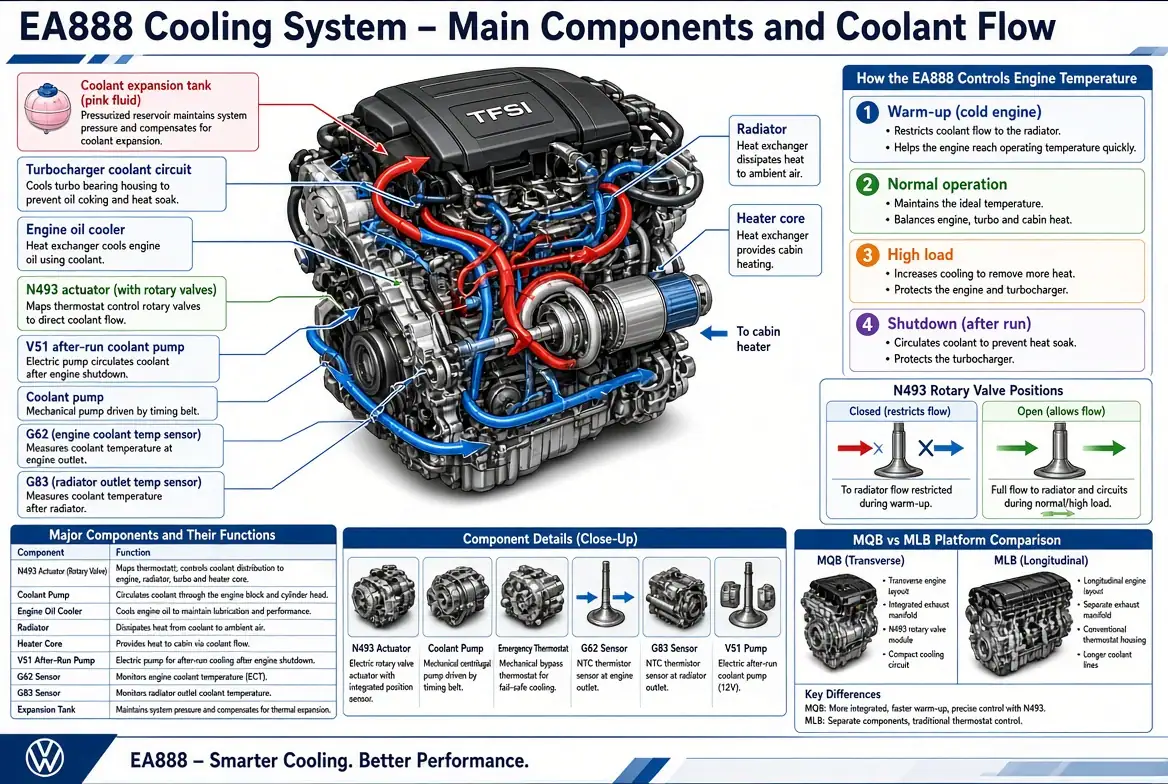

EA888 Cooling System Explained: How Volkswagen Controls Engine Temperature
Detailed technical illustration of the EA888 Gen 3 engine showing main cooling system components with…
VCDS Part 1-4: How to Perform Your First Auto-Scan on a Volkswagen or Audi
If you have completed the first three articles in this VCDS series, you now understand…


Leave a Reply