
In this post I am going to present the savings I was able to make by fixing an EPC error code shown on the dashboard of my Volkswagen Sportwagen alongside the engine check light.
First I am going to present the VW dealer cost and an independent shop; then I will tell you the money that I spent to fix the car myself in my garage. Please keep in mind that first: I am an owner of a VW Sportwagen but not a certified mechanic, second, this post is based on my personal experience with my Volkswagen and how I DIY it. For symptoms of this problem refer to my previous post Car Lost Power While Driving on Highway? From Boost to Limp Mode – Causes & Fixes
What Is the EPC Light?
But before I go deeper, let me explain what an EPC light is and what its relation is to the turbocharger.
The EPC light (Electronic Power Control) is a warning indicator on your Volkswagen Sportwagen dashboard. When it illuminates, it signals an issue with your car’s engine management system, specifically the throttle, traction control, or cruise control systems.

Common Causes of the EPC Light in a Golf Sportwagen
The EPC light in the Golf Sportwagen is most often triggered by the following issues:
- Turbocharger Wastegate: This is the most common mechanical failure reported. The wastegate actuator can become clogged or seize due to corrosion, causing low boost pressure. This often requires replacing the entire turbocharger assembly.
- Throttle Body Issues: Carbon buildup or a faulty throttle body can disrupt the air-fuel mixture, triggering the EPC system.
- Thermostat & Water Pump: A failed thermostat housing or water pump can trigger the EPC light if the engine control unit detects low coolant flow or overheating risks.
- Brake System Faults: Because the EPC works with the stability control, a faulty brake light switch or a bad brake pedal sensor is a common cause.
Focus: Turbocharger & Wastegate Issues
In this post I will be focusing on the issues related to the turbocharger and its wastegate.
How to Diagnose a Turbo-Related EPC Light
But first, how do you know if you see an EPC light that it is related to the turbocharger?
The answer to that question is to use an OBD II scanner and if you get the following code “P00AF” then there is an issue with the turbocharger / supercharger booster control module.
See the picture below.

How a Turbocharger Works (Simplified)
What is a turbocharger?
The turbocharger is a component in a car that is used to increase the output of the engine (increase the horsepower of the engine). Its principle of operation is based on using the pressurized hot engine exhaust gases from the cylinder to revolve a turbine wheel.

The 4-Step Turbo Cycle
Here’s how a turbocharger actually works:
Step one:
The air and fuel mixture enters the cylinder from the intake manifold. It burns, which creates a small explosion that pushes the piston down. That’s what makes the engine spin. Once that’s done, the hot, pressurized exhaust gases get pushed out of the cylinder.
Step two:
Those hot exhaust gases flow into the “hot side” of the turbo and spin the turbine wheel. To control the wheel spinning speed, the engine computer (ECU) controls a little door called a wastegate flapper. That door lets some exhaust bypass the turbo wheel. An actuator—basically a small electronic arm—opens and closes that flapper based on signals from the ECU.
Step three:
The turbine wheel is connected to a compressor wheel by a solid shaft. When the turbine spins, the compressor spins too. That compressor wheel sucks in fresh, clean air from your air box, then squishes it (compresses it). When air gets compressed, it heats up—a lot.
Step four:
That hot, compressed air flows through an intercooler, which cools it back down. Cooler air = more oxygen = better burn. From there, the air moves to the throttle body, gets mixed with fuel, and heads into the intake manifold. Then it’s back to the cylinders to start the whole process over again, but with more power because the air is now pressurized.
Because the gasoline/air mixture in the intake manifold is under pressure it will increase the power of the engine compared to a regular engine without a turbo. Refer to the turbocharger operating mode in the diagram in picture 4.

How Much the Professionals Quoted Me
Repair Cost
Going back to the question which is how much was the quote that I got to repair the turbocharger issue. Well I checked with a VW dealer and an independent certified repair shop and the quotes were as the following:
VW Dealer Quote: $5,205
The VW dealer quote was $5,205.81 which included the replacement of the turbocharger with a brand new OEM (original equipment manufacturer) plus labor. The new OEM turbocharger cost is $3,087.24 and the rest is labor. Of course you need to add the diagnostic fee of $198.50.
The thing is that I dropped my car off at the dealer for a diagnostic and I was waiting for their phone call for feedback, but the funny thing is they just approved the repair cost on my behalf and when I went to their location I was told that my car was in line to get repaired and that the approval was done on my behalf mistakenly. Refer to the document attached.
Independent Shop Quote
After that I took my car to an independent certified European car repair shop and I asked them how much it would cost to fix the turbocharger, and they refused to give me a quote without a proper diagnostic. So I accepted the diagnostic cost, and the reason I did that is because I was hoping that this shop might fix the turbocharger without changing it. But they ended up providing me a quote that included the following:
- Diagnostic costs $161.94
- Turbo replacement $3,038.13
There were other issues not turbocharger related detected but I will not mention them here for brevity.
My DIY Fix: Under $500
Of course as I mentioned earlier I performed the repair as a DIY and it cost me under $500 mainly to buy tools.
So after getting quotes for $5,200 from the dealer and another $3,000+ from an independent shop—both telling me I needed a whole new turbo—I decided to take a step back. I grabbed my OBD scanner, pulled the P00AF code, and started doing some research online. Turns out, a seized wastegate is super common on these VW turbos.
I pulled the turbo out (which was a pain, not gonna lie) and checked the wastegate flapper by hand. Sure enough, it was stuck. Would barely budge. The rest of the turbo? Totally fine. Spinning smoothly, no shaft play, no damaged fins. Just a flapper that got crusty from heat and corrosion over the years.
So instead of dropping thousands on a brand new turbo, I spent an afternoon cleaning up the wastegate pivot points, getting everything moving freely again, and hitting it with some high-temp anti-seize. But honestly? That didn’t work. The arm was just too far gone—corroded and worn past the point of saving. So I decided to replace the seized arm completely.
It was risky but worth the try
Total cost for the replacement arm, supplies, and a few tools I wanted to have on hand? Under $500. The EPC light and check engine light are gone, and the car has been running great ever since.
I couldn’t believe both shops wanted to replace the entire turbo for something this simple. I get it—dealers and shops have to cover their labor and warranties, but for a DIY guy like me, this was a no-brainer.
Anyway, in my next post, I’ll walk you through exactly how I did it. Step by step. Removing the turbo on a Sportwagen isn’t fun, but it’s doable, and I’ll show you how to replace that wastegate arm without swapping the whole turbo.
Blog
This section provides an overview of the blog, showcasing a variety of articles, insights, and resources to inform and inspire readers.
EA888 Gen 3 Water Pump Explained: How It Works, Failure Points and Diagnosis
If you own a Volkswagen or Audi with an EA888 Gen 3 1.8T or 2.0T…

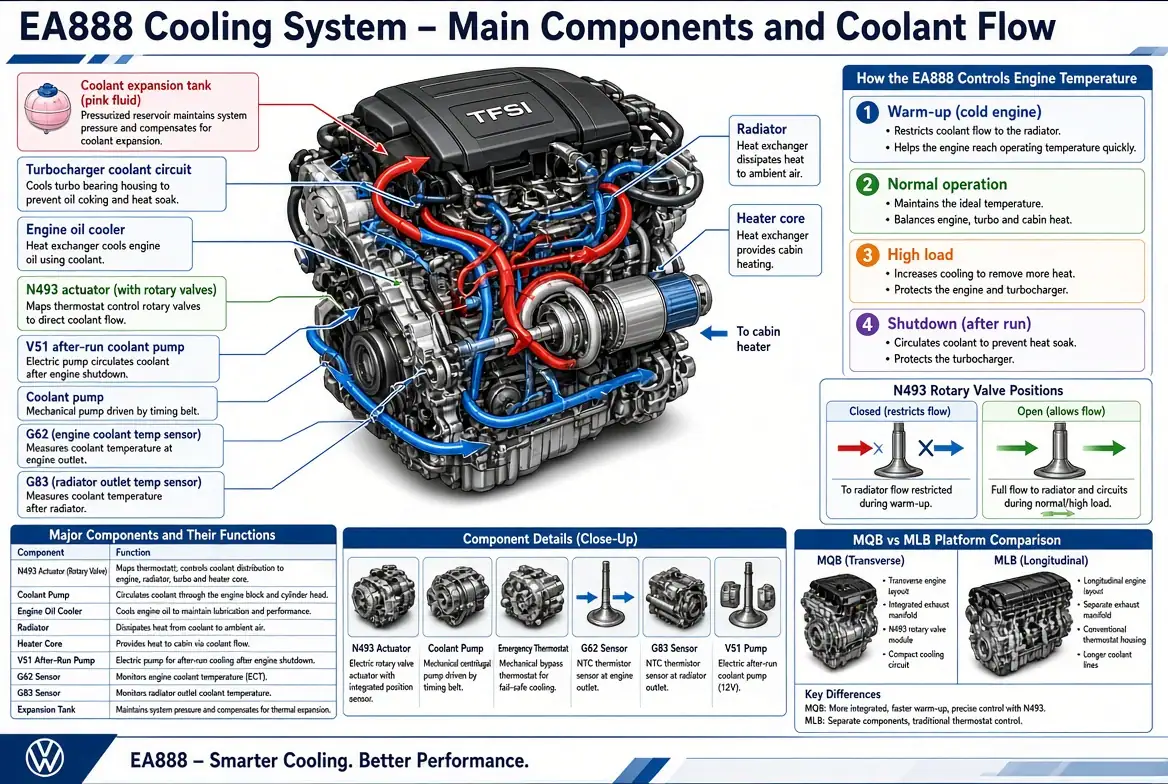

EA888 Cooling System Explained: How Volkswagen Controls Engine Temperature
Detailed technical illustration of the EA888 Gen 3 engine showing main cooling system components with…
VCDS Part 1-4: How to Perform Your First Auto-Scan on a Volkswagen or Audi
If you have completed the first three articles in this VCDS series, you now understand…


Leave a Reply