
If you own a turbocharged Volkswagen or Audi powered by an EA888 engine, few diagnostic trouble codes are as common—or as misunderstood—as P0299: Turbocharger/Supercharger Underboost Condition.
The first time this code appears, many owners assume the worst:
“My turbocharger has failed.”
That assumption often leads to unnecessary repairs and expensive parts replacements. In reality, a worn-out turbocharger is only one of many possible causes of P0299. More often, the fault originates elsewhere in the boost control system, such as a leaking charge pipe, a malfunctioning diverter valve, a sticking wastegate actuator, or another component that prevents the engine from achieving its requested boost pressure.
The good news is that most P0299 faults can be diagnosed systematically without replacing parts at random. With the right tools, live data, and a structured troubleshooting process, you can identify the root cause and avoid spending hundreds—or even thousands—of dollars unnecessarily.
This article is the first installment of a comprehensive guide dedicated to understanding and diagnosing P0299 on Volkswagen and Audi vehicles equipped with EA888 engines. Whether you drive a Golf GTI, Golf SportWagen, A3, A4, Tiguan, Passat, or another EA888-powered model, the diagnostic principles discussed here remain largely the same, although individual components and control strategies vary between engine generations.
Throughout this series, I’ll explain not only what the fault code means, but also how the engine control module (ECM) determines when to set it, the components involved in boost regulation, and why seemingly unrelated faults—such as a failing PCV valve or a loose intercooler hose—can trigger an underboost condition.
My Experience Diagnosing EA888 Turbocharger Problems
Fault codes rarely identify the failed component—they identify the system that requires further diagnosis.
I’ve spent considerable time studying the EA888 platform, reviewing Volkswagen repair information, analyzing diagnostic data, and documenting repair procedures to help other enthusiasts avoid unnecessary repairs.
While I am not a certified Volkswagen technician, every recommendation presented in this article is based on a combination of:
- Hands-on diagnostic experience
- Volkswagen service literature
- Ross-Tech VCDS documentation
- Established automotive diagnostic principles
- Common failure patterns reported by EA888 owners
My goal is not to replace the factory repair manual, but to explain why P0299 occurs and provide a logical approach to diagnosing it.
What Does Diagnostic Trouble Code P0299 Mean?
P0299 is a generic OBD-II diagnostic trouble code defined as:
Turbocharger/Supercharger Underboost Condition
Although the wording is simple, the underlying logic is much more sophisticated.
Modern turbocharged engines continuously calculate how much boost pressure should be available under current operating conditions. The engine control module compares this calculated target against the boost pressure actually measured by the intake Air pressure sensor .
Whenever the measured boost pressure remains significantly below the expected value for a specified period, the ECM concludes that the turbocharging system is unable to produce the requested boost and stores DTC P0299.
This is an important distinction.
The code does not necessarily indicate that:
- the turbocharger has failed,
- the wastegate actuator is defective,
- the diverter valve is leaking, or
- the intercooler has burst.
Instead, it simply tells you that the engine produced less boost than expected.
Determining why requires additional diagnosis.
Why Boost Pressure Matters
Turbochargers exist for one primary reason:
To increase the amount of air entering the engine.
More air allows more fuel to be burned efficiently, producing greater power while maintaining good fuel economy.
Unlike naturally aspirated engines, EA888 engines rely heavily on accurate boost control.
The engine control module (ECM) continuously adjusts turbocharger output to achieve several objectives simultaneously:
- Deliver strong acceleration
- Reduce turbo lag
- Improve fuel economy
- Lower exhaust emissions
- Protect engine components
- Prevent excessive cylinder pressures
Producing too little boost results in reduced engine performance.
Producing too much boost can damage pistons, connecting rods, head gaskets, or even the turbocharger itself.
For this reason, the ECM monitors boost pressure many times per second.
How the ECU Knows Something Is Wrong
Many drivers assume the turbocharger somehow “reports” that it has failed.
That isn’t how the system works.
Instead, the ECU collects information from numerous sensors and compares expected engine behavior with actual operating conditions.
Among the sensors involved are:
- Intake manifold pressure (MAP) sensor
- Intake air temperature sensor
- Throttle position sensor
- Engine speed sensor
- Accelerator pedal position sensor
- Mass airflow sensor (on some EA888 variants)
- Ambient pressure sensor
Using these inputs, the ECU estimates the amount of air the engine should receive.
If the calculated airflow doesn’t match the measured boost pressure, the ECU begins monitoring the deviation.
Small differences are perfectly normal.
For example:
- changing altitude,
- outside temperature,
- humidity,
- rapid throttle movements,
all influence boost pressure.
The ECU accounts for these variables.
Only when the difference exceeds calibrated limits for a sufficient period does it store P0299.
Requested Boost vs. Actual Boost
One of the most valuable concepts to understand when diagnosing turbocharger problems is the relationship between requested boost pressure and actual boost pressure.
These values can be viewed using professional diagnostic tools such as:
- VCDS
- ANCEL VD700
The ECU constantly calculates:
Requested Boost
This represents the boost pressure the engine wants to achieve based on operating conditions.
At the same time, the MAP sensor measures:
Actual Boost
This is the boost pressure actually present inside the intake manifold.
Under normal conditions, these values closely follow one another.
During acceleration, requested boost rises rapidly, and the turbocharger responds almost immediately.
Actual boost should increase smoothly until it nearly matches the requested value.
If actual boost consistently remains well below requested boost despite increasing engine load, the ECU recognizes that the turbocharging system is underperforming.
Eventually, it stores P0299.
Understanding this relationship is the foundation of accurate diagnosis.
Rather than replacing components based solely on a fault code, technicians compare requested and actual boost to determine whether the problem is mechanical, electrical, pneumatic, or sensor-related.
Why Clearing the Code Rarely Solves the Problem
One of the most common mistakes made after discovering P0299 is simply erasing the fault code and continuing to drive.
While the warning light may disappear temporarily, the underlying condition almost always remains.
As soon as the ECU detects another significant underboost event, the code returns.
In many cases, repeated underboost conditions also trigger additional symptoms, including reduced engine power, EPC warnings on certain Volkswagen models, or limp mode designed to protect the engine and turbocharger from further stress.
For this reason, clearing the code should never be considered a repair. It is only appropriate after the root cause has been identified and corrected.
Understanding the EA888 Engine Family
The EA888 is one of Volkswagen Group’s most successful turbocharged gasoline engine families. Introduced in the mid-2000s, it has powered millions of Volkswagen, Audi, Škoda, and SEAT vehicles worldwide. Over time, Volkswagen refined the platform through multiple generations, improving fuel efficiency, emissions, reliability, and performance while retaining the same basic design philosophy: a compact, direct-injected, turbocharged inline four-cylinder engine.
Depending on the model year and market, you may find an EA888 engine in vehicles such as:
- Volkswagen Golf GTI
- Golf R
- Golf SportWagen
- Golf Alltrack
- Jetta GLI
- Passat
- Tiguan
- Arteon
- Audi A3
- Audi A4
- Audi A5
- Audi Q3
- Audi Q5
- Several Škoda and SEAT models
Although these vehicles share the EA888 engine architecture, they do not all use identical turbochargers, wastegate systems, sensors, or engine calibrations. This is an important point because many online repair guides assume every EA888 behaves the same. In reality, the correct diagnostic approach often depends on the specific engine generation and turbocharger configuration.
Before replacing parts, always verify your vehicle’s engine code and model year using the VIN, emissions label, or factory service information.
Why Engine Generation Matters
One of the biggest sources of confusion surrounding P0299 is that the boost control system changed significantly across the EA888 generations.
For example, an early EA888 may use a vacuum-operated wastegate controlled by an N75 boost control solenoid, while a later EA888 Gen 3 engine may use an electronically controlled wastegate actuator integrated into the turbocharger assembly. A diagnostic procedure that applies to one configuration may be incomplete—or even misleading—when applied to another.
Understanding which system your engine uses allows you to focus your testing on the components that actually control boost pressure.
A Simplified Overview of the Turbocharging System
To understand why P0299 occurs, it’s helpful to follow the path of air through the engine.
The process begins when fresh air enters through the air intake and air filter. From there, it flows to the turbocharger compressor. Exhaust gases leaving the engine spin the turbine wheel, which is connected by a shaft to the compressor wheel. As the compressor spins, it forces additional air into the intake system, increasing the density of the air entering the cylinders.
Compressed air then travels through the charge pipes to the intercooler. The intercooler removes heat generated during compression, making the air denser and improving combustion efficiency. From the intercooler, the air passes through the throttle body and into the intake manifold before entering the cylinders.
The ECM monitors this entire process using multiple sensors and continuously adjusts turbocharger output to match the driver’s power demand while protecting the engine.
A leak, restriction, or malfunction anywhere along this path can reduce the amount of air reaching the engine, causing actual boost pressure to fall below the requested value and potentially triggering P0299.
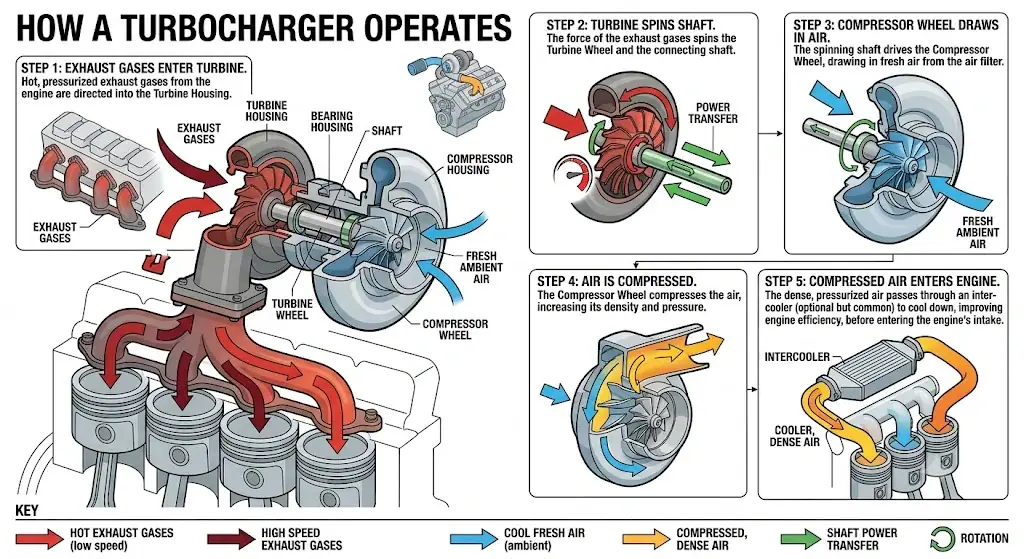
The Major Components Involved in Boost Control
Although individual designs differ, every EA888 turbocharging system relies on several key components working together.
Turbocharger
The turbocharger is the heart of the system.
It consists of two primary sections connected by a common shaft:
- The turbine, driven by exhaust gases.
- The compressor, which compresses incoming air.
As engine speed and exhaust flow increase, the turbine spins faster, allowing the compressor to generate additional boost pressure.
Contrary to popular belief, the turbocharger does not simply produce “maximum boost” all the time. Instead, the ECM carefully regulates boost according to engine load, throttle position, ambient conditions, and engine protection strategies.
Wastegate
Without a method of controlling turbocharger speed, boost pressure would continue increasing as engine speed rises.
This is the job of the wastegate.
The wastegate is essentially a bypass valve in the turbine housing. When it opens, a portion of the exhaust gases bypasses the turbine wheel instead of spinning it. This slows the turbocharger and limits boost pressure.
When the wastegate remains closed, nearly all exhaust energy drives the turbine, allowing boost pressure to build rapidly.
If the wastegate sticks open, opens too early, or fails to close completely, the turbocharger cannot generate sufficient boost. Under heavy acceleration, this commonly results in P0299.
Wastegate Actuator
The wastegate itself does not move independently. It is operated by an actuator.
Depending on the EA888 generation, the actuator may be:
- Vacuum-operated
- Pressure-operated
- Electronically controlled with an integrated motor and position sensor
Regardless of the design, the actuator’s purpose is the same: position the wastegate precisely to achieve the boost pressure requested by the ECM.
If the actuator binds, develops excessive play, loses calibration, or suffers an electrical failure, boost control becomes inaccurate.
From my experience working on an EA888 Gen 3 equipped with an electronic wastegate actuator, proper calibration is just as important as replacing a faulty component. Installing a new actuator without performing the required adaptation procedure can still result in drivability issues or recurring fault codes.
Diverter Valve
The diverter valve (DV) is frequently misunderstood.
Many people assume it creates boost pressure, but that isn’t its purpose.
Instead, it protects the turbocharger during rapid throttle closure.
Imagine accelerating hard and then suddenly lifting your foot off the accelerator. The throttle plate closes almost instantly, but the turbocharger continues spinning at extremely high speed. Without a way to relieve the trapped pressure, compressed air could surge backward through the compressor wheel, reducing turbocharger efficiency and increasing mechanical stress.
The diverter valve opens during these conditions, allowing compressed air to recirculate back into the intake system rather than forcing it against the closed throttle.
If the valve leaks when it should remain closed, valuable boost pressure escapes before reaching the engine. The result may be reduced acceleration, slower turbo spool, and eventually P0299.
Earlier EA888 engines equipped with diaphragm-style diverter valves were more susceptible to diaphragm tears and leakage. Later piston-style revisions generally improved durability, although contamination, sticking, or seal wear can still occur with age.
Intercooler
Compressing air generates heat.
Hot air is less dense than cool air, reducing engine performance.
The intercooler acts as a heat exchanger, cooling compressed air before it enters the engine.
Besides improving power, the intercooler helps reduce the risk of engine knock by lowering intake air temperature.
However, because the intercooler is part of the pressurized intake tract, damage to the core, loose hose connections, or cracked end tanks can create boost leaks that contribute to underboost conditions.
Charge Pipes and Hoses
The network of pipes connecting the turbocharger, intercooler, and intake manifold often receives little attention until a problem develops.
These pipes must remain completely sealed while carrying pressurized air.
A small crack, deteriorated O-ring, or loose clamp may not produce an obvious noise at idle, yet under boost it can release enough compressed air to prevent the engine from reaching its target pressure.
For this reason, visual inspection alone is not always sufficient. Later in this guide, we’ll discuss why smoke testing and pressure testing are among the most effective diagnostic techniques for locating boost leaks.
Sensors That Help Detect Underboost
Modern turbocharged engines depend on accurate sensor information.
Several sensors contribute directly or indirectly to boost control.
MAP Sensor
The Manifold Absolute Pressure (MAP) sensor measures intake manifold pressure and provides one of the most important inputs for boost regulation.
If the sensor becomes contaminated with oil residue or fails electrically, the ECM may receive inaccurate pressure readings, potentially affecting boost control and diagnostic decisions.
Although MAP sensor failure is less common than boost leaks or wastegate problems, it should not be overlooked during diagnosis.
Intake Air Temperature Sensor
Air density changes with temperature.
The intake air temperature sensor helps the ECM compensate for these changes when calculating airflow and boost targets.
An inaccurate temperature reading may influence engine performance calculations, although it rarely causes P0299 by itself.
Mass Air Flow Sensor (Where Equipped)
Some EA888 configurations also use a Mass Air Flow (MAF) sensor.
The MAF measures the quantity of air entering the engine before it reaches the turbocharger.
Comparing MAF readings with boost pressure can provide valuable clues when diagnosing intake restrictions, boost leaks, or sensor-related problems.
Why the ECU Continuously Adjusts Boost
Many drivers imagine turbochargers operating at a fixed pressure.
In reality, boost pressure changes constantly.
During normal driving, the ECM may request only modest boost to improve fuel economy.
Under full acceleration, requested boost rises significantly to maximize engine performance.
The requested value also changes according to:
- Engine speed
- Gear selection
- Intake air temperature
- Ambient atmospheric pressure
- Coolant temperature
- Knock control
- Engine protection strategies
- Traction and stability control interventions
This dynamic control explains why a turbocharger that appears to function normally during gentle driving may still trigger P0299 during a heavy uphill climb or full-throttle acceleration.
Only under higher load does the system demand enough boost to reveal an underlying problem.
Understanding the Bigger Picture
One of the most important lessons I’ve learned while diagnosing EA888 engines is that P0299 is rarely an isolated component failure.
It is usually the final result of a chain of events somewhere within the boost control system.
The ECU simply observes that the engine is not achieving its expected boost pressure. It cannot immediately distinguish whether the cause is a leaking hose, a sticking wastegate, a weak diverter valve, an incorrectly calibrated electronic actuator, a damaged turbocharger, or another fault altogether.
That’s why successful diagnosis depends on understanding how all of these components work together rather than assuming the turbocharger itself has failed.
In the next part of this guide, we’ll begin examining the most common causes of P0299 on EA888 engines in detail, starting with boost leaks, diverter valve failures, PCV system faults, wastegate actuator problems, and the other issues that experienced technicians investigate before ever recommending a turbocharger replacement.
In the next installment, we’ll move from theory to practice and examine each common cause of P0299 individually, including how to recognize its symptoms, why it causes underboost, and the diagnostic tests that confirm or eliminate it.
Disclaimer: This guide is based on my hands-on experience diagnosing and repairing EA888-powered Volkswagen and Audi vehicles, manufacturer service information, and diagnostic best practices. I am an automotive enthusiast—not a certified Volkswagen or Audi technician. Always verify repair procedures and specifications for your specific vehicle, engine code, and model year before performing maintenance or repairs.
Leave a Reply