Category: DTC Codes
A growing library of diagnostic trouble code (DTC) guides covering common check engine light codes across gas and diesel vehicles. Each post breaks down what a specific code means, the most likely root causes, how to confirm the fault with proper diagnostic tools, and the repair steps that actually fix it — not just a generic code definition pulled from a database.
You’ll find P-codes, B-codes, C-codes, and U-codes covering everything from boost and charge pressure faults to sensor, actuator, ignition, and emissions-related trouble codes. Guides draw on real, hands-on diagnostic and repair work — including VCDS-based diagnostics on VW/Audi platforms — so you’re getting practical troubleshooting steps, not just theory.
Is It Worth Replacing the Original EA888 Plastic Water Pump with an Aluminum Assembly?
The short answer: an EA888 aluminum water pump can be worth the money, but only under three conditions. The replacement must suit your engine. You must be able to verify the manufacturer. Finally, the warranty must cover more than the part. An aluminum housing may outlast plastic, especially after a crack or warp. However, material…
Written by
Inside an IHI IS12 Turbocharger: What It Is, How It Works, and How It Comes Apart
A turbocharger is a small, fast-spinning device that gives an engine more air. This article explains what one is and what each part does. It also shows what happens when someone takes one apart and examines it. Which IHI IS12 turbocharger this article covers The unit described here is the IHI IS12. You find it…
Written by
VW SportWagen P00B7 and P0131: VCDS Scan Results and Next Diagnostic Steps
In Part 1 of this case study, I described the check engine light that came on during a trip from New York to Boston. My 2018 Volkswagen SportWagen 1.8T has the EA888 Gen 3 engine. The temperature gauge climbed almost to the red zone, so the cooling system became my first priority. My first scan,…
Written by
VW SportWagen P00B700 and P013100: VCDS Diagnosis Guide for the EA888 1.8T
On October 15, 2026, I was travelling from Manhattan New York to Boston in my 2018 Volkswagen SportWagen 1.8T (EA888 Gen 3) when the check engine light came on and the temperature gauge climbed almost to the red zone. On Saturday, October 17, I scanned the car with my VD700 diagnostic tool. It recorded two…
Written by
IS20 Turbocharger Shaft Play: What’s Normal and When Should You Worry?
You remove the air intake pipe from your Volkswagen Golf GTI, Golf SportWagen, or another EA888-equipped car. Then you gently move the compressor wheel of the IS20 turbocharger and feel the shaft move from side to side. Is the turbocharger worn out? Not necessarily. A journal-bearing turbocharger can show some radial movement when the engine…
Written by
EA888 Gen 3 N493 Engine Temperature Control Actuator Explained
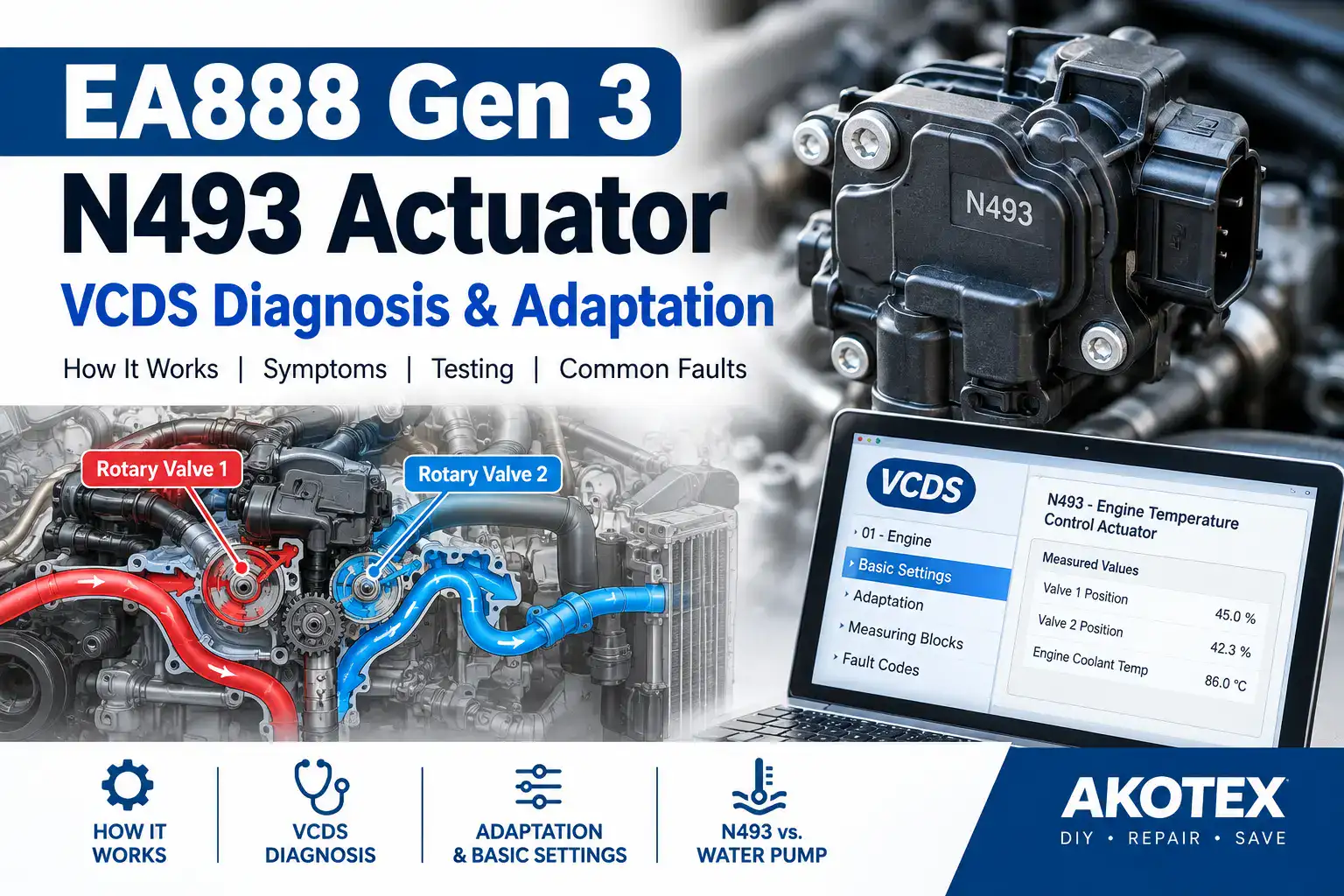
Rotary Valve, VCDS Diagnosis & Adaptation The N493 Engine Temperature Control Actuator ranks among the most important—and most misunderstood—components in the cooling system of many Volkswagen and Audi EA888 Gen 3 engines. Unlike a conventional thermostat that simply opens as coolant temperature rises, the EA888 Gen 3 Innovative Thermal Management (ITM) system can actively control…
Written by

EA888 Gen 3 Water Pump Explained: How It Works, Failure Points and Diagnosis
If you own a Volkswagen or Audi with an EA888 Gen 3 1.8T or 2.0T engine, the water pump is one cooling-system component worth understanding before you start swapping parts. At first glance, the assembly looks confusing. It packs a mechanical coolant pump, an electronically controlled actuator, gears, rotary valves, sensors, and an emergency thermostat…
Written by
EA888 Cooling System Explained: How Volkswagen Controls Engine Temperature
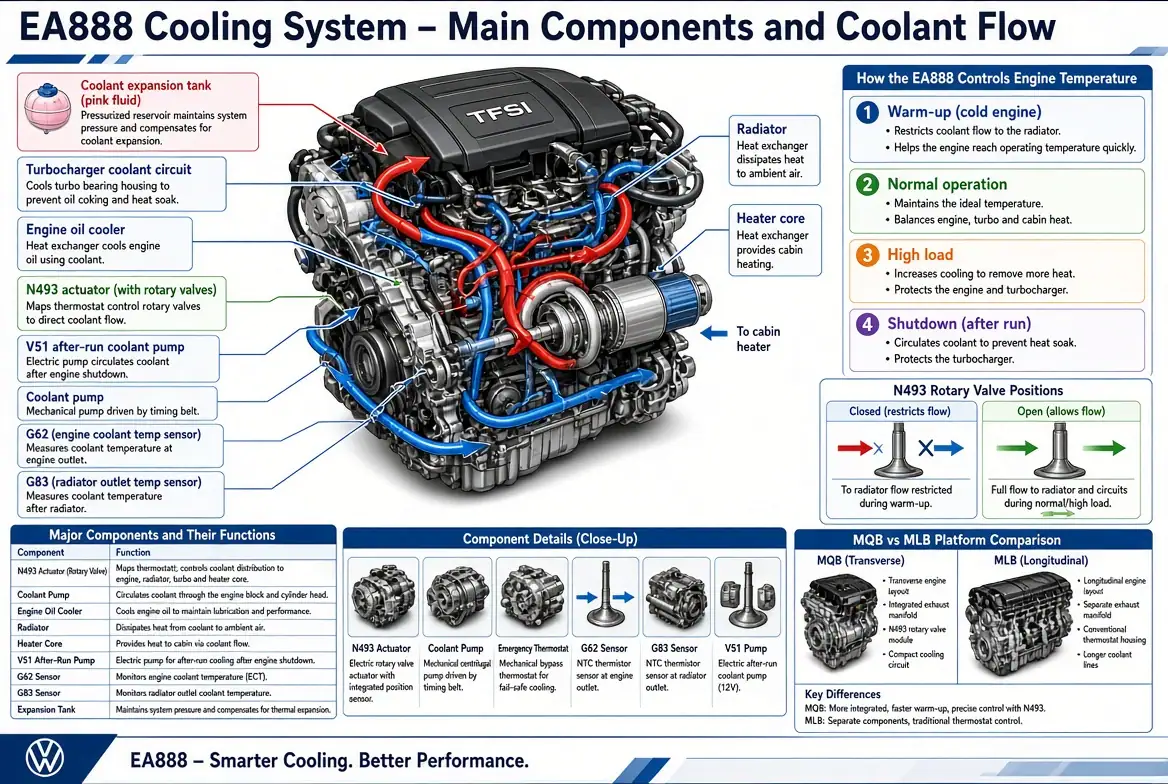
Detailed technical illustration of the EA888 Gen 3 engine showing main cooling system components with color-coded coolant flow (red for hot, blue for cooled). Labels include N493 actuator with rotary valves, V51 after-run pump, G62 and G83 temperature sensors, radiator, heater core, expansion tank, oil cooler, and turbocharger circuit. Right panel explains the four temperature-control…
Written by

VCDS Part 1-4: How to Perform Your First Auto-Scan on a Volkswagen or Audi
If you have completed the first three articles in this VCDS series, you now understand what VCDS is, how Volkswagen and Audi electronic systems communicate, and what the main VCDS functions are used for. Now it is time to put that knowledge into practice by performing your first Auto-Scan. An Auto-Scan gives you a broad…
Written by
P2563 VW & Audi: Turbocharger Boost Control Position Sensor Diagnosis
P2563 — Turbocharger Boost Control Position Sensor “A” Circuit Range/Performance If your Volkswagen or Audi has stored P2563, you may be facing a turbocharger-control problem. However, that does not automatically mean the turbocharger needs to be replaced. This distinction is important. A P2563 fault can be caused by the turbocharger position sensor, electrical wiring, actuator…
Written by