Category: Engine
Guides covering engine diagnostics, maintenance, and repair, from routine service to tracking down harder-to-diagnose performance issues. Topics include oil and fluid maintenance, timing components, carbon buildup, misfires, cooling system issues, and diagnosing check engine lights using OBD-II scanners and platform-specific tools like VCDS.
Whether you’re doing preventive maintenance or working through a specific engine fault, you’ll find practical, hands-on write-ups here — based on real diagnostic and repair work rather than generic explanations.
EA888 Gen 3 Water Pump Explained: How It Works, Failure Points and Diagnosis
If you own a Volkswagen or Audi with an EA888 Gen 3 1.8T or 2.0T engine, the water pump is one cooling-system component worth understanding before you start swapping parts. At first glance, the assembly looks confusing. It packs a mechanical coolant pump, an electronically controlled actuator, gears, rotary valves, sensors, and an emergency thermostat…
Written by
EA888 Cooling System Explained: How Volkswagen Controls Engine Temperature
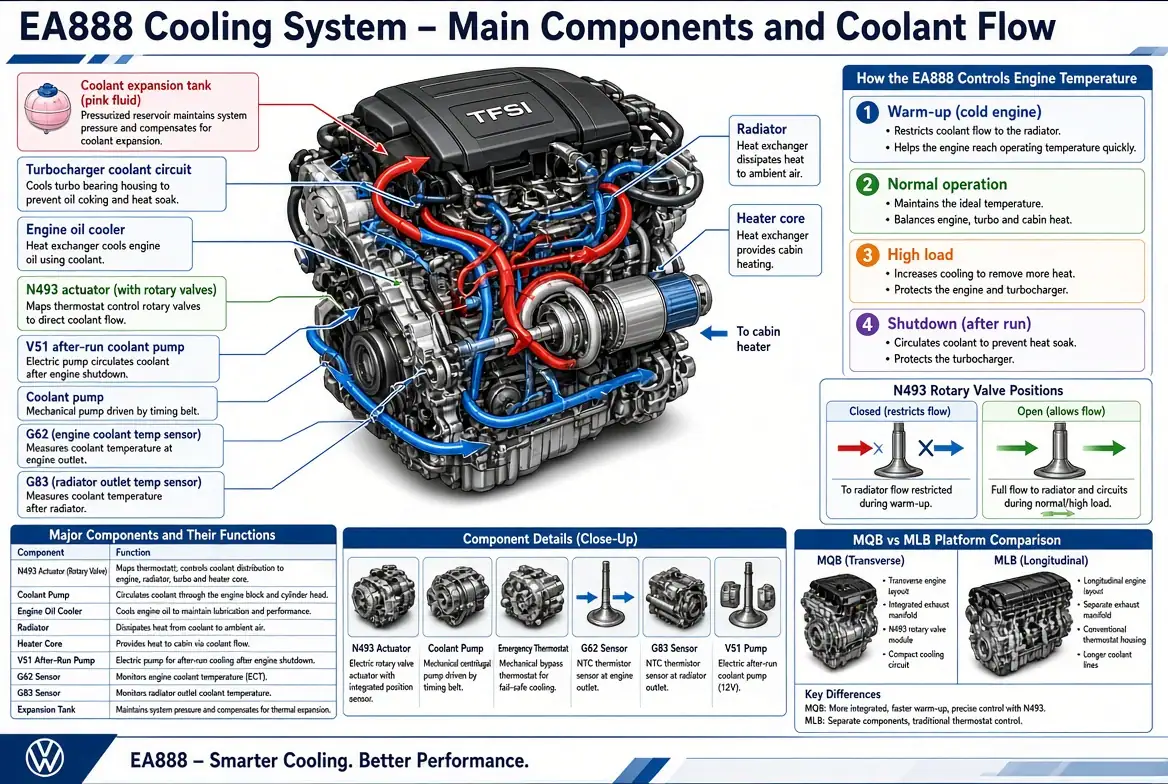
Detailed technical illustration of the EA888 Gen 3 engine showing main cooling system components with color-coded coolant flow (red for hot, blue for cooled). Labels include N493 actuator with rotary valves, V51 after-run pump, G62 and G83 temperature sensors, radiator, heater core, expansion tank, oil cooler, and turbocharger circuit. Right panel explains the four temperature-control…
Written by
P2563 VW & Audi: Turbocharger Boost Control Position Sensor Diagnosis
P2563 — Turbocharger Boost Control Position Sensor “A” Circuit Range/Performance If your Volkswagen or Audi has stored P2563, you may be facing a turbocharger-control problem. However, that does not automatically mean the turbocharger needs to be replaced. This distinction is important. A P2563 fault can be caused by the turbocharger position sensor, electrical wiring, actuator…
Written by
P0017 Code on VW & Audi: Complete Crankshaft-Camshaft Correlation Diagnosis
If your Volkswagen or Audi has stored P0017, the most important thing to understand is that this code does not automatically mean the camshaft position sensor has failed. P0017 is a crankshaft-to-camshaft correlation fault. In generic OBD-II terminology, it means: P0017 – Crankshaft Position – Camshaft Position Correlation (Bank 1, Sensor B) The engine control…
Written by
P0016 Code on VW & Audi: Crankshaft-Camshaft Correlation Diagnosis
Seeing the P0016 code on your VW or Audi can be concerning. This diagnostic trouble code (DTC) indicates a synchronization problem between your engine’s crankshaft and camshaft on Bank 1. In VW/Audi-specific terms, as outlined by Ross-Tech, this is defined as: Bank 1: Camshaft Position Sensor (G40) / Engine Speed Sensor (G28): Incorrect Correlation. This…
Written by
P0234 Diagnosis and Repair: How I Troubleshoot Turbocharger Overboost on the VW/Audi EA888 Engine — Part 2
In Part 1, I explained what P0234 means and how the Volkswagen/Audi EA888 engine controls turbocharger boost. I explained that: P0234 does not automatically mean the turbocharger is damaged. The fault simply tells me that: Actual boost pressure is higher than the ECU expected. The challenge is identifying why the ECU cannot control boost correctly.…
Written by
P0234 Explained: Diagnosing Turbocharger/Supercharger Overboost Condition on the VW/Audi EA888 Engine — Part 1
In this post, I will explore one of the less understood turbocharger-related DTC codes reported by Volkswagen and Audi owners: P0234 — Turbocharger/Supercharger “A” Overboost Condition. At first glance, this code sounds like a serious turbocharger failure. Many vehicle owners immediately assume that the turbocharger must be replaced because the engine is producing too much…
Written by
Sensors on the VW/Audi EA888 Engine (A Complete Guide) — Part 2
In Part 1, I explored the sensors responsible for controlling airflow and turbocharger boost. Those sensors tell the Engine Control Module (ECM) how much air is entering the engine and how much boost the turbocharger is producing. However, air alone is not enough. The ECU must also know: The sensors covered in this section work…
Written by
Sensors on the VW/Audi EA888 Engine (A Complete Guide)-Part 1
The Volkswagen Audi Group (VAG) EA888 engine is one of the most advanced turbocharged gasoline engines ever produced. Whether installed in a Volkswagen Golf GTI, Golf R, Sportwagen, Jetta GLI, Tiguan, Passat, or an Audi A3, A4, A5, Q3, or Q5, the EA888 engine depends on dozens of electronic sensors working in harmony to optimize…
Written by
P0299 Explained: Diagnosing Turbo Underboost on Volkswagen and Audi EA888 Engines (Part 3)
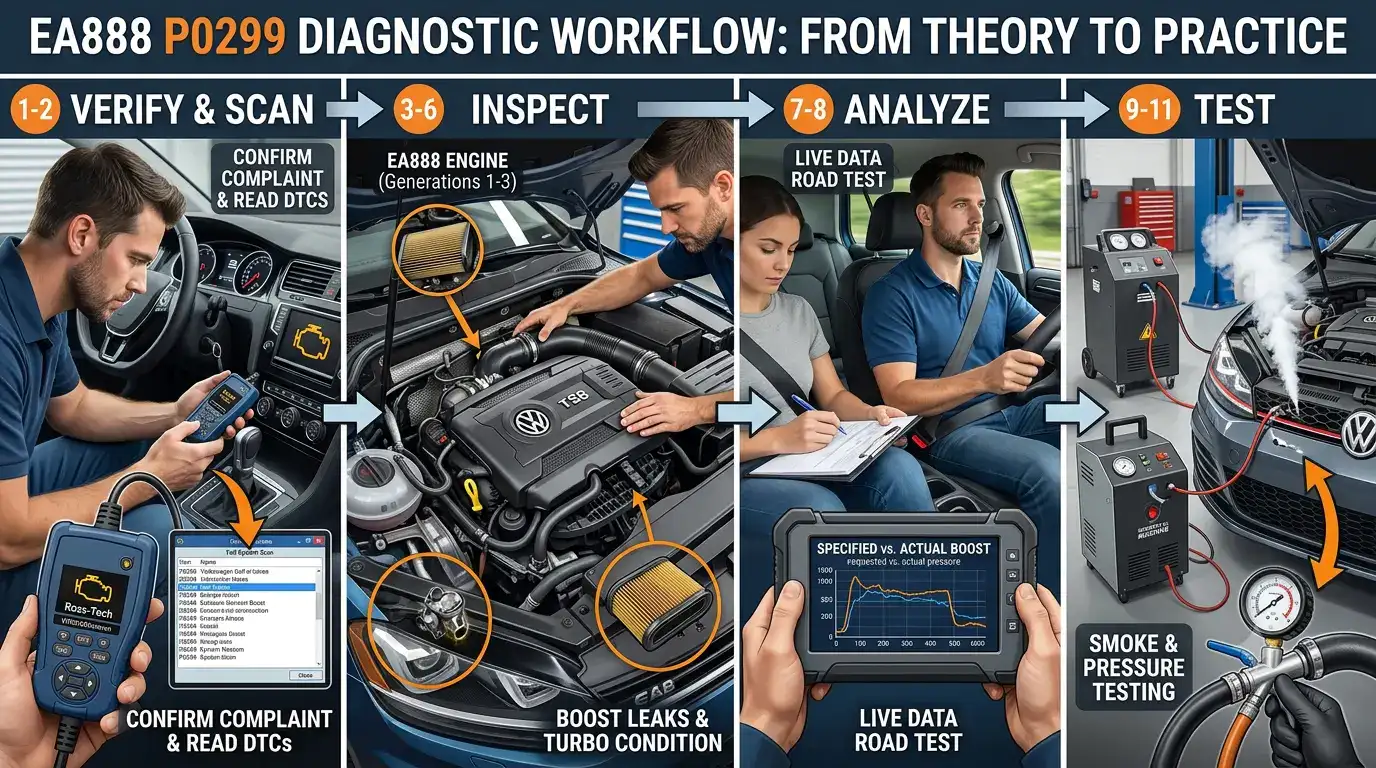
In Parts 1 and 2, we explored how the EA888 engine turbocharging system works and examined the most common causes of Diagnostic Trouble Code (DTC) P0299. In this part, we’ll move from theory to practice by following a professional diagnostic workflow. Rather than replacing parts based on guesswork, you’ll learn how to collect evidence using…
Written by