
If your Volkswagen or Audi suddenly displays the EPC warning light, loses power, and enters limp mode, a scan with VCDS, ANCEL VD700, OBDeleven, or another advanced diagnostic tool may reveal Diagnostic Trouble Code (DTC) P334A – Charge Pressure Actuator Electrical Malfunction.
At first glance, this seems straightforward. The code contains the word “Electrical,” leading many owners—and sometimes even repair shops—to assume the electronic wastegate actuator has failed. The result is often an expensive recommendation to replace the actuator or even the entire turbocharger assembly.
After diagnosing and repairing my friend 2017 Volkswagen Golf Alltrack 1.8T equipped with the EA888 Gen 3 engine and IS12 turbocharger, I discovered that the reality is far more complex.
In many cases, P334A is not caused by an electrical failure at all. Instead, the electronic actuator is forced to work against increasing mechanical resistance inside the turbocharger wastegate mechanism. As the resistance rises, the actuator draws more electrical current than the Engine Control Module (ECM) expects. Eventually, the ECM interprets this excessive current draw as an electrical malfunction and stores DTC P334A.
Understanding this relationship between mechanical resistance and electrical current is the key to diagnosing the fault correctly and avoiding unnecessary parts replacement.
In this comprehensive guide (this post and the next two posts), I’ll explain:
- What P334A really means
- Why Volkswagen labels it as an electrical malfunction
- How the electronic wastegate actuator works
- Why many dealerships replace the entire turbocharger
- How to diagnose the actual root cause
- When the actuator can be repaired or replaced
- When the turbocharger must be removed
- How wastegate calibration and adaptation restore proper operation
The explanations in this guide are based on my own repair experience, Volkswagen service information, and practical diagnostic procedures using VCDS and the ANCEL VD700 scanner.
What Does P334A Mean?
Diagnostic Trouble Code P334A is generally described as a Charge Pressure Actuator Electrical Malfunction or Charge Pressure Control Actuator Electrical Error.
The code indicates that the Engine Control Module has detected abnormal electrical behavior from the electronic wastegate actuator, sometimes identified in Volkswagen service documentation as V465.
Unlike older turbochargers that use a vacuum-operated wastegate, modern Volkswagen EA888 Gen 3 engines rely on an electronically controlled actuator to regulate boost pressure with much greater precision.
The actuator continuously communicates with the ECM by providing:
- Position feedback
- Electrical current consumption
- Internal motor operation
- Target versus actual position
If any of these parameters fall outside the acceptable operating range, the ECM stores P334A and activates protective strategies to prevent turbocharger damage.
Why the Description Is Misleading
One of the biggest misconceptions surrounding P334A is the word “Electrical.”
Many technicians immediately suspect:
- failed actuator electronics
- damaged wiring
- faulty connectors
- defective ECM
Although these failures are possible, they are not always the primary cause.
Think of the actuator like an electric window motor.
If the window tracks become rusty or jammed, the motor must work much harder to move the glass. The motor draws significantly more current even though nothing is wrong with the electrical system itself.
The same principle applies to the turbocharger.
As friction increases inside the wastegate linkage or flapper mechanism, the actuator motor requires more torque to move the wastegate.
More torque requires more electrical current.
When the ECM detects current outside its expected operating range, it assumes an electrical malfunction—even though the underlying problem may actually be mechanical.
Understanding this relationship prevents expensive misdiagnosis.
How the Electronic Wastegate System Works
To understand P334A, it’s helpful to first understand how boost pressure is controlled.
A turbocharger uses exhaust gases to spin a turbine connected to a compressor wheel.
The faster the turbine spins, the more air enters the engine.
More air allows more fuel to burn, increasing engine power.
However, excessive boost pressure can damage the engine.
To regulate boost, Volkswagen uses a wastegate valve.
The wastegate controls how much exhaust gas reaches the turbine.
When the wastegate remains closed:
- More exhaust reaches the turbine.
- Turbo speed increases.
- Boost pressure rises.
When the wastegate opens:
- Some exhaust bypasses the turbine.
- Turbo speed decreases.
- Boost pressure drops.
The ECM constantly adjusts the wastegate position to maintain the requested boost pressure under changing engine loads.
Unlike earlier vacuum-operated systems, the EA888 Gen 3 platform uses an electronic actuator mounted directly on the turbocharger.
This actuator contains:
- a DC electric motor
- reduction gears
- an internal position sensor
- a control circuit
- a linkage connected to the wastegate lever
Every few milliseconds, the ECM compares:
Requested position
↓
Actual actuator position
↓
Boost pressure
↓
Engine load
↓
Throttle position
↓
Intake air temperature
↓
Exhaust conditions
The actuator then makes continuous adjustments to keep boost exactly where the ECM wants it.
This precise control is one reason why modern turbocharged engines deliver strong performance while meeting strict emissions standards.
Why Mechanical Problems Become Electrical Faults
This is the most important concept in understanding P334A.
The actuator motor is designed to move the wastegate through a specific operating force.
Under normal conditions, movement is smooth.
Electrical current remains within normal limits.
As the turbocharger ages, several mechanical issues can develop:
- corrosion around the wastegate pivot
- carbon accumulation
- worn bushings
- heat distortion
- binding linkage
- increased friction inside the flapper mechanism
Each of these problems increases the effort required to move the wastegate.
The actuator compensates by drawing more electrical current.
Initially, the ECM may simply notice slower movement.
As resistance increases further, current rises beyond calibrated thresholds.
At this point, the ECM determines that something is wrong with the actuator circuit and stores:
P334A – Charge Pressure Actuator Electrical Malfunction
In other words:
Mechanical resistance
↓
Higher actuator torque
↓
Higher electrical current
↓
ECM detects abnormal electrical load
↓
P334A is stored
This explains why replacing the actuator alone sometimes does not solve the problem.
If the mechanical resistance remains inside the turbocharger, the new actuator is subjected to the same excessive load.
Eventually, the replacement actuator may fail as well.
Vehicles Commonly Affected
Although this guide focuses on the EA888 Gen 3 platform used in many Volkswagen and Audi vehicles, P334A may appear on several turbocharged Volkswagen Group engines equipped with electronic wastegate actuators.
Common applications include:
Volkswagen
- Golf MK7 1.8T
- Golf GTI
- Golf R
- SportWagen
- Alltrack
- Passat
- Tiguan
- Jetta GLI
Audi
- A3
- A4
- A5
- Q3
- Q5
SEAT
- Leon
- Ateca
Škoda
- Octavia
- Superb
- Kodiaq
Although the diagnostic code is identical, repair procedures differ depending on the turbocharger model and actuator design. Some turbochargers allow actuator replacement without removing the turbocharger, while others require complete turbocharger removal for proper repair and calibration.
For this reason, it is essential to identify your engine code and turbocharger model before ordering replacement parts or beginning repairs.
My Experience Diagnosing P334A
When a 2017 Volkswagen Golf Alltrack 1.8T (EA888 Gen 3) entered limp mode and illuminated the EPC warning light, the scan tool reported P334A.
At first, I assumed the actuator had failed electrically.
However, after carefully inspecting the turbocharger and monitoring live data with VCDS, I discovered that the actuator was struggling against excessive resistance in the wastegate mechanism rather than suffering from an internal electrical defect.
That experience changed the way I approached turbocharger diagnostics.
Instead of replacing parts based solely on the diagnostic code, I began analyzing the relationship between electrical measurements and mechanical movement. This approach ultimately led to a successful repair while avoiding unnecessary component replacement.
In the next post I will examine the most common root causes of P334A, explain why some vehicles repeatedly experience this fault, and show you how to distinguish between a defective actuator and a turbocharger with mechanical binding before spending money on replacement parts.
Blog
This section provides an overview of the blog, showcasing a variety of articles, insights, and resources to inform and inspire readers.
EA888 Gen 3 Water Pump Explained: How It Works, Failure Points and Diagnosis
If you own a Volkswagen or Audi with an EA888 Gen 3 1.8T or 2.0T…

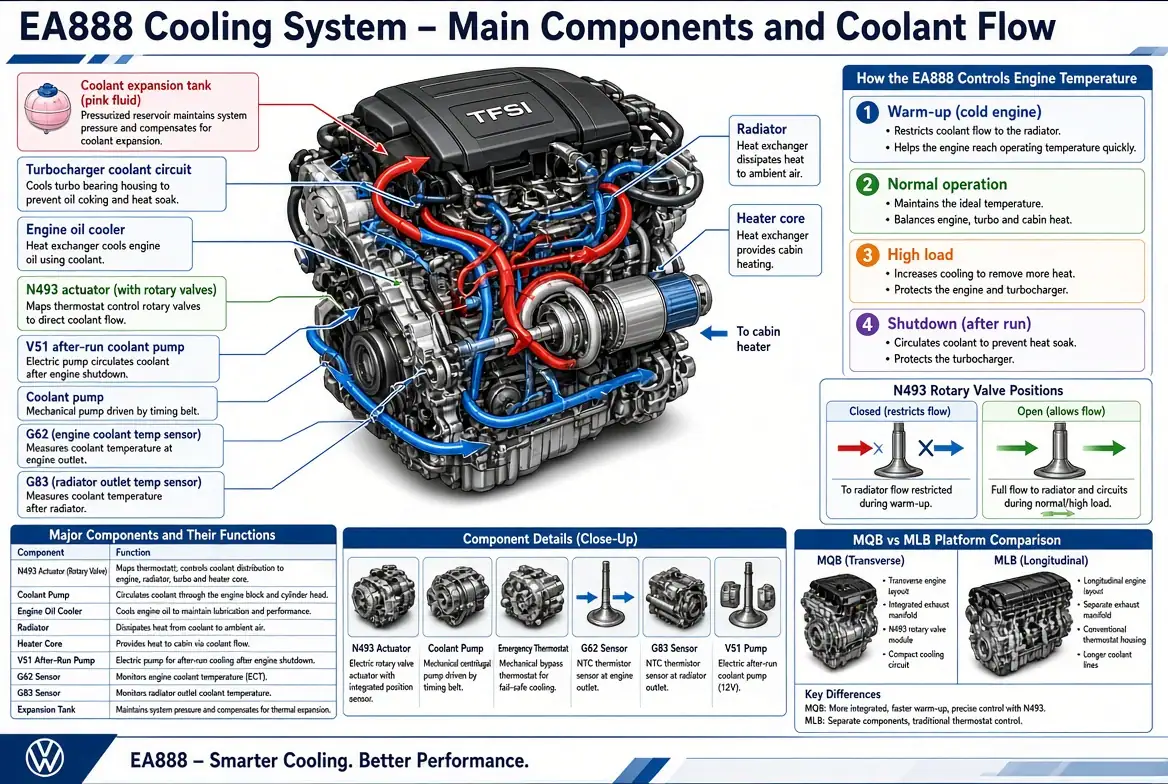

EA888 Cooling System Explained: How Volkswagen Controls Engine Temperature
Detailed technical illustration of the EA888 Gen 3 engine showing main cooling system components with…
VCDS Part 1-4: How to Perform Your First Auto-Scan on a Volkswagen or Audi
If you have completed the first three articles in this VCDS series, you now understand…


Leave a Reply