Category: VCDS
**Category: VCDS**
**Description:**
Everything you need to know about VCDS (VAG-COM Diagnostic System) — the professional diagnostic software for Volkswagen, Audi, SEAT, and Škoda. From beginner guides and hardware comparisons (HEX-V2 vs HEX-NET) to real-world fault code diagnosis, adaptations, coding, and live data tips.
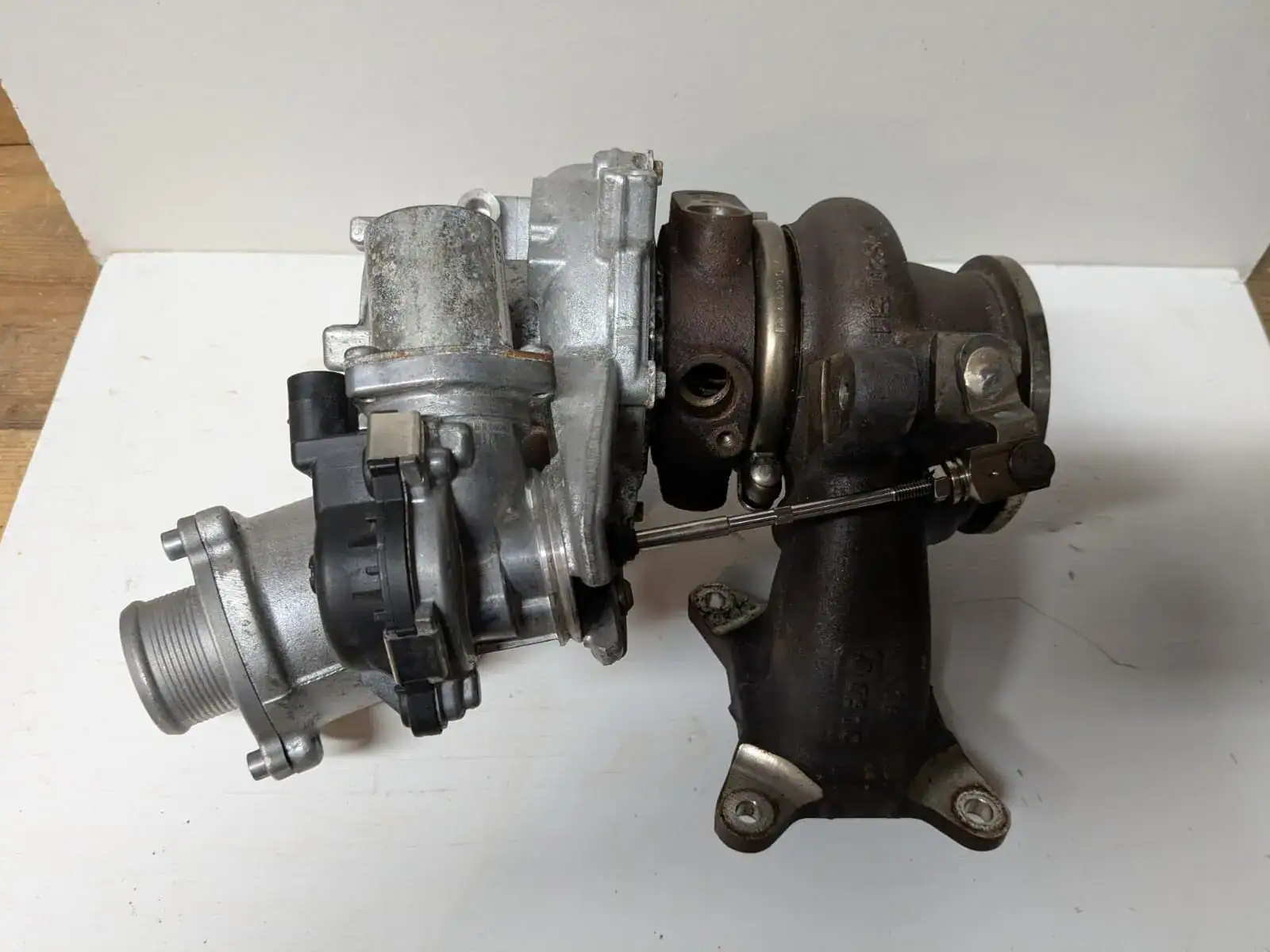
IS20 Turbocharger Shaft Play: What’s Normal and When Should You Worry?
You remove the air intake pipe from your Volkswagen Golf GTI, Golf SportWagen, or another EA888-equipped car. Then you gently move the compressor wheel of the IS20 turbocharger and feel the shaft move from side to side. Is the turbocharger worn out? Not necessarily. A journal-bearing turbocharger can show some radial movement when the engine…
Written by
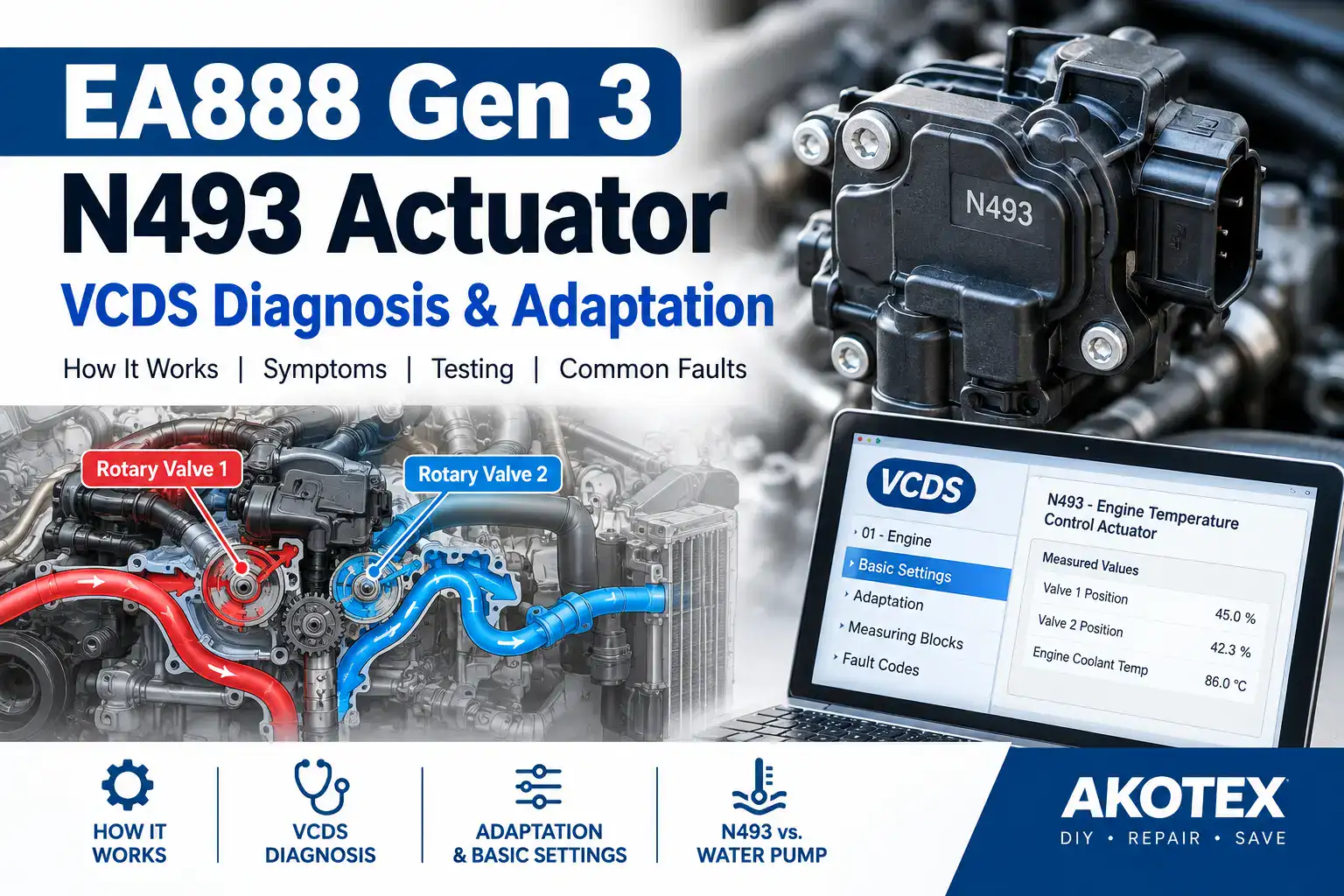
EA888 Gen 3 N493 Engine Temperature Control Actuator Explained
Rotary Valve, VCDS Diagnosis & Adaptation The N493 Engine Temperature Control Actuator ranks among the most important—and most misunderstood—components in the cooling system of many Volkswagen and Audi EA888 Gen 3 engines. Unlike a conventional thermostat that simply opens as coolant temperature rises, the EA888 Gen 3 Innovative Thermal Management (ITM) system can actively control…
Written by

EA888 Gen 3 Water Pump Explained: How It Works, Failure Points and Diagnosis
If you own a Volkswagen or Audi with an EA888 Gen 3 1.8T or 2.0T engine, the water pump is one cooling-system component worth understanding before you start swapping parts. At first glance, the assembly looks confusing. It packs a mechanical coolant pump, an electronically controlled actuator, gears, rotary valves, sensors, and an emergency thermostat…
Written by
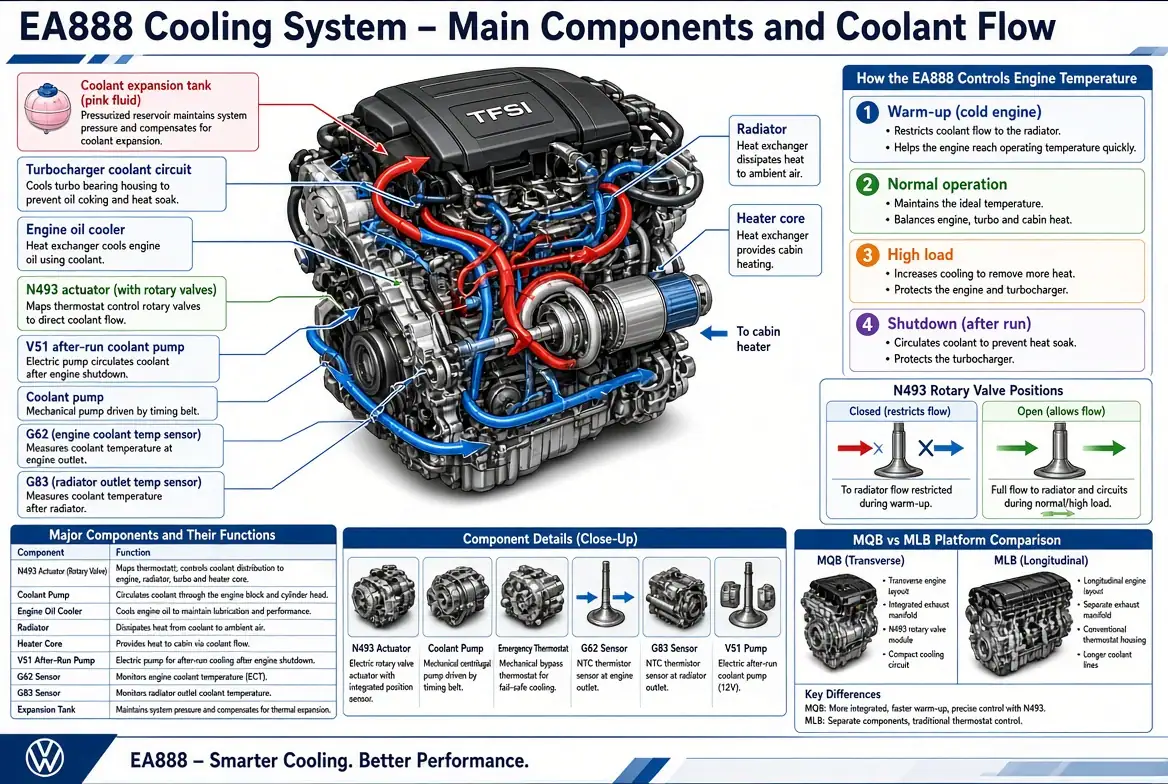
EA888 Cooling System Explained: How Volkswagen Controls Engine Temperature
Detailed technical illustration of the EA888 Gen 3 engine showing main cooling system components with color-coded coolant flow (red for hot, blue for cooled). Labels include N493 actuator with rotary valves, V51 after-run pump, G62 and G83 temperature sensors, radiator, heater core, expansion tank, oil cooler, and turbocharger circuit. Right panel explains the four temperature-control…
Written by

VCDS Part 1-4: How to Perform Your First Auto-Scan on a Volkswagen or Audi
If you have completed the first three articles in this VCDS series, you now understand what VCDS is, how Volkswagen and Audi electronic systems communicate, and what the main VCDS functions are used for. Now it is time to put that knowledge into practice by performing your first Auto-Scan. An Auto-Scan gives you a broad…
Written by
P2563 VW & Audi: Turbocharger Boost Control Position Sensor Diagnosis
P2563 — Turbocharger Boost Control Position Sensor “A” Circuit Range/Performance If your Volkswagen or Audi has stored P2563, you may be facing a turbocharger-control problem. However, that does not automatically mean the turbocharger needs to be replaced. This distinction is important. A P2563 fault can be caused by the turbocharger position sensor, electrical wiring, actuator…
Written by
VCDS Part 1-3: Understanding the VCDS Main Menu — Complete Beginner’s Guide
If you have followed the first and second parts of the VCDS guide, you now understand what VCDS is and how Volkswagen and Audi vehicles organize their electronic control systems. You have learned that VCDS is much more than a generic OBD-II code reader. It can communicate with individual control modules, display manufacturer-specific diagnostic information,…
Written by
P0017 Code on VW & Audi: Complete Crankshaft-Camshaft Correlation Diagnosis
If your Volkswagen or Audi has stored P0017, the most important thing to understand is that this code does not automatically mean the camshaft position sensor has failed. P0017 is a crankshaft-to-camshaft correlation fault. In generic OBD-II terminology, it means: P0017 – Crankshaft Position – Camshaft Position Correlation (Bank 1, Sensor B) The engine control…
Written by
P0016 Code on VW & Audi: Crankshaft-Camshaft Correlation Diagnosis
Seeing the P0016 code on your VW or Audi can be concerning. This diagnostic trouble code (DTC) indicates a synchronization problem between your engine’s crankshaft and camshaft on Bank 1. In VW/Audi-specific terms, as outlined by Ross-Tech, this is defined as: Bank 1: Camshaft Position Sensor (G40) / Engine Speed Sensor (G28): Incorrect Correlation. This…
Written by
Understanding Volkswagen and Audi Diagnostic Architecture Part 1-2
If you want to become good at diagnosing a Volkswagen or Audi with VCDS, you need to understand more than just how to read fault codes. You need to understand how the vehicle’s electronic systems communicate with each other. When you connect VCDS to the diagnostic port, you are not simply connecting a scanner to…
Written by