
Turbocharged cars are everywhere now. That little four-cylinder under your hood makes as much power as a V6 from ten years ago. But all that extra punch comes with a catch—your engine cares a lot about what you pour into the tank.
Walk into any gas station and you face the same question: regular or premium? The price gap usually hovers around 60 to 70 cents a gallon. Over a full year of driving, that difference can eat up over $300 from your wallet.
After years turning wrenches, here is the bottom line: You do not need premium gas for your daily commute. You absolutely do need it when you work the engine hard. Match your fuel to your driving style, and you will protect your turbo, keep your engine running clean, and put roughly $250 back in your pocket every year.
Let me walk you through the science, the myths, and the real-world habits that make this work.
What Octane Actually Does (And Doesn’t Do)
Let us clear up the biggest misunderstanding first. Octane does not give you more power. It does not burn hotter, and it does not contain more energy.
Think of octane as a measure of patience. It tells you how much heat and pressure the fuel can handle before it gives up and explodes on its own. Low-octane gas (87) ignites relatively easily. High-octane gas (91 or 93) resists that early explosion.
In your engine, the spark plug is supposed to trigger the burn. But inside a turbo engine, the air gets squeezed so tightly that cylinder pressures shoot way up. Under heavy acceleration, the temperature inside that combustion chamber can climb above 1,500°F. Under those extreme conditions, 87-octane gas sometimes cannot wait for the spark. It detonates prematurely. We call that “knock” or “ping.”
Knock sends a shockwave through the engine. It hammers the pistons, the rings, and the rod bearings.
Here is the good news: your car’s computer has a built-in bouncer called a “knock sensor.” It listens for that pinging sound. The moment it hears trouble, it steps in and pulls back the ignition timing. This stops the knock instantly. It protects your hardware from immediate damage.
But pulling timing does have a price. Your engine loses efficiency. You lose peak torque—usually about 15 to 20 lb-ft, which is noticeable when you floor it to pass a semi-truck on a two-lane road. The car feels sluggish, less responsive, and a bit flat.
Here is the key takeaway: that loss only shows up under heavy load. When you are cruising to work at steady speed, the cylinder pressures stay low. The knock sensor stays quiet. On 87 octane, the computer does not pull any timing at all. You get the exact same smooth ride as you would on premium.
The Turbocharger’s Real Enemy: Heat, Not Vibration
Turbos spin incredibly fast. We are talking 120,000 revolutions per minute—twenty times faster than your engine’s crankshaft. They also sit right in the path of hot exhaust gases that can exceed 1,600°F.
That heat is the real threat to your turbo’s lifespan.
When you lug a turbo engine up a steep grade on regular gas, the computer pulls timing to protect you. But that delayed timing also raises exhaust gas temperatures. Hotter exhaust gasses cook the oil that lubricates the turbo’s center bearing. Cooked oil turns into solid carbon sludge. That sludge clogs oil feed lines, scores the bearing surfaces, and eventually causes shaft play and seal failure.
Turbo failure rarely happens suddenly. It creeps up over 30,000 or 40,000 miles of sustained high-heat operation on marginal fuel.
Now, let me correct a mistake I made in the past. I used to blame cheap gas for a seized wastegate pin I fixed in my garage. After digging deeper and talking to other specialists, I learned I blamed the fuel for a purely mechanical rust problem. The gas did not cause that seizure. The wastegate linkage seizes from heat cycling, not carbon from pump gas. I
Does that mean fuel is irrelevant? No. But the primary damage path is heat → cooked oil → bearing wear, not vibration from knocking.
Clean Fuel Matters, But Oil Matters Even More
Premium gas usually carries a stronger dose of detergent additives. These detergents help keep your fuel injectors spraying a perfect cone pattern and prevent deposits from forming on the piston tops.
But here is a crucial detail that most drivers miss: Top Tier gasoline contains those high-level detergents in regular grade, too. Brands like Shell, Chevron, Costco, Exxon, and Mobil meet the Top Tier standard across all their octane levels. So, if you buy Top Tier regular, you already get excellent cleaning power.
For modern direct-injection engines (which cover most turbo cars today), the fuel does not even touch the intake valves. The valves get their carbon deposits from oil vapor circulating through the PCV system. That means switching to premium gas will not clean your intake valves.
If you want to fight carbon buildup, focus on these two things instead:
- Use a low-volatility, high-quality full-synthetic oil (meeting the API SP or ACEA C3 standard).
- Change that oil religiously every 5,000 miles, not 10,000.
The engines that run cheap oil on long intervals look terrible inside, regardless of whether the owner used premium or regular gas. The engines that run quality synthetic oil on short intervals stay clean.
The Real Money: Do the Math With Me
Let us put some hard numbers on this.
The U.S. Energy Information Administration tracks fuel prices closely. Historically, premium runs about 65 cents more per gallon than regular. In some states, that gap stretches past a dollar.
Consider a typical daily-driver turbo crossover. It gets about 26 miles per gallon. The average American drives around 13,500 miles per year.
- Total fuel used per year: 13,500 ÷ 26 = 519 gallons.
- Extra cost if you buy premium every single tank: 519 × $0.65 = **$337**.
Now, here is the smart play. I use a “3-to-1” fueling strategy:
- Tank 1, 2, and 3 (commuting, errands, city driving): I buy Top Tier 87 octane.
- Tank 4 (road trips, mountain passes, towing, or hot summer days): I switch to 91 or 93 octane.
If I follow this pattern, I only buy premium about one out of every four tanks. That drops my yearly premium cost to roughly $84.
My total savings compared to always buying premium? About $253 per year.
Over five years, that is $1,265. That money buys a full set of high-quality tires, covers two major transmission services, or pays for a brand-new OEM turbocharger if you ever need one.
When You Absolutely Must Spend Money on Premium
I do not want you to think I am anti-premium. There are specific, non-negotiable situations where regular gas is a bad bet.
Do not run regular in these conditions:
- Extreme heat (above 90°F). Hot intake air makes knock much more likely. Hot weather raises your octane requirement by about one full point for every 20-degree rise. On a scorching summer day, 87 octane simply does not cut it under load.
- Towing a heavy trailer or hauling a full load. Sustained high throttle pushes cylinder pressures into the danger zone for minutes at a time. The intercooler heat-soaks, and the ECU starts pulling timing aggressively.
- Climbing steep mountain passes. The turbo works harder to maintain boost in thin air. Turbine inlet temperatures spike. This is exactly when you need premium’s patience.
- Track days, autocross, or aggressive canyon driving. If you keep your foot flat for more than 5 seconds at a time, you are in the engine’s high-load map. Give it premium and get the full power the engineers designed.
For the morning commute, cold starts, and stop-and-go traffic, the engine never works hard enough to need high-octane fuel. I have monitored knock sensors, and checked fuel trims on both fuels in these conditions. The data shows no meaningful difference.
My Maintenance Routine for Maximum Turbo Life on a Budget
If you mostly run regular gas, you need to be a little more disciplined about basic care. Here is my straightforward checklist:
1. Change your oil every 5,000 miles. Do not stretch it to 10,000 if you drive hard or live in a hot climate. Use a full synthetic that meets API SP or ACEA C3 standards. These oils resist low-speed pre-ignition—a far more destructive event than simple knock.
2. Idle for 45 seconds after a hard highway run. When you pull off the interstate, do not shut the engine off immediately. Let it idle while you gather your wallet or check your phone. This allows the turbo housing to shed heat. Idling circulates cool oil through the bearings and prevents coking.
3. Use a PEA-based fuel cleaner every 6,000 miles. Brands like Red Line SI-1 or Chevron Techron work well. Add it right before an oil change. This cleans the injector nozzles and piston rings, which helps control blow-by and keeps your oil cleaner.
Using an OBD Scanner to Make Smart Choices
You do not need expensive equipment. A simple $20 Bluetooth OBD scanner paired with a smartphone app will show you how your engine responds to different fuels.
Watch the “Knock Retard” or “Ignition Timing Pull” parameter.
- On 87 octane at light throttle: You should see 0 to 0.5 degrees of retard. That is completely safe.
- On 87 octane climbing a hill at full throttle: You might see 5 to 8 degrees of retard. The ECU is pulling timing heavily. Exhaust temps rise. This is your signal to either back off the throttle or switch to premium next time.
- On 93 octane at full throttle: You should see 0 to 2 degrees of retard. The engine runs efficiently and stays cooler.
Your scanner does not lie. Trust the data, not the hype.
Quick Answers to the Questions I Get Most Often
Q: My owner’s manual says “Premium Fuel Recommended.” Does that force me to use it?
A: No. “Recommended” means the advertised horsepower comes from premium. “Required” means the engine will knock and could suffer damage on regular. If it says “Recommended,” you are safe on regular for daily driving. You will just lose about 5% of peak power.
Q: Can I mix regular and premium in the same tank?
A: Absolutely. Half a tank of 87 and half a tank of 93 gives you roughly 90 octane. This is a cost-effective way to create your own mid-grade for those occasional heavy-load trips.
Q: Will using regular gas void my warranty?
A: Under the Magnuson-Moss Act, the manufacturer must prove your fuel directly caused the damage. Unless they find severe detonation marks on the pistons (which requires a borescope inspection), they cannot void a claim simply because you bought 87 octane.
The Bottom Line: Drive Smart, Fuel Smart
I do not have anything against premium gas. It is a great tool. But it is an expensive insurance policy that you cash in far too often if you buy it every week.
Here is my personal rule, and I have used it for over 120,000 miles on my own daily driver:
- Buy Top Tier regular for your routine driving. Let the knock sensors stay quiet. Keep the cash in your pocket.
- Buy premium for adventure driving. Use it in July heat, mountain roads, towing trips, or any time you plan to drive aggressively.
Combine this smart fueling strategy with fresh synthetic oil and a short cool-down idle. My personal turbocharger still shows factory-spec bearing clearance after all those miles. My used oil analysis reports come back clean with no excessive wear metals.
You do not need to be a mechanic to make this work. Just watch how you drive. If you are taking it easy, save your money. If you are pushing the engine, give it the good stuff. Your turbo will last longer. Your engine will stay cleaner. And you will have an extra $250 at the end of the year to put toward tires, brake pads, or a nice dinner out.
Fuel smart, drive smart, and enjoy the boost.
Blog
This section provides an overview of the blog, showcasing a variety of articles, insights, and resources to inform and inspire readers.
EA888 Gen 3 Water Pump Explained: How It Works, Failure Points and Diagnosis
If you own a Volkswagen or Audi with an EA888 Gen 3 1.8T or 2.0T…

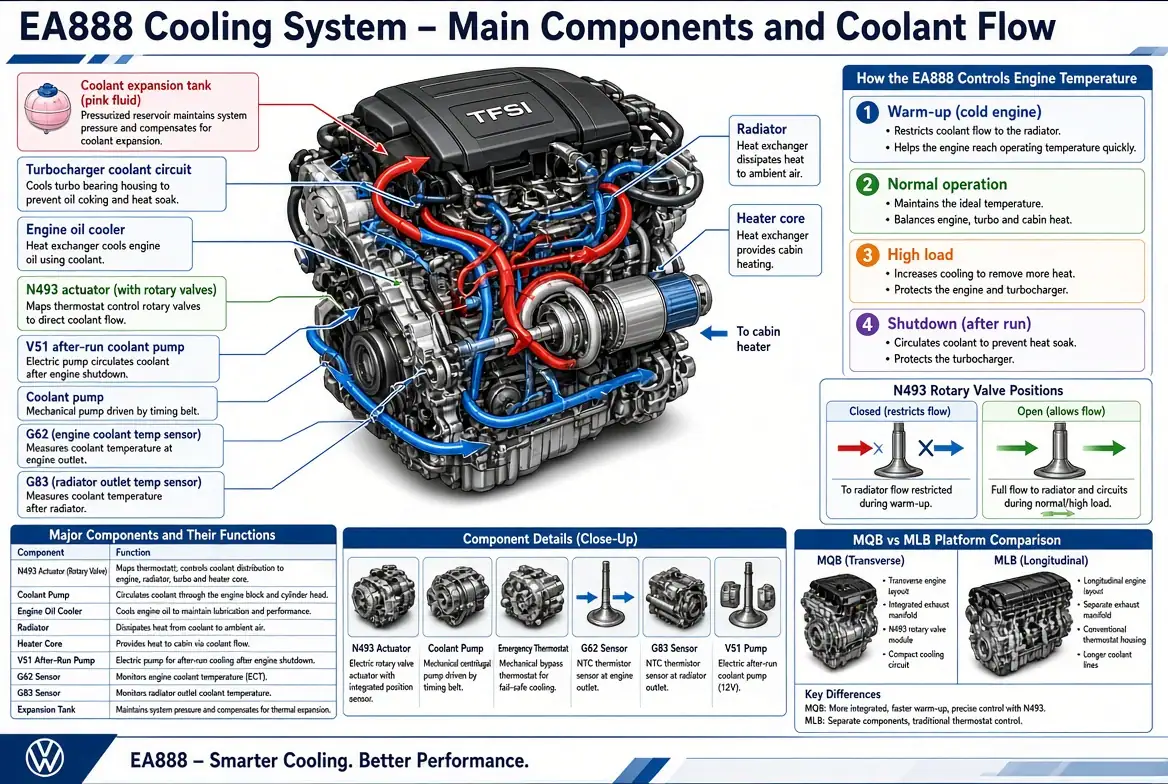

EA888 Cooling System Explained: How Volkswagen Controls Engine Temperature
Detailed technical illustration of the EA888 Gen 3 engine showing main cooling system components with…
VCDS Part 1-4: How to Perform Your First Auto-Scan on a Volkswagen or Audi
If you have completed the first three articles in this VCDS series, you now understand…


Leave a Reply