
Seeing the P0016 code on your VW or Audi can be concerning. This diagnostic trouble code (DTC) indicates a synchronization problem between your engine’s crankshaft and camshaft on Bank 1. In VW/Audi-specific terms, as outlined by Ross-Tech, this is defined as: Bank 1: Camshaft Position Sensor (G40) / Engine Speed Sensor (G28): Incorrect Correlation.
This code signals that your Engine Control Module (ECM) has detected that the camshaft and crankshaft are not rotating in perfect harmony. While this is a serious issue, the diagnostic approach is critical. The most common mistake is to immediately replace the camshaft or crankshaft sensors. P0016 is a correlation fault, indicating that the ECM sees an unexpected relationship between the two signals. Do not assume this means a failed sensor. Because this is a correlation code, your first job is to determine whether the discrepancy is caused by mechanical timing, camshaft adjustment, oil/hydraulic control, or an electrical/signal problem like a wiring issue or faulty reluctor wheel.
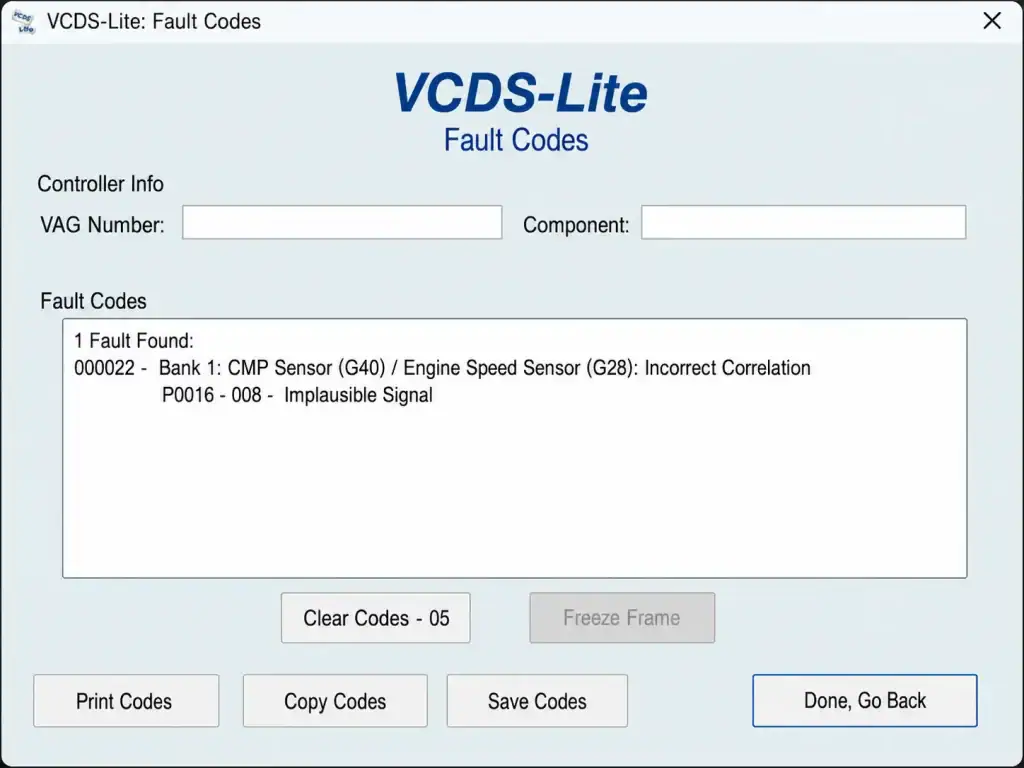
What Does P0016 Actually Mean?
To understand P0016, you must first understand the relationship between the crankshaft and camshaft. The crankshaft controls the pistons’ up-and-down motion, while the camshaft controls the opening and closing of the engine’s valves. For the engine to run efficiently, these two shafts must be perfectly synchronized.
The ECM constantly compares the signals from the Camshaft Position Sensor (G40) and the Engine Speed/Crankshaft Sensor (G28). When these signals deviate from the expected values, the ECM triggers the P0016 code. The deviation indicates that the relationship between the crankshaft and camshaft signals does not match the expected value. The underlying cause may be mechanical, hydraulic/VVT-related, or electrical/signal-related.
P0016 Symptoms: What to Look For
The most immediate symptom is an illuminated Check Engine Light. However, depending on the severity of the timing error, you may also experience:
- Poor Engine Performance: A noticeable lack of power, sluggish acceleration, or a feeling that the engine is struggling, especially under load.
- Rough Idle or Stalling: The engine may feel shaky, vibrate excessively, or stall when idling.
- Hard Starting or No-Start: The engine may crank for an extended period before starting. In severe cases, if the timing is significantly off, it might not start at all.
- Reduced Fuel Economy: A timing mismatch forces the engine to work harder, consuming more fuel.
- Unusual Engine Noises: You might hear rattling, ticking, or knocking from the engine, often near the timing chain area. A pronounced or abnormal cold-start rattle can be an important clue when diagnosing timing-chain or tensioner problems on EA888 engines, but the noise alone does not confirm the cause.
Common Causes of P0016 on VW/Audi Engines
The P0016 code can be triggered by several issues, but in the VW/Audi world, the causes are often mechanical or related to the variable valve timing (VVT) system.
1. Mechanical Timing Issues
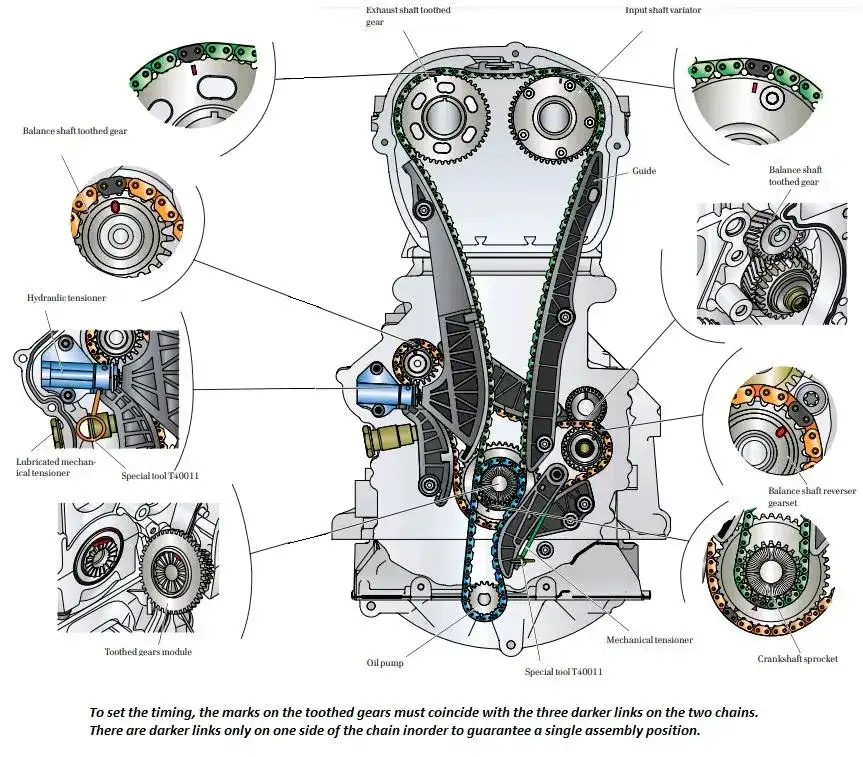
- Stretched Timing Chain: This is a well-known issue on many VW/Audi engines, particularly certain generations of the 2.0T EA888. Over time and mileage, the timing chain can stretch, causing the camshaft and crankshaft to fall out of sync.
- Failed Timing Chain Tensioner: A worn or failed tensioner can cause the timing chain to become loose. If the tensioner fails completely, the chain can “jump a tooth” on the sprocket, leading to a significant timing error and, in the worst case, catastrophic engine damage.
- Worn Timing Belt: On engines with a timing belt (such as the 1.8T/2.0T EA113), a worn or incorrectly installed belt can also lead to correlation errors.
2. Camshaft Adjustment (VVT) System
- Faulty Camshaft Adjuster (Phaser): The phaser adjusts camshaft timing. If it fails mechanically or hydraulically, it can cause a correlation error.
- Camshaft Adjustment Valve (N205): A faulty solenoid or control valve for the VVT system can prevent the camshaft from adjusting correctly.
- Low Oil Pressure or Poor Oil Condition: The VVT system relies on clean oil at the correct pressure to function. Low oil levels, old oil, or sludge can cause the adjusters to stick or operate sluggishly, triggering the code.
3. Sensor and Wiring Problems
- Faulty Camshaft or Crankshaft Sensors: A failing sensor, wiring problem, poor signal, or reluctor/trigger-wheel issue can potentially create a correlation fault. However, because P0016 is a correlation code, it is essential to rule out mechanical and hydraulic causes first.
- Wiring Issues: Corroded, frayed, or loose wiring and poor connections can interfere with the signals sent to the ECM.
Crucial Diagnostic Advice: Do not start by replacing sensors. On VW/Audi engines, it is critical to first check the mechanical timing and camshaft adjustment system before suspecting an electrical component.
How to Diagnose P0016: A Step-by-Step Decision Tree
A systematic diagnosis is essential to avoid throwing money at the wrong parts. Here is a diagnostic decision tree for VW/Audi vehicles:
| Step | Action | What to Look For |
|---|---|---|
| 1. Scan & Record | Perform a full VCDS Auto-Scan. Record freeze-frame data and all fault codes. | Look for other codes like P0340, P0335, P0011, or P0021. This data tells you the conditions when the fault occurred. |
| 2. Check Oil | Check the engine oil level and condition. | Low oil level or oil that is old/sludgy can starve the VVT system of the hydraulic pressure it needs to function. |
| 3. Check Camshaft Adaptation | Using VCDS, go to the engine control module and check the Measuring Values for camshaft adaptation (Phase Position) and specified vs. actual values. | Compare the specified and actual values using the factory specification for the specific engine. A significant deviation from the expected value can indicate a mechanical timing or VVT problem. |
| 4. Mechanical Timing Verification | If scan data points toward a mechanical timing problem, verify mechanical timing using the manufacturer-specific procedure and appropriate timing tools for that engine. | This allows you to determine whether the mechanical timing is correctly positioned and whether further inspection of the chain, belt, tensioner, guides, or related components is necessary. |
| 5. Inspect VVT System | If mechanical timing is correct, investigate the camshaft adjuster (phaser) and control valve (N205). Perform VCDS Basic Settings/Actuator tests. | A faulty adjuster or valve will fail to actuate correctly. It might also be clogged with debris, indicating a previous oil-related failure. |
| 6. Investigate Sensors/Wiring | Only after ruling out mechanical and VVT issues should you test the sensors and their wiring. | Test the G40 and G28 sensors and their wiring for resistance, voltage, and signal integrity. |
Diagnosing P0016 with VCDS
A generic OBD-II scanner can identify P0016, but a VW/Audi-capable diagnostic tool such as VCDS can provide much more useful information for determining why the correlation fault occurred.
- Auto-Scan: Start with a full Auto-Scan to see all fault codes across all modules.
- Freeze-Frame Data: After the scan, view the freeze-frame data for the P0016 fault. This shows the RPM, engine load, coolant temperature, and other parameters at the exact moment the fault was stored. This data can help you understand if the fault occurs at idle, under load, or at a specific temperature.
- Measuring Values:
- Go to Engine control module -> Measuring Values.
- Select groups related to camshaft adaptation and phase position (the specific groups vary by engine, e.g., Group 091, 093, or 200 on many EA888 engines).
- Look for the Camshaft Phase Position value. This value (in degrees) shows the deviation between the specified and actual camshaft position.
- The key question to answer: Is the camshaft physically out of position? Or is the ECU commanding a position that the adjuster isn’t following? The data will help you distinguish between a mechanical timing issue and a hydraulic/control issue.
- Basic Settings: On some models, you can perform an “Actuator Test” or “Basic Settings” for the VVT system to see if the N205 valve is responding to the ECM’s commands.
Real-World Diagnostic Example: EA888 Gen 2
To illustrate how this process works, consider a common scenario on a 2.0T EA888 Gen 2 engine.
- Symptom: The owner reports a pronounced rattling noise on cold start and a P0016 code stored.
- Step 1 (Scan): A VCDS Auto-Scan confirms P0016 and no other camshaft sensor codes.
- Step 2 (Oil): The oil level is low and appears old, but the VVT system has been working correctly.
- Step 3 (VCDS Data): Measuring Value Group 091 shows a camshaft phase position of -8.0° (specified 0.0°). This large deviation is clear evidence that the camshaft is physically out of position relative to the crankshaft.
- Step 4 (Mechanical Timing): A mechanical inspection with the correct tools confirms that the timing chain has stretched and the tensioner has extended to its limit.
The Diagnostic Conclusion: The VCDS data didn’t just show a code; it provided a value that changed the diagnostic direction. The -8.0° deviation confirmed a physical timing problem, guiding the mechanic toward a timing chain replacement instead of wasting time on sensors or wiring.
P0016 on VW/Audi EA888 Engines
The EA888 engine family has undergone several generations (Gen 1, Gen 2, Gen 3, Gen 3B) with different designs and failure patterns. On these engines, the VCDS measuring values are critical. If the phase position value is significantly outside the specified range, it is evidence of a timing or camshaft-control problem that requires further diagnosis. Timing-chain, tensioner, and camshaft-adjustment problems are important possibilities to investigate on applicable EA888 engines.
Important Distinction: The timing architecture is different: applicable EA113 engines use a timing belt, while the EA888 variants discussed here use a timing chain. Therefore, the mechanical timing checks and common failure points differ between the engines.
How Serious is P0016?
P0016 should be taken seriously. It indicates that your engine’s timing is compromised. The danger depends on what caused the correlation error and how far the engine timing has moved. It can range from a control-system problem to a serious mechanical timing issue.
In many modern interference engines (including most VW/Audi engines), if the timing is significantly off, the pistons and valves can collide, causing catastrophic engine failure and requiring a complete rebuild or replacement. However, the code itself does not automatically mean your engine is on the verge of destruction. A systematic diagnosis will reveal the extent of the problem.
Repair Options
The repair cost depends almost entirely on the root cause. The repair should be selected only after the diagnostic evidence identifies the root cause. P0016 itself does not tell you which component needs to be replaced.
- Sensor or Wiring Repair: If the G40 or G28 sensor is faulty, or if there is a wiring issue, the repair will be relatively inexpensive.
- VVT System Repair: A faulty N205 valve or a clogged camshaft adjuster is a moderate job, but it can be complex depending on access.
- Mechanical Timing Correction: This is the most labor-intensive and expensive repair. Correcting mechanical timing or replacing a stretched chain, failing tensioner, or worn guides involves significant disassembly and specialized tools.
Common Diagnostic Mistakes to Avoid:
- Replacing Sensors First: This is the most common and costly mistake. P0016 is a correlation fault, not a sensor failure code.
- Ignoring the Oil: Low oil pressure or poor oil quality is a leading cause of VVT problems. Always check the oil level and condition first.
- Condemning the Timing Chain from Scan Data Alone: A camshaft adaptation value outside the expected range is evidence that deserves investigation—it is not, by itself, proof that the timing chain needs replacement. Confirm the diagnosis using the engine-specific mechanical timing procedure and other available data.
Frequently Asked Questions
Can P0016 be caused by a bad camshaft sensor?
A failing camshaft sensor, wiring problem, or trigger-wheel issue can potentially create a correlation fault. However, because P0016 is a correlation code, you should diagnose the mechanical timing and VVT system first before suspecting an electrical component.
Can low engine oil cause P0016?
Yes. The VVT system relies on oil pressure to function. Low oil levels or poor oil quality can cause the camshaft adjusters to stick, leading to a correlation error.
How do I diagnose P0016 with VCDS?
Use VCDS to view Measuring Values for camshaft adaptation and phase position. This data will show the degree of deviation between the specified and actual camshaft position, providing key evidence of a mechanical or VVT issue.
Can a P0016 cause a no-start?
Yes, if the timing is off far enough. A significant mechanical timing error can prevent the engine from starting, and if it’s an interference engine, it can cause piston-to-valve contact.
Should I replace the camshaft sensor before checking timing?
No. Replacing sensors is a common and expensive misdiagnosis. The correct approach is to verify mechanical timing and the VVT system first. Only then should you suspect a sensor.
Can P0016 occur without obvious drivability symptoms?
Yes. In some cases, the Check Engine Light may be the only symptom. This can indicate a minor correlation error that is not yet severe enough to affect performance.
What is the difference between P0016 and P0011?
P0011 typically indicates “A” Camshaft Position – Timing Over-Advanced or System Performance (Bank 1), while P0016 is a correlation fault between the crankshaft and camshaft. Both relate to timing, but P0016 is more specific to a synchronization mismatch between the two sensors’ signals.
Conclusion
The P0016 code on your VW or Audi is a clear signal that your engine’s camshaft and crankshaft are not synchronized. While the problem can range from a minor control system issue to a major mechanical failure, the key to a cost-effective repair is a systematic diagnostic approach.
Do not start by replacing sensors. P0016 is a correlation fault. Use a tool like VCDS to gather data, check your oil, verify mechanical timing using the manufacturer-specific procedure, and inspect the VVT system. A camshaft adaptation value outside the expected range is evidence that deserves investigation—it is not, by itself, proof of a failed component. By following a logical diagnostic process, you can accurately pinpoint the cause of the P0016 code and avoid unnecessary repairs.
Leave a Reply