
If you own a Volkswagen or Audi with an EA888 Gen 3 1.8T or 2.0T engine, the water pump is one cooling-system component worth understanding before you start swapping parts.
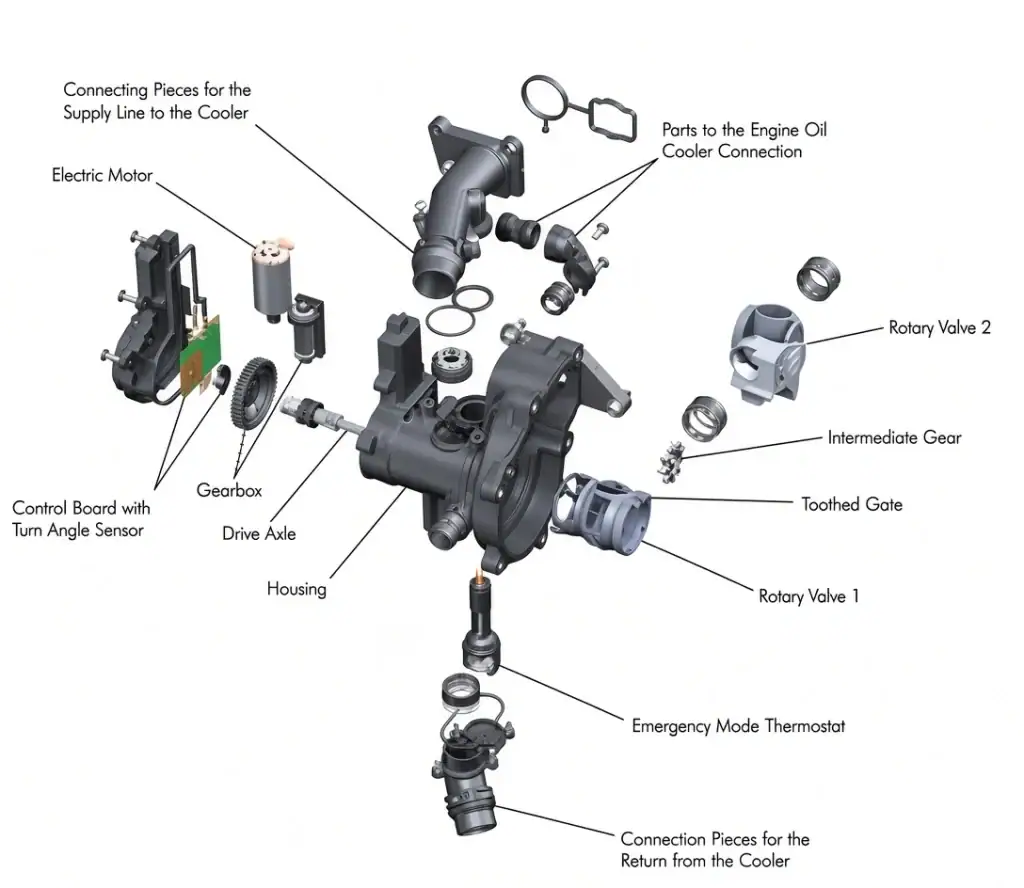
At first glance, the assembly looks confusing. It packs a mechanical coolant pump, an electronically controlled actuator, gears, rotary valves, sensors, and an emergency thermostat into a single thermal-management unit. The exploded view accompanying this article illustrates the major components. The exact visual arrangement can vary by engine and part revision; for diagnosis, the functional relationships between the components matter more than their position in the illustration.
The key thing to understand: the mechanical coolant pump and the electronic N493 actuator do two different jobs. The mechanical pump moves coolant. The N493 actuator positions the rotary valves that decide where that coolant goes. Keeping that distinction straight is the difference between a five-minute diagnosis and an unnecessary parts swap.
This article covers the EA888 Gen 3 MQB transverse-engine cooling architecture used in vehicles like the Golf, GTI, and SportWagen — engines built roughly from 2012 onward, including later “Gen 3B” revisions found in cars like the Mk7/Mk7.5 GTI and Golf R. The pump/N493 assembly changed across that span: part numbers, valve configurations, and even drive arrangements can differ between an early Gen 3 and a later Gen 3B, and between lower-output and high-output tunes of the engine. Treat this article as a conceptual guide to how the system works, not a spec sheet — always confirm part numbers and procedures against your specific engine code (found on the engine or in your service records) before ordering parts.
What Is the EA888 Gen 3 Water Pump?
The EA888 Gen 3 uses Volkswagen’s Innovative Thermal Management (ITM) system. Instead of relying mainly on a mechanical pump and a passive thermostat like a conventional engine, it uses electronically controlled rotary valves to manage where coolant flows.
The water pump/N493 assembly shown in the diagram includes:
- Mechanical coolant pump
- N493 Engine Temperature Control Actuator (electric motor, gearbox, drive axle, control board and turn-angle sensor)
- Rotary Valve 1 and Rotary Valve 2, linked by an intermediate gear and toothed gate
- Emergency-mode thermostat
- Coolant connections
In short: mechanical circulation plus electronic flow control, combined into one unit. A separate, independently replaceable component — the V51 auxiliary pump — also plays a role in the wider cooling circuit and is covered on its own below, since it’s easy to confuse with the main pump. (Our broader EA888 Cooling System Explained article covers how all of these pieces interact with the radiator, heater core, turbocharger, oil cooler, and temperature sensors.)
The Most Important Distinction: Pump vs. N493
This is the single most useful concept for reading an exploded view. If you’re working from the diagram, focus first on which parts create coolant flow and which parts control coolant routing; the exact layout can vary between revisions.
The mechanical coolant pump’s job is simple: move coolant. On most EA888 Gen 3 applications it’s driven off the balance-shaft belt system — meaning it turns and moves coolant any time the engine is running, independent of the electric motor shown in the diagram. Some variants use a slightly different drive arrangement, so confirm the specifics for your engine code, but the underlying principle holds across the platform: the mechanical pump’s circulation doesn’t depend on the N493 electronics.
The N493 actuator’s job is different: control coolant distribution. Its electric motor drives an internal gearbox and valve mechanism, positioning the rotary valves so the engine control system can choose which coolant circuits are active.
| Component | Function |
| Mechanical pump | Creates coolant flow |
| N493 actuator | Controls coolant routing |
| Rotary valves | Determine the coolant path |
That separation is critical when diagnosing a failure.
The V51 Auxiliary Pump: A Separate Component, Not a Backup for the Main Pump
Don’t confuse the main mechanical water pump with the V51 auxiliary coolant pump — they do different jobs. The main pump is mechanically driven and handles primary circulation. V51 is an electric auxiliary pump that runs when extra circulation is needed, including certain idle and after-run situations. So if you hear the coolant pump or radiator fan keep running after you shut off the engine following a hard drive, that’s often normal.
V51 is independently replaceable, and it can fail on its own. A failed or weak V51 doesn’t just affect after-run noise; it can contribute to overheating under conditions that rely on auxiliary flow (such as after-run heat-soak protection) or to poor heater performance, particularly at idle or in stop-and-go traffic. Keep V51 in mind as a candidate any time symptoms fall under “something else entirely” in the diagnosis table below — it’s a common miss when owners assume every cooling complaint traces back to the main pump or N493.
Why Does the Water Pump Need an Electric Actuator?
A conventional cooling system uses a thermostat to decide when coolant flows through the radiator. The EA888 takes a more active approach: the engine control module commands the N493 actuator to reposition the rotary valves based on:
- Engine coolant temperature
- Engine load and speed
- Warm-up requirements
- Cabin heating demand
- Turbocharger cooling requirements
That lets the system restrict flow during warm-up and open it up under thermal load — a cooling system that actively manages temperature rather than just waiting for a thermostat to open.
Reading the Exploded View
If you’re working from the diagram, here’s what to look for rather than a full re-description of each part:
- Electric motor, control board, gearbox, and drive axle (items typically clustered together) — these all belong to the N493 actuator, not the mechanical pump. An electrical fault here doesn’t mean the pump itself has failed.
- Rotary Valve 1 and 2 — positioned by the actuator; their angle determines which coolant passages are open or restricted.
- Emergency-mode thermostat — a mechanical, wax-element thermostat needing no electrical signal. It’s the backup path if the electronic valve system fails, typically opening around 110–115°C (230–239°F), though the exact figure can vary by variant.
The practical takeaway: everything on the actuator side of the diagram is about routing coolant, not making it flow. If you’re staring at the exploded view trying to decide what failed, ask first whether the symptom looks mechanical (leak, noise, no flow) or electrical/routing (fault code, wrong temperature behavior, valve-position disagreement).
The Mechanical Pump Is a Major Failure Point — Even Without an Electrical Fault
All that electronics shouldn’t distract from the fact that the mechanical pump itself is a known weak point on these engines, and it can fail on its own — the N493 actuator can be working perfectly the entire time. Common failure modes:
- Bearing failure. A worn bearing can eventually let coolant escape through the pump’s weep-hole (a small drain hole built into the housing specifically to vent past a failing seal, so leaking there is a designed-in early-warning sign, not a random crack). A developing leak here drops coolant level gradually, and cooling performance deteriorates as it does.
- Seal failure. A deteriorated seal leads to coolant leakage.
- Impeller failure. The plastic impeller can crack or separate from its metal shaft. When that happens the drive still turns, but it no longer moves coolant effectively — circulation drops or stops entirely even while the N493 electronics work perfectly. This failure is often intermittent rather than all-or-nothing: a slipping impeller may only lose grip on its shaft when hot or under load, so the car can seem fine at idle in the driveway and overheat on the highway an hour later. That inconsistency is exactly what makes it maddening to diagnose from symptoms alone.
Coolant type and condition also factor into failure risk. The EA888 Gen 3 is designed around VW’s G13 spec coolant (or G12++ depending on year and region). Using the wrong coolant, mixing incompatible types, or running on old, degraded coolant can accelerate seal and impeller wear — so coolant condition is worth checking alongside the mechanical components themselves.
Bottom line: the absence of an N493 fault code doesn’t prove the mechanical pump is healthy. These are independent failure paths.
A Water-Pump Problem Doesn’t Always Mean an N493 Problem
This is where diagnosis matters. Say your EA888 is overheating or losing coolant. A few possibilities:
- Mechanical pump failure — the pump is damaged or leaking; the N493 may still work fine.
- N493 actuator failure — the pump circulates coolant normally, but the valves can’t be positioned correctly.
- Rotary-valve problem — the actuator works electrically, but a valve or linkage is stuck or damaged.
- Something else entirely — low coolant, trapped air, a radiator or fan issue, a bad hose or connection, a faulty temperature sensor, a wiring fault, or a V51 auxiliary-pump problem (see above).
A cooling-system symptom shouldn’t automatically mean a water-pump replacement. Check the complete system first.
How Target Temperature Shifts With Conditions
At cold start, the EA888 doesn’t send maximum coolant flow through the radiator — that would only slow warm-up. Instead, the thermal-management system restricts circulation through parts of the cooling system so the engine reaches operating temperature faster, while still protecting components that need active thermal management, like the cylinder head and turbocharger.
Under heavy load, that strategy flips. More heat comes from combustion, the cylinder head, the turbocharger, the exhaust, and engine oil, so the system increases heat rejection — meaning the target coolant temperature shifts significantly with operating conditions. Our main article cites roughly 107°C under partial load versus roughly 85°C under full load as an example of this load-dependent strategy. In other words: don’t diagnose an EA888 off a single coolant-temperature reading.
How to Diagnose an EA888 Water-Pump Problem
Step 0 — Check warranty and recall eligibility. Before you spend a dollar, check whether your VIN is covered by a service campaign or extended warranty. In the US, some EA888 Gen 3 water-pump failures have been covered under extended warranty programs; in other regions, service campaigns may apply. Ask specifically whether your VIN is covered for a “water pump” or “thermal management” issue before assuming you’re paying out of pocket. Your dealer (or VW/Audi customer care) can check your VIN — it costs nothing to ask, and it’s worth doing before you order parts or start turning wrenches.
Step 1 — Check the coolant level. Check the expansion tank with the engine cold, following the vehicle-specific procedure. A low level alone can mimic pump-failure symptoms.
Step 2 — Look for leaks. Inspect the water-pump area, hoses, coolant connections, expansion tank, radiator, oil-cooler connections, and turbocharger coolant connections. A leak doesn’t always leave a puddle — it can evaporate, run along the engine, or only show up when the system is hot and pressurized.
Step 3 — Scan the ECU. If you have VCDS, scan the engine control module and record fault codes before clearing them. A few codes commonly show up in this diagnostic area — for example, P2181 (Cooling System Performance, a generic OBD-II code, not EA888-specific) and P00B7 / P00B8 (Coolant Thermostat “A” Heater Control Circuit Low/High, which relate to an electronically controlled thermostat or actuator circuit on some applications). VW-specific codes tied to N493 valve-position disagreement or actuator implausibility will also appear on many scans. Treat these as starting points, not a checklist — confirm the exact codes your VCDS session returns against your ECU software version, since coverage varies by year and region.
Step 4 — Check measuring values. In VCDS: [01 – Engine] → [Adv. Measuring Values], and search for cooling-related parameters — engine coolant temperature, radiator temperature, coolant-pump data, actuator data, and cooling-fan data. Compare G62 (engine coolant-temperature data) with G83 (radiator outlet temperature data): a large or implausible difference can be a useful clue for a coolant-flow or valve-control problem. Measuring-value identifiers vary by ECU and vehicle, so don’t assume one EA888’s channel numbers match another’s. For a deeper explanation of G62/G83 behavior, see our broader EA888 cooling-system article.
Don’t Forget Air Trapped in the Cooling System
Replacing the water pump doesn’t automatically fix a cooling problem. Trapped air can cause poor cabin heat, temperature fluctuations or spikes, unusual circulation, erratic fan behavior, and coolant-level changes. With the EA888’s multiple circuits and rotary valves, proper filling and bleeding matters — follow the vehicle-specific Volkswagen procedure.
Two tools make this considerably easier and more reliable than a gravity fill: a vacuum-fill tool draws air out of the system before coolant goes in, largely eliminating trapped-air pockets in one step, and a cooling-system pressure tester lets you confirm the system holds pressure (and spot a slow leak) before you button everything up. While you have the pressure tester out, check the expansion tank cap itself — its spring-loaded valve is a common wear point, and a weak cap that can’t hold rated pressure will cause coolant loss and overheating even when every other component is healthy. Most pressure testers include an adapter for testing caps directly. Neither tool is strictly required, but both are standard practice on this platform and worth the modest cost if you’re doing the job more than once.
Water Pump or N493? Use the Symptoms Carefully
| Symptom | Likely area | Distinguishing clue |
| Coolant leaking from pump area | Mechanical pump / seal | Visible drip or crust at the weep-hole area under the pump |
| Pump bearing noise or wear | Mechanical pump | Noise changes with engine RPM, not electrical load |
| Impeller failure | Mechanical pump | Overheats mainly under load or at speed, seems fine at idle — classic sign of a slipping impeller |
| Valve-position fault | N493 / rotary-valve mechanism | Fault code references valve position or actuator disagreement |
| Actuator electrical fault | N493 / electrical circuit | Fault code points to N493 wiring, motor, or sensor circuit |
| Overheating at idle but fine under load | Airflow (fan/clutch/shroud), low coolant, or circulation/control issue | Idle-only overheating often points more toward airflow issues or low coolant than a load-dependent flow restriction |
| Overheating under load but fine at idle | Restriction, insufficient flow at high demand, or airflow/radiator issue | Symptom appears specifically as demand increases |
| Slow warm-up | Thermal-management / valve system | Coolant temp climbs unusually slowly even after several minutes of driving |
| Cooling fan running excessively | Temperature, cooling, or control problem | Persists even at normal coolant temperatures |
| Coolant warning, but no leak found and pump/N493 test fine | V51 auxiliary pump or sensor | Check V51 operation and after-run behavior before assuming the main pump or N493 |
These are starting points for diagnosis, not automatic conclusions — a symptom can have more than one underlying cause.
When Should You Replace the Water Pump?
Don’t replace it just because you have a cooling-related fault code. First figure out whether the problem is mechanical, electrical, coolant-flow related, or something else entirely. A proper diagnosis can save you from replacing an expensive assembly when the real issue is a sensor, a wiring fault, a coolant leak, trapped air, or a radiator problem.
Worth knowing going in: on most EA888 Gen 3 applications, the mechanical pump and N493 actuator are only available as a single combined assembly, not as separate serviceable parts. That means a failed impeller — a purely mechanical failure — can still require replacing the N493 electronics, and a failed N493 can mean replacing a mechanically healthy pump. That’s a strong reason to diagnose which side actually failed before ordering the assembly. Depending on the vehicle, access can also mean removing components like the intake manifold or working in tight quarters around the front of the engine, which is why many owners treat this as a moderate-to-involved DIY job rather than a quick swap. If you’re not confident about torque specs, coolant capacity, or the bleeding procedure for your specific model, this is a reasonable point to hand the job to a shop.
DIY Inspection Checklist
Before replacing an EA888 water pump/N493 assembly, work through these in order — level and leaks first, then diagnostics, then component tests, then fill/bleed:
1. Level & Visual Checks
a) Coolant level
b) Coolant condition
c) Visible coolant leaks
d) Pump and surrounding area
e) Hoses and connections
f) Expansion tank and cap
2. Scan & Data
a) ECU fault codes
b) G62 coolant-temperature data (the main engine coolant-temperature sensor, typically near the thermostat/coolant-pump housing)
c) G83 radiator-temperature data (the radiator outlet temperature sensor)
3. Component Tests
a) Mechanical pump condition
b) N493 actuator operation
c) Rotary-valve operation
d) Cooling fan
e) V51 auxiliary pump
4. Air & Fill
a) Evidence of trapped air
b) Proper coolant filling/bleeding procedure
This follows the same philosophy as our main EA888 cooling article: diagnose the whole system before replacing the first suspicious-looking part.
Final Thoughts
The EA888 Gen 3 water-pump assembly is a good example of how far engine cooling has evolved. The mechanical coolant pump provides physical circulation, while the N493 Engine Temperature Control Actuator uses an electric motor, gearbox, and rotary valves to control where that coolant goes. An emergency mechanical thermostat backs up the electronics if they fail.
Most importantly: don’t mistake an N493 actuator problem for a mechanical water-pump failure. They’re related components in the same assembly, but they do different jobs — and knowing the difference can save you from replacing expensive parts unnecessarily.
Scan it. Understand the coolant flow. Test the components. Then replace the failed part. That’s the DIY approach.
Leave a Reply