
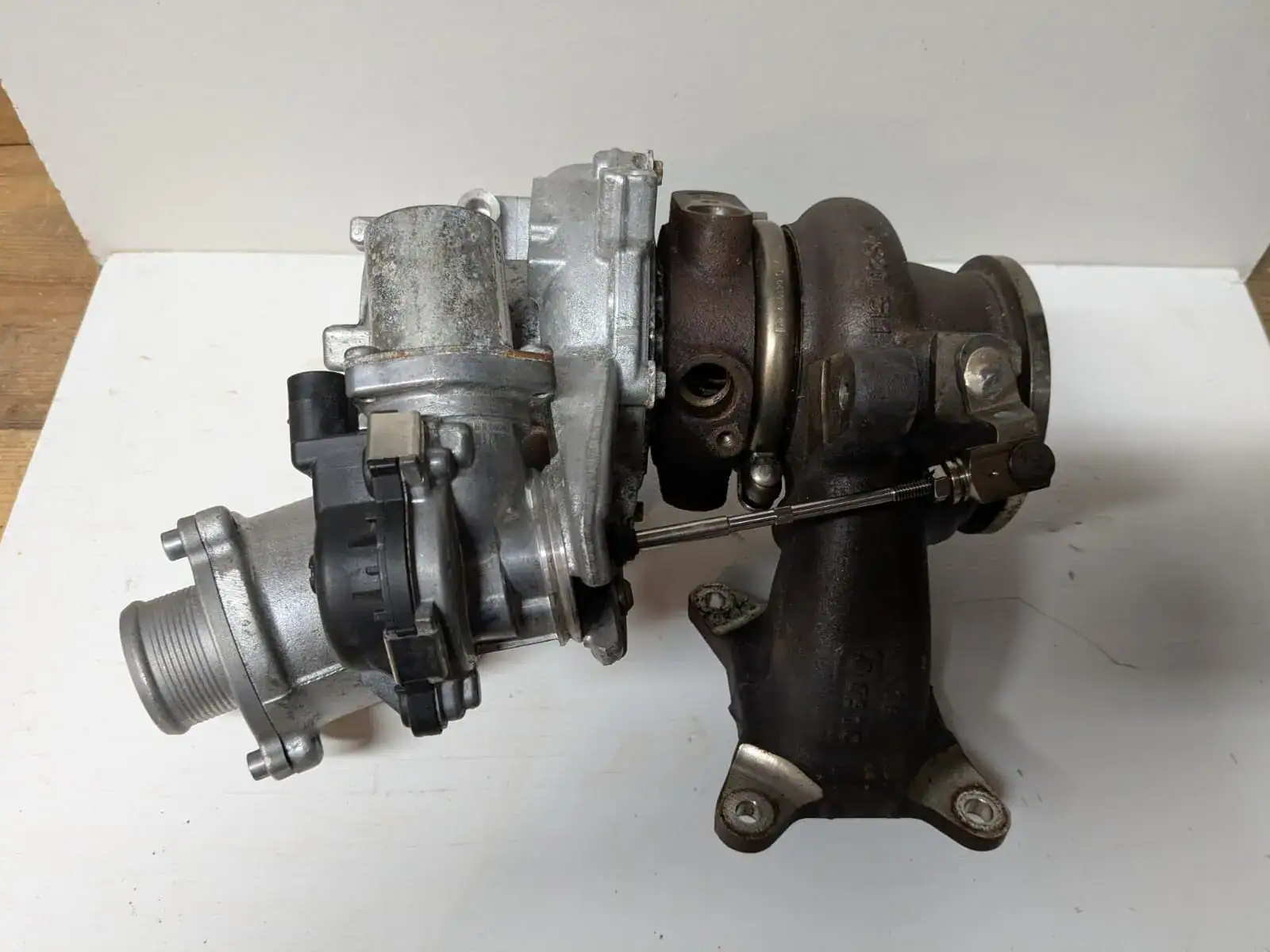
You remove the air intake pipe from your Volkswagen Golf GTI, Golf SportWagen, or another EA888-equipped car. Then you gently move the compressor wheel of the IS20 turbocharger and feel the shaft move from side to side. Is the turbocharger worn out?
Not necessarily. A journal-bearing turbocharger can show some radial movement when the engine is off, because the oil film that supports the shaft during operation is missing. However, excessive clearance, axial movement beyond specification, or wheel contact with the housing points to a real mechanical problem.
There is another catch. The wastegate linkage and actuator sit on the turbine side and have no mechanical connection to the compressor shaft. However, their rattle and movement are easy to mistake for shaft play. This guide shows you how to tell them apart and how to inspect the IS20. It also lists the warning signs you should not ignore.
1. How the IS20 Shaft and Bearings Work
The IHI IS20 turbocharger in the Volkswagen Golf GTI (EA888 Gen 3) has two wheels on one shaft. Four main parts matter for this guide:
- Compressor wheel: it draws in and compresses intake air.
- Turbine wheel: it uses exhaust-gas energy to drive the shaft.
- Center housing: it holds the rotating assembly and supplies lubrication and cooling.
- Bearings: they control shaft movement and maintain the clearances the turbocharger needs.
The shaft spins at very high speed. Therefore, its bearings must limit friction, vibration, and contact between the wheels and their housings. For this reason, zero clearance in every direction is the wrong expectation.
Bearing designs differ, though. The oil-film explanation below applies to conventional journal-bearing turbochargers. Do not apply it automatically to an aftermarket ball-bearing conversion or a rebuilt unit with a different bearing configuration.
2. Why IS20 Shaft Play Exists When the Engine Is Off
First, compare a turbocharger at rest with one running on pressurized oil. In a conventional journal-bearing design, a thin oil film supports the spinning shaft [1]. When the engine stops, that film disappears. As a result, you may feel some radial movement when you move the compressor wheel by hand. You must therefore read every measurement against the specification for that particular turbocharger.
What IS20 shaft play feels like
No reliable universal finger test separates acceptable from excessive IS20 shaft movement. A novice may feel slight movement and assume the bearings are worn. Meanwhile, another person may dismiss large movement because the wheel still spins. Neither conclusion holds up without further checks.
Use these observations as an initial screening guide:
- Some radial movement, smooth rotation, no scraping: this may be normal, but it does not prove the bearings meet specification.
- The wheel visibly approaches or touches the housing: investigate immediately, because contact is never ordinary clearance.
- Rough rotation, grinding, damaged blades, or rubbing marks: treat these as signs of possible mechanical damage.
- Noticeable in-and-out movement: check axial end play with the correct service procedure.
In short, hand feel helps you spot obvious problems. However, it cannot measure bearing clearance.
A sense of scale for IS20 shaft play
We deliberately do not publish a pass/fail figure for the IS20, because that number must come from the service documentation for your exact turbocharger. Still, a rough sense of scale helps you decide how urgently to act. Treat the points below as orders of magnitude for a small passenger-car turbocharger, not as specifications.
- Bearing clearances in turbochargers this size are tiny, typically a fraction of a millimeter. For reference, a human hair is roughly 0.05 to 0.1 mm thick, and a sheet of printer paper is about 0.1 mm.
- Radial movement: a faint, slightly springy give is consistent with a healthy journal-bearing design, but it does not prove the bearings meet specification. In contrast, movement you can clearly see from the compressor inlet calls for a measurement. The same goes for any rocking that makes you wonder whether the wheel can reach the housing.
- Axial movement: a barely perceptible give is one thing. However, a distinct click or clunk, or a shaft you can slide visibly back and forth, deserves a dial-indicator measurement.
Feel also varies with leverage and access. The wheel edge magnifies bearing clearance, so the movement you feel there is larger than the clearance inside the bearing. Likewise, a narrow inlet or an awkward hand angle changes what you perceive, and a larger wheel on a bench feels different from a small wheel in the car. Therefore, treat feel as a trigger for measurement, not a verdict.
Treat three signs as triggers: movement you can see, a distinct click or clunk, or any scraping. If you notice one, measure the shaft and compare the result with the specification for your turbocharger. This scale never replaces that measurement.
3. Radial vs. Axial IS20 Shaft Play
Evaluate these two directions of movement separately.
Radial shaft play: movement across the shaft
Radial movement is side-to-side movement. For example, move the compressor wheel up and down while you look into the compressor inlet.
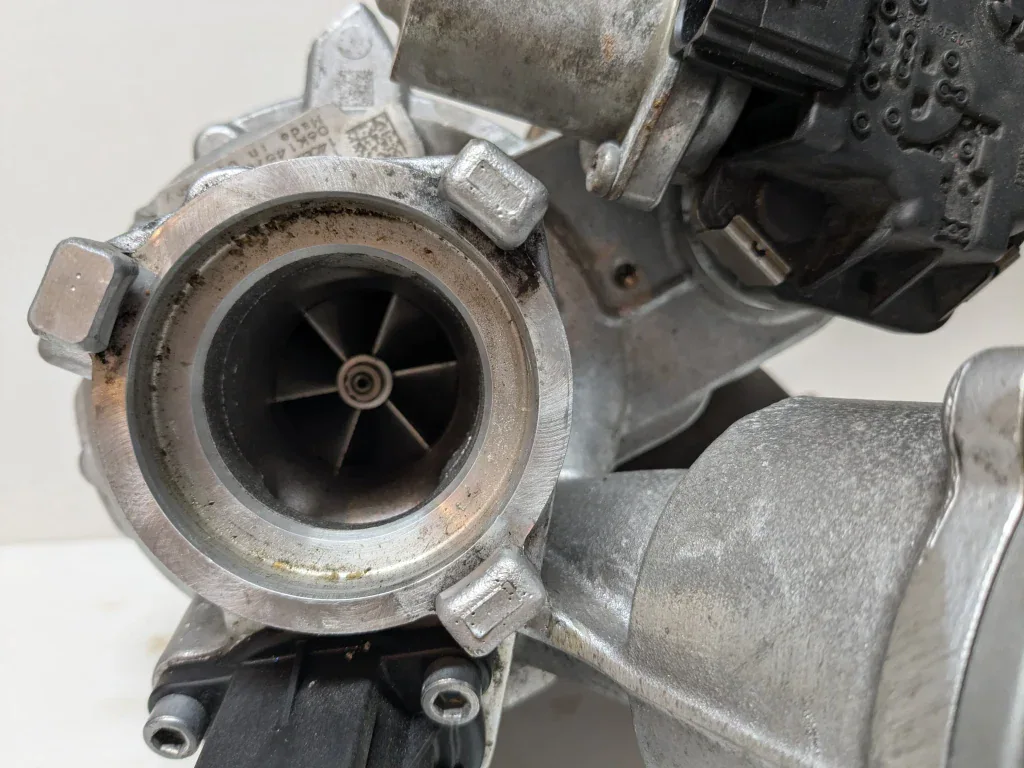
A stationary journal-bearing turbocharger may show radial clearance. The important questions are whether the measured clearance meets the specification and whether the wheel stays clear of its housing throughout its permitted movement.
Axial shaft play: movement along the shaft
Axial movement is the in-and-out movement of the shaft toward the compressor side and the turbine side.
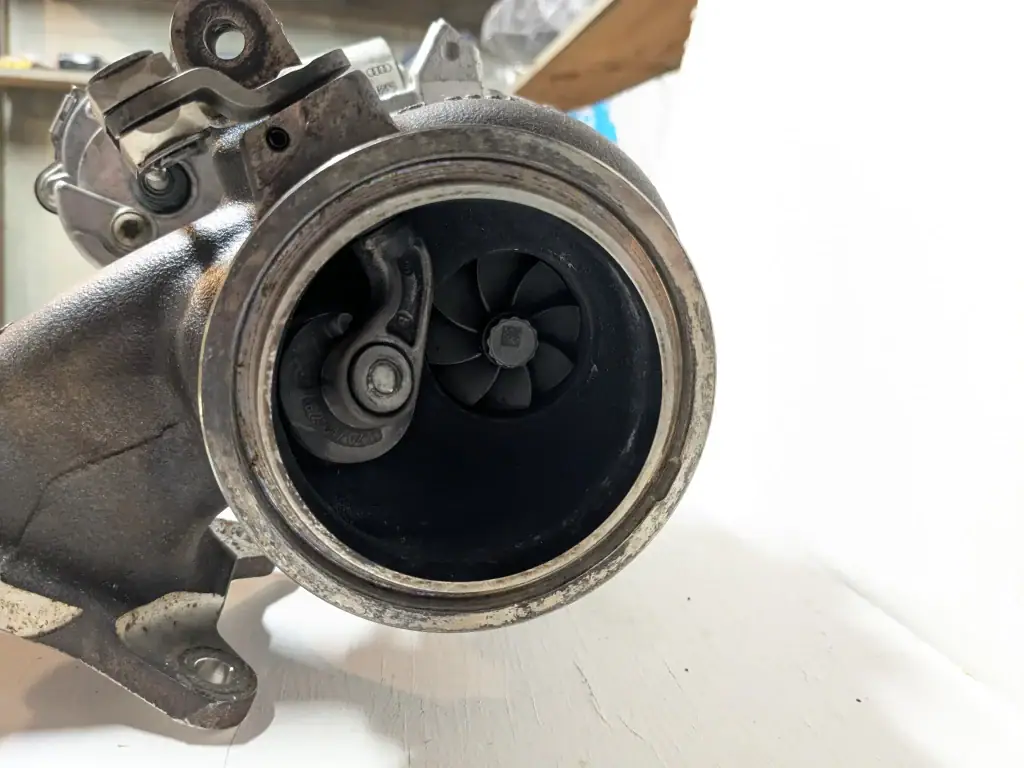
In a conventional turbocharger, the journal bearings take the radial loads, while a separate thrust bearing takes the axial loads [1]. Therefore, excessive end play can point to wear or damage in the thrust-bearing components. Radial feel tells you nothing conclusive about axial clearance, so measure end play separately and compare it with the IS20 service specification.
Important: do not use a clearance figure from a different BorgWarner, Garrett, or other turbocharger model as an IS20 pass/fail limit.
4. Is It IS20 Shaft Play or the Wastegate?
The IS20 uses an electronically controlled wastegate. Volkswagen Group training material describes an electrical actuator with a DC motor, a gear, and a push rod that moves the wastegate valve [2]. The actuator drives a linkage, and that linkage moves the wastegate flap to regulate exhaust flow through the turbine.
When you inspect the turbocharger, you may notice movement or hear a rattle at the actuator rod, linkage, or wastegate lever. That movement is not compressor shaft movement. The table below separates the mechanisms.
| Component | What moves | What a problem may cause |
|---|---|---|
| Turbocharger shaft | Compressor and turbine wheels rotate together | Bearing noise, wheel contact, oil-related symptoms |
| Wastegate linkage | Lever and flap controlling exhaust bypass | Rod or lever rattle, boost-control problems, underboost or overboost |
| Electronic actuator | Motor and actuator mechanism | Position faults, failed adaptation, P0299 and other boost-control errors |
Why the IS20 wastegate rattles
Three points make this confusion especially common on the IS20:
- Some slack at the rod is part of the design, because the training material notes that the push rod has clearance and tolerance compensating elements [2]. A small amount of rod movement is therefore not automatically a fault.
- Excessive rod or lever rattle is a commonly reported complaint on EA888 Gen 3 cars. Owners and repair guides describe wear at the rod, lever, or wastegate bushing, often as a metallic rattle on deceleration. Worn linkage can stop the wastegate from sealing, and it can contribute to underboost faults such as P0299.
- The electric actuator itself can also fail. A motor, gear, or position-sensor problem can leave the actuator unable to reach its commanded position, so it can cause boost-control faults even when the turbocharger bearings are fine.
How to tell wastegate movement from IS20 shaft play
If you can safely reach the compressor inlet, inspect the compressor wheel and watch the shaft itself. If the movement or rattle seems to come from the external wastegate linkage, do not condemn the bearings automatically.
Assess the actuator and linkage with the correct procedure for the vehicle. Do not force the actuator, change its rod adjustment, or tighten the linkage to remove normal clearance. In addition, the training material states that the charge pressure actuator needs scan-tool adaptation after replacement. It also lists a dedicated setting gauge for locking the wastegate during adjustment work [2].
If you have a boost-control fault, check the actuator’s electrical connection, its position data, the linkage movement, and the applicable guided tests. Only then decide which component has failed.
5. What Causes Excessive IS20 Shaft Play?
If the measured clearance exceeds the applicable limit, investigate several possible causes.
Insufficient oil supply
The turbocharger needs a steady supply of clean engine oil. A restricted feed, low oil pressure, contamination, or an installation problem can damage its bearings. Therefore, investigate the oil feed line, the oil pressure where appropriate, and any restrictions that the vehicle-specific service procedure identifies.
Verify oil pressure with a mechanical gauge at the port and under the conditions the procedure gives. The dashboard warning is not a measurement, because the engine uses oil pressure switches instead of a gauge-type sender. Moreover, its regulated oil pump has more than one pressure stage. A reading therefore only means something when you compare it with the figure for the same engine speed and temperature [2].
If the original lubrication fault remains, replacing the turbocharger will not solve the problem.
Oil contamination
Particles or debris in the oil can damage precision bearing surfaces. If a turbocharger has internal damage, inspect the engine oil and filter for contamination. Then find the source of any debris.
Treat the turbocharger as part of the lubrication system, not as an isolated part. The training material itself states that it is not a repair manual and that you must consult current repair literature for repair work [2]. Follow the vehicle-specific service instructions when you replace the turbocharger or inspect related components.
Oil drainage problems
Oil must also drain correctly from the turbocharger center housing. A restricted return line or another drainage problem may contribute to oil leakage. Nevertheless, oil in the intake or exhaust does not prove by itself that the shaft bearings are worn. Inspect the oil supply and return, the crankcase ventilation system, and other plausible causes before you blame the rotating assembly.
Foreign-object damage and operating stress
Debris entering the intake can damage compressor blades, and exhaust-side problems can damage the turbine wheel. Excessive temperatures, lubrication problems, and other abnormal conditions can also harm the rotating assembly. Look for damaged blades, rubbing marks, rough rotation, and evidence of housing contact.
6. How to Inspect IS20 Shaft Play
A basic inspection can reveal obvious damage. However, it does not replace a measured clearance check.
Steps for a basic hand check
- Make the vehicle safe. Switch off the engine and let the engine and turbocharger cool completely. Never put your fingers near the wheels while the engine runs. Remove the intake pipe only as far as the service procedure requires.
- Inspect the compressor wheel. Use a light to examine the blades and the accessible housing. Look for chipped or bent blades, foreign-object damage, and circular marks that suggest contact.
- Rotate the wheel gently. Where you can reach it safely, turn the compressor wheel by hand. It should not grind, bind, or scrape the housing. Do not force it or lever on the blades.
- Check radial movement. Gently move the shaft perpendicular to its center line, and watch whether the wheel approaches or touches the housing. If it scrapes, do not operate the vehicle until you find the cause.
- Check axial movement. Gently push and pull the shaft along its center line. If you notice a distinct click or visible in-and-out travel, get a proper measurement. Do not judge the turbocharger good or bad from feel alone.
Measuring IS20 shaft play with a dial indicator
A dial indicator can measure shaft movement accurately when you set it up and use it according to the service procedure. Position the indicator correctly, and load the shaft in the prescribed direction. Then compare the total measured movement with the specification for your exact turbocharger. If that specification is unavailable, ask a qualified turbocharger specialist or Volkswagen technician to assess it.
7. Is an In-Place Check Enough for IS20 Shaft Play?
No. An in-place hand check is a screening test, not a complete diagnosis. With the IS20 installed, you can usually reach only the compressor side. As a result, you may not be able to inspect the turbine wheel, judge exhaust-side housing contact, or measure shaft movement the way a bench procedure does. You also cannot assess every internal bearing surface by moving the compressor wheel.
An in-place check still helps you find obvious damage, but it has limits:
- You cannot establish the exact radial clearance.
- Axial end play may not give a meaningful reading.
- The turbine wheel and exhaust-side housing stay mostly out of view.
- Oil pressure and flow remain unverified.
If the inspection reveals scraping, rough rotation, damaged blades, or other serious signs, investigate further. However, do not remove the turbocharger just because you feel some radial movement. Likewise, do not dismiss obvious damage because the car still makes boost.
8. What If the IS20 Has a P0299 Underboost Code?
P0299 means the engine control system detected an underboost condition. The code does not automatically mean the shaft bearings are worn. Ross-Tech’s P0299 diagnostic reference lists several possible causes, including leaking or disconnected hoses and pipes, the charge pressure control, the diverter valve, and the turbocharger itself [3]. Treat the code as a starting point for diagnosis, not as proof that the turbocharger has failed.
On an IS20-equipped car, the investigation may include:
- Charge-air leaks and loose connections
- Diverter-valve or other boost-system faults
- Electronic wastegate actuator faults, including motor, gear, and position-sensor problems (see Section 4)
- Wastegate linkage wear, rod rattle, or flap and bushing movement (see Section 4)
- Turbocharger damage
- Incorrect or incompatible ECU calibration
Use VCDS or another suitable diagnostic tool to record the fault information. Then compare requested and actual boost under the appropriate test conditions. Where the tool supports it, examine wastegate-related measuring values and run the applicable guided tests. If the actuator cannot reach its commanded position, or if the wastegate does not operate correctly, investigate that control system. Do not assume that bearing play is responsible.
9. Can You Keep Driving With IS20 Shaft Play?
The answer depends on what you found. If you feel some radial movement but the wheel turns smoothly and does not rub, do not panic. That observation alone cannot condemn the turbocharger. Instead, verify the applicable specification and look for other warning signs.
However, stop the engine and arrange further inspection if you find any of these:
- Compressor or turbine wheel contact with its housing
- Grinding, scraping, or significant mechanical damage
- Substantial axial movement that nobody has evaluated
- Sudden, severe turbocharger noise with loss of power
- Significant oil leakage, smoke, or signs of internal damage
If the oil-pressure warning appears, stop the engine safely and follow the vehicle’s low-oil-pressure instructions. In addition, do not run high-load boost tests to see whether a suspected mechanical fault gets worse.
10. Should You Replace the IS20?
Replace or rebuild the turbocharger only when the evidence supports it. A faulty actuator, worn wastegate linkage, charge-air leak, damaged hose, or external oil-line problem may be repairable without replacing the whole turbocharger. On the other hand, internal bearing damage, wheel contact, or clearance outside the applicable limits may justify replacement or professional rebuilding.
Before you buy a replacement, verify the part number, actuator configuration, calibration requirements, and installation instructions for your specific engine.
Two practical gotchas for DIYers
- Check whether the actuator is included. Depending on the part number and supplier, it may come fitted to a replacement turbocharger, or a seller may list it separately. Confirm this before ordering. Otherwise, you may end up with a turbocharger and no matching actuator, or with two actuators.
- Plan for calibration. Whenever you replace the actuator or disturb the linkage, you must adjust the wastegate and adapt the actuator with a suitable scan tool, as the training material describes [2]. Skip this step, and you can see boost-control faults even though the new parts are fine.
The goal is to correct the underlying problem. Otherwise, a new turbocharger leaves the original cause of failure in place.
The Bottom Line on IS20 Shaft Play
A little radial movement at the compressor wheel does not mean your IS20 is worn out. Likewise, movement at the wastegate linkage is not shaft movement. At Akotex, we apply one rule to shaft-play questions. First, identify which component moves. Next, measure it against the specification for your exact turbocharger. Only then decide what to replace.
References
- BorgWarner Inc., US Patent 8,197,183 B2, “Spherical thrust bearing system for turbochargers.” The background section describes journal bearings supporting the shaft on an oil film, with the journal bearings taking radial loads and the thrust bearing taking axial loads. https://patents.google.com/patent/US8197183
- Audi of America, eSelf-Study Program 920243, “The Audi 1.8L and 2.0L Third Generation EA888 Engines” (11/2013, revision 2 12/2013). This is the US edition of Volkswagen Group SSP 606, judging by its 606_xxx figure numbers. See “Oil supply” (pp. 28 to 31), “Air supply and charging” (p. 49) and “Turbocharger” (pp. 53 to 55). It covers the third-generation EA888 turbocharger in general and does not use the designation IS20. The document states that it is not a repair manual. https://static.nhtsa.gov/odi/tsbs/2014/MC-10122162-9999.pdf
- Ross-Tech Wiki, “16683 / P0299 / 000665.” https://wiki.ross-tech.com/wiki/index.php?title=16683%2FP0299%2F000665
Leave a Reply