
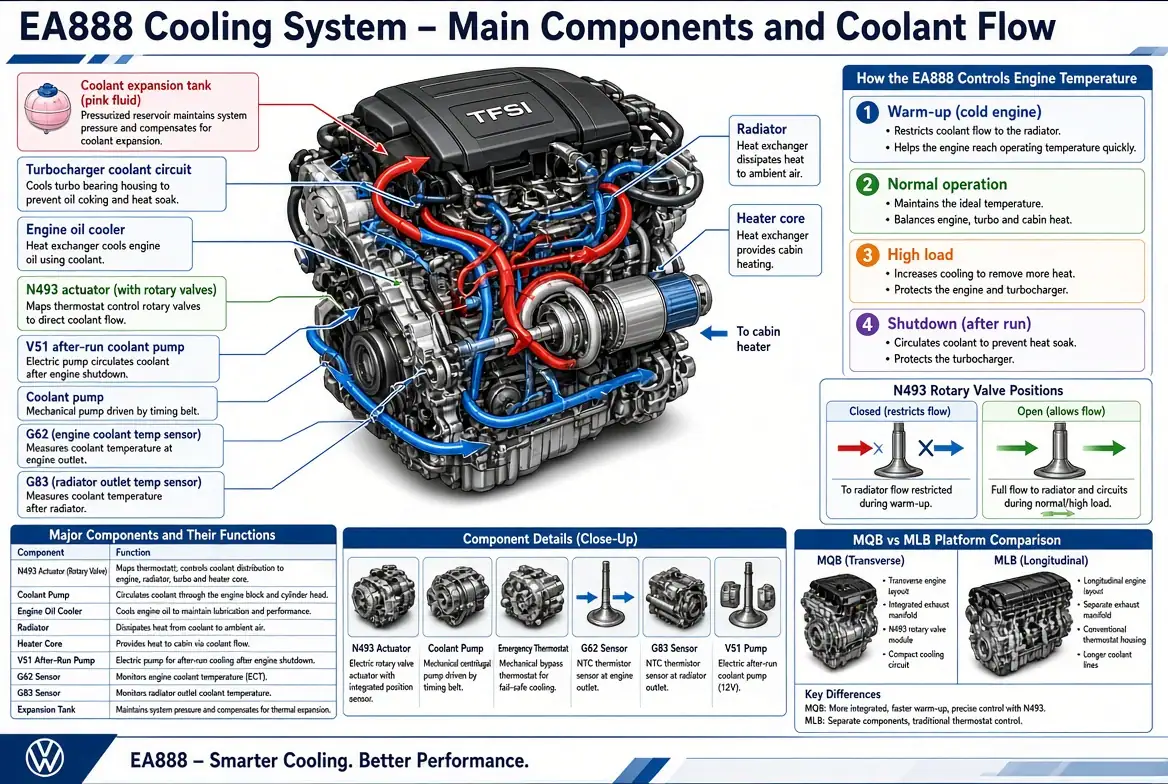
The cooling system in the Volkswagen and Audi EA888 engine is much more sophisticated than a traditional engine cooling system.
If you are working on a VW Golf, GTI, SportWagen, Jetta, Passat, Audi A3, or another vehicle equipped with an EA888 engine, understanding the cooling system can make diagnosing overheating, coolant leaks, slow warm-up, heater problems, and coolant-pump faults much easier.
The EA888 Gen 3, including the 1.8T and 2.0T engines, uses an electronically controlled thermal-management system to regulate coolant flow. Instead of relying only on a conventional thermostat, the engine control system actively controls where coolant flows and how much heat is removed.
This design has several objectives:
- Warm the engine quickly after a cold start.
- Reduce friction and emissions during warm-up.
- Maintain an appropriate operating temperature.
- Reduce engine temperature under high load.
- Control turbocharger temperature.
- Provide cabin heat when requested.
- Protect the engine and turbocharger after shutdown.
Volkswagen calls this system Innovative Thermal Management (ITM) on the EA888 Gen 3.
Important: EA888 engines exist in several generations and configurations. The exact cooling-system components and control strategy can vary between engines. This article focuses primarily on the EA888 Gen 3 1.8T/2.0T system, including the type used in many MQB vehicles such as the VW SportWagen.
This article specifically covers the MQB transverse-engine layout.
That means the N493 actuator with integrated rotary valves, as fitted to the Golf, GTI, A3, and similar front-wheel-drive-based platforms.
Audi vehicles on the MLB longitudinal-engine platform (A4, A5, Q5, and similar models) are different.
They use a map-controlled thermostat and a separate electric auxiliary pump, not the N493 rotary-valve assembly described here.
Confirm which architecture applies before using this article to diagnose a longitudinal-engine Audi.
1. Why the EA888 Cooling System Is Different
A conventional engine cooling system is relatively easy to understand.
A mechanical water pump circulates coolant through the engine. When the engine becomes hot, the thermostat opens and allows coolant to flow through the radiator. The radiator removes heat from the coolant before the coolant returns to the engine.
The EA888 takes this concept considerably further.
The engine control module can influence coolant flow through different parts of the engine depending on:
- Coolant temperature
- Engine load
- Engine speed
- Operating conditions
- Cabin-heating demand
- Turbocharger thermal requirements
- Engine shutdown conditions
The result is a cooling system that can deliberately restrict coolant flow during warm-up and increase cooling when the engine is under heavy load.
This is important because maximum cooling is not always desirable.
During a cold start, the engine actually benefits from retaining heat.
2. The Major Components of the EA888 Cooling System
The exact configuration depends on the engine and vehicle, but the EA888 Gen 3 cooling system can include the following major components:
| Component | Function |
| Coolant pump | Circulates engine coolant |
| Engine Temperature Control Actuator N493 | Controls coolant distribution |
| Rotary valves | Direct coolant through different circuits |
| Emergency thermostat | Provides a mechanical safety function |
| Main radiator | Removes heat from engine coolant |
| Coolant expansion tank | Allows coolant expansion and provides a fill/pressure point |
| G62 coolant temperature sensor | Reports engine coolant temperature |
| G83 radiator outlet temperature sensor | Monitors radiator-side coolant temperature |
| V51 after-run coolant pump | Provides coolant circulation after shutdown when required |
| Heater core | Transfers engine heat into the passenger compartment |
| Engine oil cooler | Transfers heat between engine oil and coolant |
| Turbocharger coolant circuit | Helps control turbocharger temperature |
Volkswagen’s EA888 Gen 3 documentation identifies the N493 temperature-control actuator, coolant pump, G62 coolant-temperature sensor, G83 radiator temperature sensor, V51 after-run pump, radiator, heater circuit, turbocharger and engine-oil cooler as parts of the thermal-management system.
Coolant specification also matters more on this system than on a conventional cooling system.
Use only the VW/Audi-specified coolant for the model year, typically G12evo or G13.
Mixing coolant types or substituting a generic or older-spec coolant can cause silicate drop-out.
That drop-out can clog or damage the plastic rotary valves and seals inside the N493 assembly.
3. The Coolant Pump and N493 Temperature Control Actuator
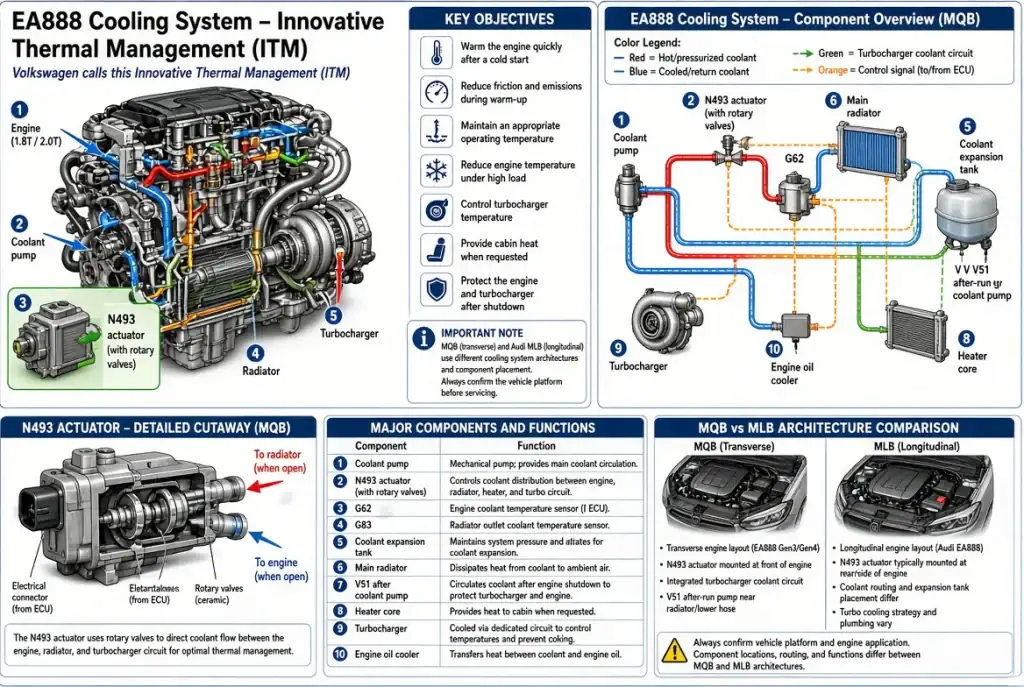
One of the most important parts of the EA888 Gen 3 cooling system is the engine temperature control actuator N493.
The N493 assembly incorporates the coolant pump and rotary-valve mechanism.
This is fundamentally different from the simple thermostat arrangement found on many older engines.
The coolant pump circulates coolant while the rotary valves control where the coolant goes.
The system therefore has two separate but related jobs:
The pump moves coolant.
The rotary valves control the coolant path.
This allows the engine control module to change the cooling strategy according to operating conditions.
The EA888 Gen 3 coolant pump is driven through a toothed-belt arrangement from the balance-shaft system, while the N493 actuator controls the internal rotary valves.
The mechanical coolant pump itself is a common failure point on this engine, independent of the N493 electronics.
It is driven off the balance-shaft belt. A failing bearing can allow coolant to leak from the pump’s weep hole.
The plastic impeller can also separate from its metal shaft.
Either failure can cause a leak, or a complete loss of mechanical coolant circulation, even while the N493 actuator itself is functioning and reporting no electrical fault.
The system also includes a purely mechanical backstop for this reason: the emergency thermostat built into the N493 housing. It is a wax-element thermostat with no electrical connection to the ECU. If the N493 actuator fails, electrically or mechanically, or if the ECU loses control of the rotary valves, this thermostat mechanically opens on its own at approximately 110–115°C (230–239°F). That forces coolant through the radiator and prevents catastrophic overheating, despite the loss of electronic control.
4. What the Rotary Valves Actually Do
The rotary valves are central to understanding the EA888 cooling system.
Instead of simply waiting for coolant to reach a thermostat temperature, the system can actively regulate the coolant circuits.
The N493 actuator controls the position of the rotary valves.
Depending on the valve position, coolant flow can be directed toward or restricted from components such as:
- Engine block
- Cylinder head
- Main radiator
- Engine oil cooler
- Turbocharger
- Heater circuit
The engine control module selects the valve position based on a programmed thermal-management strategy.
This allows the EA888 to operate in several different thermal-management phases.
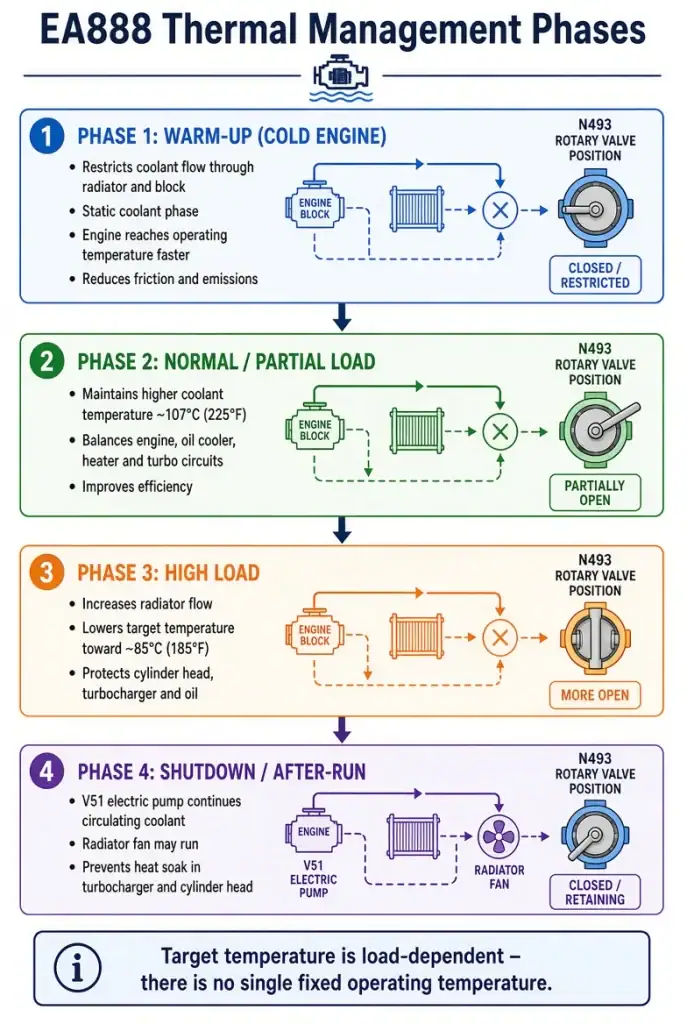
5. Cold Start: Keeping Heat Inside the Engine
The first objective after starting a cold EA888 engine is to reach operating temperature as quickly as possible.
This may seem strange because the cooling system’s job is normally considered to be removing heat.
However, removing too much heat from a cold engine would actually make warm-up slower.
Therefore, during the initial warm-up phase, the system restricts coolant circulation through parts of the cooling system.
Volkswagen describes this as a static coolant phase.
During this phase, coolant flow through the engine block and radiator is restricted so that combustion heat remains concentrated in the engine.
This helps the engine:
- Reach operating temperature faster.
- Reduce friction.
- Improve fuel efficiency.
- Reduce emissions.
- Bring engine oil toward its normal operating condition.
The system is therefore not simply trying to make the engine “cold.”
It is trying to make the engine the correct temperature as quickly as possible.
6. Why the Turbocharger Still Needs Cooling During Warm-Up
There is an interesting complication with a turbocharged engine.
Even while the engine is warming up, the cylinder head and turbocharger can experience significant heat.
The EA888 therefore does not simply stop all coolant movement.
As the engine transitions through the warm-up strategy, a small coolant flow is introduced through areas including the cylinder head and turbocharger.
Volkswagen describes this as a mini-volume coolant stream.
This provides thermal protection while still allowing the engine to warm rapidly.
This is an important diagnostic concept.
A coolant system that intentionally restricts flow does not necessarily indicate a malfunction.
The restriction can be part of the normal thermal-management strategy.
7. Cabin Heat Changes the Cooling Strategy
The passenger compartment heater is another important part of the EA888 cooling system.
When you turn on the heater, the vehicle needs hot coolant to flow through the heater core.
The engine control system therefore has to balance two objectives:
- Warm the engine quickly.
- Provide heat to the passenger compartment.
The EA888 can use the heater circuit during warm-up to transfer heat from the engine to the cabin.
An additional coolant pump, identified as V51, can assist coolant circulation under certain operating conditions.
V51 is strictly an electric auxiliary pump, separate from the mechanical, belt-driven coolant pump inside the N493 assembly.
Its job is to maintain coolant flow when the mechanical pump can’t do so on its own.
That includes idle, when the belt-driven pump isn’t spinning fast enough to circulate coolant effectively, and after-run, when the engine and mechanical pump are off entirely.
Consequently, cabin heating can influence the engine’s thermal-management strategy.
This is one reason why coolant behavior can change when the climate-control system is turned on.
8. The Engine Oil Cooler
The EA888 also uses the coolant system to help manage engine-oil temperature.
The engine oil cooler allows heat to be transferred between the engine oil and coolant.
During certain stages of warm-up, the oil cooler becomes part of the thermal-management strategy.
This provides an important advantage.
When the engine oil is cold, the coolant can help bring the oil toward operating temperature.
When the engine is producing significant heat, the coolant can also help remove heat from the oil.
Therefore, the cooling system is not only protecting the cylinder head and cylinder block.
It is also part of the engine’s overall thermal-management system.
9. When the Engine Reaches Operating Temperature
Once the engine has warmed up, the cooling strategy changes.
The engine control module can progressively introduce the radiator into the coolant circuit.
At lower engine loads, the EA888 can operate at a relatively high coolant temperature.
Volkswagen’s EA888 Gen 3 documentation describes coolant-temperature control reaching approximately 107°C (225°F) under partial-load conditions.
Why operate at a relatively high temperature?
Because higher coolant temperature under appropriate operating conditions can improve efficiency and reduce friction.
However, high coolant temperature is not desirable under every condition.
10. What Happens Under High Engine Load?
When engine load and engine speed increase, the cooling system changes its strategy.
More heat is being produced by:
- Combustion
- Cylinder head
- Exhaust system
- Turbocharger
- Engine oil
The system therefore increases heat rejection through the radiator.
Volkswagen’s EA888 Gen 3 documentation describes reducing coolant temperature toward approximately 85°C (185°F) under full-load conditions.
The important point is that there is not one single coolant temperature that applies to every driving condition.
The ECU continuously manages temperature according to operating conditions.
This is why diagnosing the EA888 cooling system based only on a single temperature number can be misleading.
11. The Main Radiator
The radiator is responsible for transferring heat from the engine coolant to the surrounding air.
When the thermal-management system determines that additional cooling is required, coolant is directed through the radiator.
Air passing through the radiator removes heat from the coolant.
The cooled coolant then returns to the engine cooling circuit.
The radiator therefore represents the primary heat-rejection component of the large cooling circuit.
However, the radiator does not determine when the engine needs cooling.
That decision is controlled by the engine’s thermal-management strategy.
12. The Cooling Fan
The radiator depends on airflow.
At higher vehicle speeds, natural airflow through the radiator can provide significant cooling.
At low vehicle speeds or when additional cooling is required, the electric cooling fan increases airflow through the radiator.
The engine control system can therefore coordinate:
- Coolant flow
- Radiator involvement
- Cooling-fan operation
- After-run coolant circulation
This coordinated approach allows the EA888 to manage heat more precisely than a simple mechanical cooling system.
13. What Happens When You Shut the Engine Off?
This is one of the most important features for owners of turbocharged EA888 engines.
Turning off the engine does not necessarily mean that coolant circulation immediately stops.
After a high-load drive, substantial heat can remain in the:
- Cylinder head
- Turbocharger
- Exhaust area
- Engine oil
- Coolant
The EA888 can therefore continue operating parts of the cooling system after the engine has been switched off.
The V51 after-run coolant pump can circulate coolant after shutdown when the ECU determines that additional cooling is required.
The radiator fan may also continue operating. This is normal.
14. Why the Turbocharger Needs After-Run Cooling
The turbocharger operates in an extremely hot environment.
Even after the engine stops, heat can continue moving from the exhaust side of the turbocharger into surrounding components and coolant.
Without appropriate thermal management, localized temperatures could become very high.
The after-run strategy helps prevent excessive heat accumulation.
Volkswagen documentation states that the V51 after-run coolant pump can be activated after a warm engine is switched off to protect the turbocharger, with the run-on duration calculated by the ECM.
Therefore, hearing a pump or cooling fan operate for several minutes after shutting off the engine does not automatically indicate a fault.
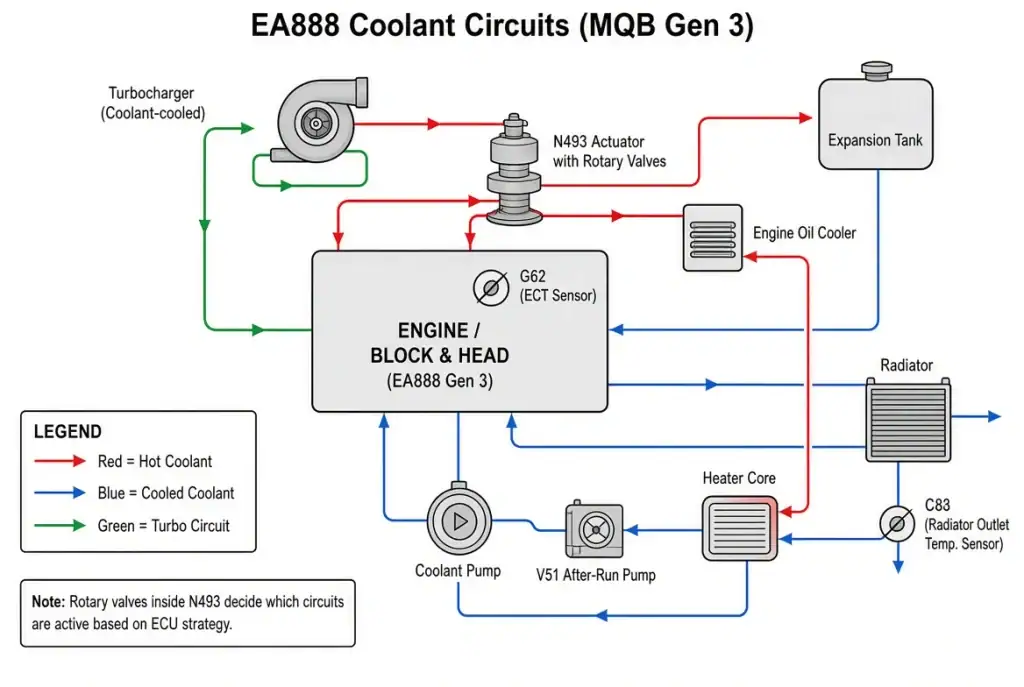
15. The EA888 Cooling System Has Multiple Circuits
One of the most confusing aspects of the EA888 is that there is not simply one coolant path.
Depending on the exact engine and vehicle configuration, coolant can circulate through different paths involving:
Engine block/head → turbocharger → N493 rotary valve
Engine block/head → oil cooler → N493 rotary valve
Engine block/head → N493 rotary valve → radiator
Engine block/head → N493 rotary valve → heater core
In each case, coolant leaves the block/head and picks up heat from a component such as the turbocharger or oil cooler.
It then arrives at the N493 rotary valve, not a generic engine “control module.”
The rotary valve is what actually decides where that coolant goes next: back to the radiator for cooling, to the heater core for cabin heat, or back to the pump to recirculate.
The control valves determine which circuits are active.
This is why troubleshooting an EA888 cooling problem requires understanding coolant flow, not simply locating the thermostat.
16. Coolant Temperature Sensors
The ECU needs temperature information to control the cooling system.
Two important sensors in the EA888 Gen 3 system are:
G62 — Engine Coolant Temperature Sensor
G62 provides engine coolant temperature information to the engine control module.
The ECU uses this information for thermal-management decisions.
It can influence:
- Coolant control
- Fueling
- Ignition
- Warm-up strategy
- Cooling fan operation
- Other engine-management functions
G83 — Radiator Outlet Temperature Sensor
G83 monitors coolant temperature on the radiator side.
This gives the ECU additional information about the effectiveness of radiator cooling.
Having temperature information from different points in the cooling system allows the ECU to determine whether the expected temperature difference is occurring.
17. Why Temperature Sensor Data Is So Useful for Diagnosis
Suppose the engine coolant temperature is high.
That information alone does not tell you what has failed.
Possible causes could include:
- Insufficient coolant
- Air trapped in the cooling system
- Coolant leak
- Coolant pump problem
- N493 actuator problem
- Valve-control problem
- Radiator restriction
- Cooling-fan problem
- Temperature-sensor problem
- Wiring problem
- Electrical connection problem
This is why measuring coolant temperatures at different points is more useful than immediately replacing a component.
For example, if G62 indicates a high engine temperature while radiator-side temperature behavior does not correspond to the expected cooling strategy, the problem may involve coolant flow or thermal-management control rather than the radiator itself.
18. Using VCDS to Diagnose the EA888 Cooling System
VCDS can be extremely useful for cooling-system diagnosis.
After connecting VCDS:
Step 1 — Connect to the vehicle
Connect the VCDS interface to the vehicle’s diagnostic connector.
Switch the ignition on.
Start VCDS and verify that communication with the vehicle is working correctly.
Step 2 — Open the Engine Control Module
Select:
[Select] → [01-Engine]
The exact menu names can vary depending on the VCDS version and vehicle.
Step 3 — Check Fault Codes
Select:
[Fault Codes – 02]
Record all stored and intermittent cooling-system-related faults before clearing anything.
Do not immediately erase the codes.
The fault-code information can provide important clues about whether the problem involves:
- Temperature sensors
- Coolant pumps
- Actuators
- Electrical circuits
- Implausible temperature signals
- Thermal-management components
Step 4 — Examine Measuring Values
Select:
[Adv. Measuring Values]
Search for cooling-related values such as:
- Engine coolant temperature
- Radiator coolant temperature
- Coolant pump information
- Temperature-control actuator information
- Cooling fan information
The exact measuring-value names and identifiers vary by ECU software and vehicle.
Do not assume that a measuring-value number from one EA888 ECU will be identical on another vehicle.
Step 5 — Compare Temperatures
The most useful diagnostic information often comes from comparing temperatures rather than looking at a single value.
For example:
Cold engine
G62 and other relevant temperature readings should be reasonably consistent with the actual ambient/engine temperature.
Warm-up
The temperatures should change as the thermal-management strategy progresses.
Under load
Radiator involvement and coolant temperature should respond to increased heat production.
After shutdown
The system may continue operating the auxiliary pump or cooling fan.
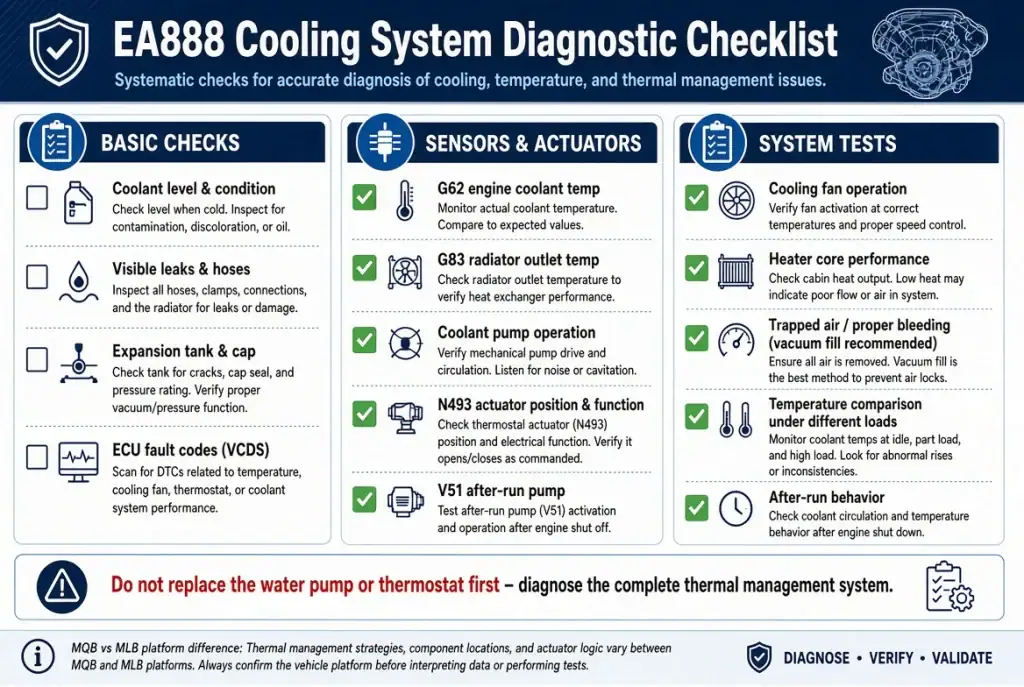
19. A Simple EA888 Cooling-System Diagnostic Strategy
When diagnosing a cooling problem, use a logical sequence.
Problem: Engine overheats
Start with the basics:
- Check coolant level.
- Inspect for visible leaks.
- Inspect coolant hoses and connections.
- Check the expansion tank and cap.
- Scan the engine ECU for fault codes.
- Check G62 temperature data.
- Check radiator temperature data.
- Check coolant-pump operation.
- Check N493 actuator operation where applicable.
- Check cooling-fan operation.
- Check for air trapped in the cooling system.
- Verify coolant circulation.
Do not automatically replace the water pump.
The EA888 cooling system contains several components capable of producing similar symptoms.
20. Common EA888 Cooling-System Symptoms
Several symptoms can point toward cooling-system problems.
| Symptom | Possible areas to investigate |
| Engine overheating | Coolant level, pump, radiator, fan, N493, trapped air |
| Coolant warning | Low coolant, leak, sensor, expansion tank |
| Slow warm-up | Thermal-management control, thermostat/valve system, temperature sensor |
| Heater blows cold | Low coolant, air, heater circuit, coolant pump |
| Cooling fan runs frequently | High coolant temperature, sensor data, thermal-management issue |
| Pump runs after shutdown | May be normal depending on engine temperature |
| Coolant loss | Hose, connection, radiator, water-pump/thermostat assembly, other leak |
| Temperature readings appear implausible | G62/G83 sensor or wiring |
| EPC/check-engine light with cooling fault | Sensor, actuator, wiring, thermal-management problem |
These symptoms are diagnostic starting points, not automatic component diagnoses.
21. Why Coolant Leaks Can Be Difficult to Find
EA888 cooling systems contain many hoses, connections, seals and components.
A small leak may not leave an obvious puddle underneath the vehicle.
Coolant can:
- Evaporate from a hot component.
- Run along the engine.
- Collect in areas that are difficult to see.
- Leak only when the system is hot and pressurized.
Therefore, an unexplained coolant-level drop should not be ignored simply because there is no visible puddle.
A proper pressure test and visual inspection may be necessary.
Always follow the vehicle-specific service procedure when pressurizing or servicing the cooling system.
22. Do Not Ignore Air in the Cooling System
Air trapped in the cooling system can produce symptoms that resemble component failure.
Possible symptoms include:
- Fluctuating coolant temperature
- Poor cabin heat
- Unusual coolant circulation
- Temperature spikes
- Coolant-level changes
- Cooling fan operation
The EA888 cooling system contains multiple circuits and control valves, so proper filling and bleeding are important.
Volkswagen service documentation specifies dedicated procedures for filling and venting the cooling system on applicable EA888 configurations.
Do not assume that simply filling the expansion tank completely is equivalent to correctly bleeding the system.
In practice, this system is notoriously difficult to bleed by conventional means.
The multiple rotary-valve circuits readily trap large air pockets.
Topping off the expansion tank and running the engine through heat cycles often fails to clear them.
A vacuum-fill tool, an air-operated venturi-style filler, is considered close to essential for this system.
It pulls the entire cooling system into a vacuum before drawing coolant in, so all circuits fill completely with far less risk of trapped air.
23. Why You Should Not Diagnose the EA888 Using One Temperature
A common mistake is to assume:
“The engine should always operate at exactly one temperature.”
That is not how the EA888 thermal-management system works.
The target temperature can change according to operating conditions.
At lower loads, the system can permit higher coolant temperatures.
Under higher loads, it can increase cooling and lower the coolant-temperature target.
Therefore, temperature should always be interpreted together with:
- Engine load
- Engine speed
- Vehicle speed
- Ambient temperature
- Coolant level
- Cooling-system status
- ECU fault codes
- Coolant-control commands
This approach produces a much more accurate diagnosis.
24. EA888 Cooling System: The Big Picture
The easiest way to understand the EA888 cooling system is to think of it as a computer-controlled heat-management system rather than simply a radiator system.
The basic sequence is:
Cold start
↓
Restrict unnecessary coolant flow
↓
Engine warms rapidly
↓
Small coolant flow protects hot components
↓
Oil and heater circuits are progressively incorporated
↓
Radiator becomes increasingly involved
↓
Normal temperature regulation
↓
Higher cooling demand under load
↓
After-run cooling after shutdown when necessary
The ECU continuously adjusts the system to balance efficiency, performance and component protection.
25. EA888 Cooling System vs. a Traditional Cooling System
| Traditional system | EA888 thermal management |
| Mechanical coolant pump | Controlled coolant circulation |
| Conventional thermostat | Active coolant-flow management |
| Simple coolant path | Multiple coolant circuits |
| Radiator mainly controlled by thermostat | ECU-controlled thermal strategy |
| Limited temperature management | Load-dependent temperature management |
| Cooling largely passive | Electronic control of coolant distribution |
| Engine shutdown generally ends circulation | After-run cooling can continue |
| Fewer temperature inputs | Multiple temperature measurements |
This complexity provides benefits, but it also means diagnosis requires more than checking whether the radiator is hot.
26. The Most Important Components to Understand
If you are learning to diagnose the EA888, concentrate on these components first:
G62
Engine coolant temperature sensor.
G83
Radiator outlet coolant temperature sensor.
N493
Engine temperature control actuator and coolant-pump assembly on applicable Gen 3 configurations.
V51
Radiator
Primary heat exchanger for the large coolant circuit.
Heater Core
Transfers engine coolant heat into the passenger compartment.
Engine Oil Cooler
Helps regulate engine-oil temperature.
Expansion Tank
Provides coolant expansion volume and system filling/pressure management.
Understanding how these components interact is much more useful than memorizing individual parts.
27. Final Thoughts
The EA888 cooling system is one of the engine’s most important control systems.
It does much more than prevent overheating.
The thermal-management system determines how quickly the engine warms up, how much heat is removed during high-load operation, how engine oil temperature is managed, how cabin heat is provided, and how the turbocharger is protected after the engine is switched off.
For EA888 owners, this also explains why some behavior that looks unusual can actually be normal.
A cooling fan running after shutdown does not automatically mean the car is overheating.
A coolant temperature that changes with engine load does not automatically indicate a thermostat problem.
Likewise, a coolant warning does not automatically mean the water pump has failed.
The correct approach is to understand the coolant circuit, control strategy, sensor data and fault codes together.
When diagnosing an EA888 cooling-system problem, start with the complete system rather than replacing the first component that appears suspicious.
Leave a Reply