
On October 15, 2026, I was travelling from Manhattan New York to Boston in my 2018 Volkswagen SportWagen 1.8T (EA888 Gen 3) when the check engine light came on and the temperature gauge climbed almost to the red zone. On Saturday, October 17, I scanned the car with my VD700 diagnostic tool. It recorded two fault codes:
- P00B700: Engine coolant flow low/performance (Ross-Tech describes the base code P00B7 as insufficient engine cooling or coolant flow).
- P013100: Oxygen sensor circuit, Bank 1 Sensor 1, signal too low (low voltage).
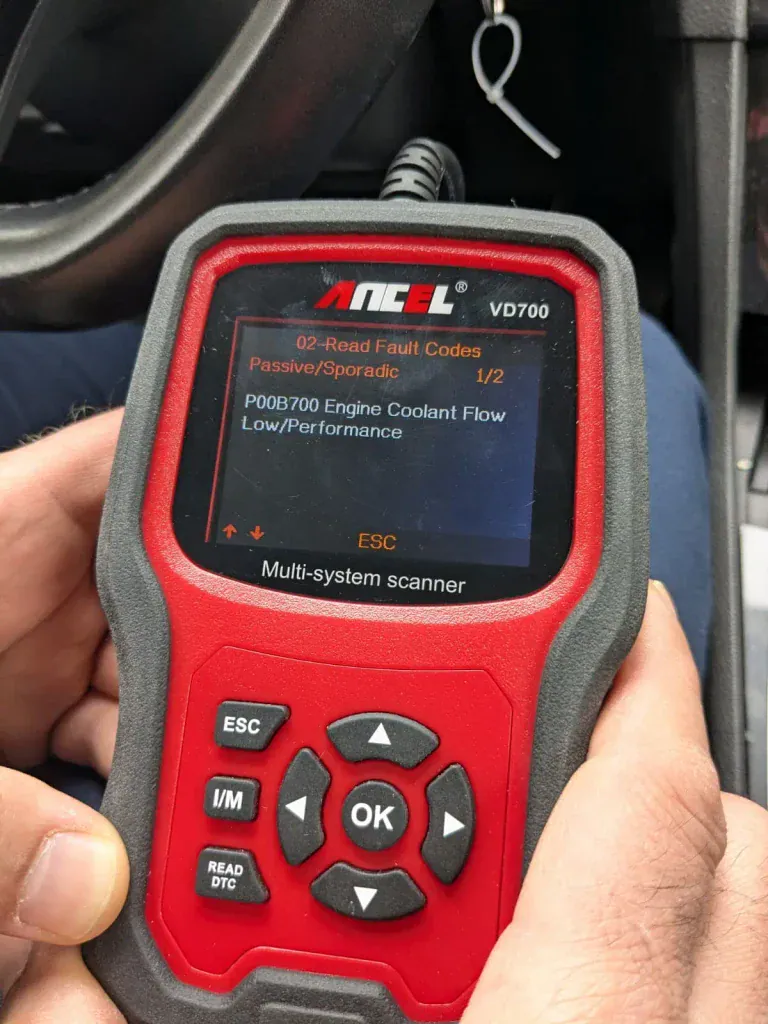
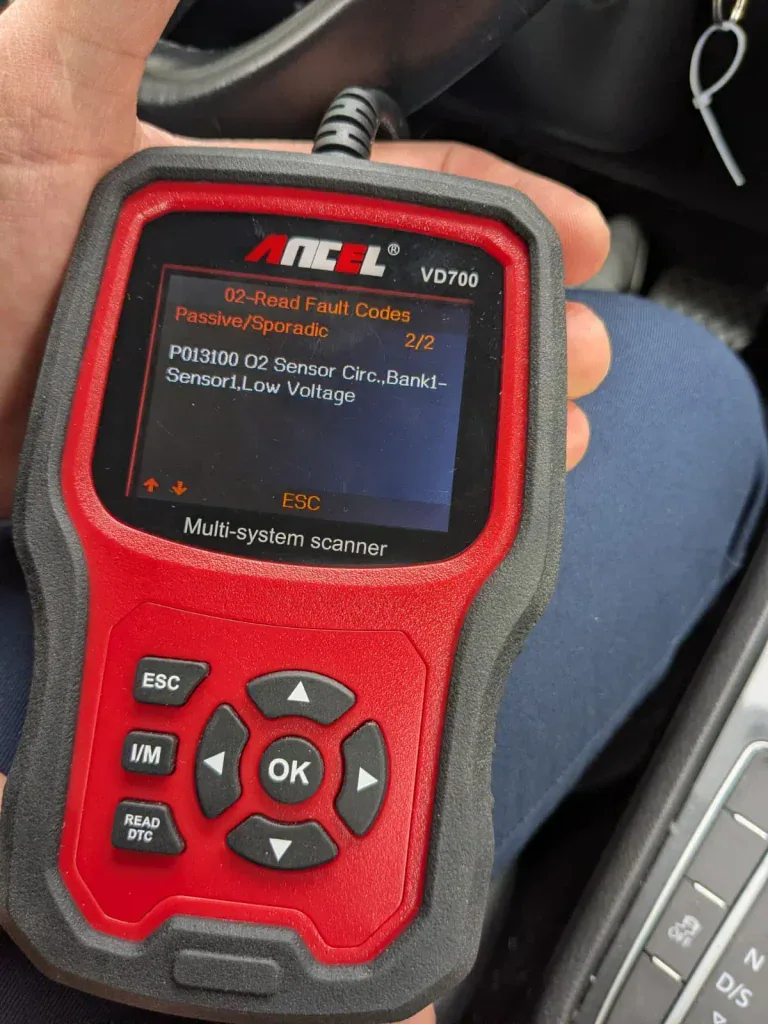
These codes point to two different systems. P00B700 concerns cooling and coolant-flow regulation. P013100 concerns the upstream oxygen-sensor signal or its circuit. Because the gauge nearly reached red, the cooling fault is the priority and I would investigate it first. A diagnostic trouble code (DTC) identifies a condition the engine control module (ECM) detected. It does not identify the failed part, so replacing the water pump, the N493 actuator, or the oxygen sensor before testing risks spending money without proving the cause.
This single guide covers what the codes mean, how to work through each one with VCDS (Ross-Tech’s VW/Audi diagnostic software), and when it is safe to keep driving. Results and the confirmed repair will follow in Part 2.
Current case status: The VD700 scan confirmed both codes. The root causes and required repairs have not yet been verified. The VCDS procedures below describe the diagnostic plan, not tests I have already completed on this car.
What do P00B700 and P013100 mean?
Although both faults appeared in the same scan, investigate them separately.
P00B700: Coolant flow low/performance
The base code is P00B7. Volkswagen tools may display an extended code such as P00B700, and the extra digits can carry manufacturer-specific information. Do not assume the suffix alone identifies the failed component.
The EA888 Gen 3 uses electronically controlled rotary coolant valves in addition to a mechanical coolant pump, so a coolant-flow fault can involve several components. Ross-Tech lists these possible causes:
- A sticking rotary coolant valve or a faulty N493 Engine Temperature Control Actuator.
- A water pump that is not circulating coolant adequately.
- Coolant leakage from the pump or thermostat housing.
- Damaged wiring, poor connections, or actuator position-feedback problems.
- Other restrictions or faults in the cooling circuit.
P00B700 makes the cooling system a priority. It does not prove that the water pump or N493 has failed.
P013100: Upstream oxygen sensor, signal too low
On this four-cylinder engine there is only one cylinder bank, so Bank 1 is the whole engine. Sensor 1 is the sensor upstream of the catalytic converter, and its feedback helps the ECM control the air-fuel mixture. This sensor is located or mounted upstream of the turbocharger.
The EA888 uses a wideband (planar) oxygen sensor, not a conventional narrowband sensor, so the familiar 0.1 to 0.9 V switching rule does not apply. A wideband sensor has a sensing cell (the Nernst cell) and a pump cell, and the ECM interprets their electrical behaviour to determine the exhaust mixture. A low-signal fault must therefore be judged against the correct sensor data and circuit specifications.
Possible causes include:
- A defective upstream oxygen sensor.
- Damaged wiring or a poor connection.
- A signal, reference-voltage, or ground fault in the circuit.
- An air-fuel mixture or exhaust condition that affects how the signal is interpreted.
A heater-circuit fault is worth checking only if related codes or test results point to it. P013100 alone does not mean the heater has failed.
Step 1: Save a complete VCDS Auto-Scan first
Before clearing anything, connect VCDS and save a full Auto-Scan. It gives a broader view than the engine controller alone, because other modules may hold faults that point to a shared electrical problem or low system voltage.
In 01 – Engine, record:
- The exact fault text and status for each code.
- Fault frequency and mileage, if the ECU exposes them.
- Freeze-frame data (coolant temperature, engine speed, load), when available.
- Other engine-controller faults stored alongside P00B700 and P013100.
- Relevant faults in other modules.
Clearing codes too early erases useful context. Save the scan first, then decide whether clearing codes is appropriate for a controlled test. Note also whether each fault is active, intermittent, or stored from an earlier event. A fault that returns immediately after clearing behaves differently from one that returns only after warm-up, and that difference helps narrow the search.
Step 2: Diagnose P00B700 (coolant flow)
Reference: Ross-Tech, P00B7 (Insufficient Engine Cooling / Coolant Flow).
2a. Check the coolant level and look for leaks
Park safely and let the engine cool completely. Check the level against the reservoir markings and inspect accessible components for:
- Coolant residue or wetness around the water pump and thermostat housing.
- Dried deposits at hose connections and coolant pipes.
- Damaged connectors or wiring near cooling-system parts.
- Signs of earlier repairs or disturbed seals.
- Unexplained coolant loss.
Safety: Never open the coolant reservoir cap on a hot engine. The system is pressurised, and escaping coolant can cause serious burns. If there is evidence of a leak, a pressure test using the correct procedure and pressure limit for the vehicle may be appropriate.
A correct coolant level does not guarantee adequate circulation, and a leak does not by itself prove the pump is bad. Both are simply evidence that shapes the next checks.
2b. Record coolant-temperature data
In VCDS, open 01 – Engine, Advanced Measuring Values and search the labels your ECU actually offers. Try terms such as coolant temperature, engine temperature regulation, radiator outlet temperature, N493 or temperature-control actuator, specified and actual actuator position, and cooling-system operating status.
Exact names and availability depend on the ECU software and engine code, so record the labels you see rather than copying measuring-block or IDE numbers from another model. Compare the readings with ambient conditions and with each other when cold, then watch how they change during warm-up. A value that is implausible from a cold start points to a different problem than a pattern that goes wrong only as the engine warms. No single universal temperature trace diagnoses every P00B7 fault.
2c. Evaluate the N493 actuator and rotary valves
Inspect the connector and wiring before condemning the actuator. Then, where both are available, compare the specified and actual N493 positions while observing operating conditions. If the requested position changes but the actual position stays fixed, moves erratically, or fails to follow, further testing is justified.
That mismatch does not prove the actuator motor is defective. A sticking valve, mechanical restriction, position-feedback problem, wiring fault, or installation issue can look the same.
Output Tests vs. Basic Settings: these are two different VCDS functions, found under different menus.
- Output Tests (01 – Engine, Output Tests) command a component to activate so you can see whether it responds. Use this to check whether N493 moves and whether its reported position follows the command.
- Basic Settings (01 – Engine, Basic Settings) runs adaptation or calibration routines, typically after a component has been replaced or a system has been opened.
Neither is guaranteed to exist for N493 on every ECU and software version. Confirm the test and its conditions in the vehicle-specific service information before running it. If the actuator does not follow a command, investigate its electrical supply, wiring, feedback signals, and mechanical movement before replacing it.
2d. Check the water pump and thermostat housing
Combine the scan results with a physical inspection and the factory procedure. Look for coolant loss or leakage, abnormal temperature behaviour, evidence of inadequate circulation, N493 movement or feedback that does not match the request, and related codes pointing to electrical or coolant-temperature problems.
Do not replace the pump solely because P00B700 is stored, and do not replace N493 solely because it is a known possible cause. The decision should follow the evidence, not a component’s reputation. For more on the system, see my guide: EA888 Cooling System Explained: How Volkswagen Controls Engine Temperature.
2e. Rule out overheating damage
A gauge that nearly reaches red means the engine may have run hotter than normal, even briefly. That does not prove damage, but these are worth ruling out before more driving:
- Coolant level now compared with before the trip, and any loss since.
- Oil that looks milky or creamy on the dipstick or under the filler cap.
- White exhaust smoke, a sweet coolant smell, or rough running.
- A cooling system that stays pressurised or bubbles after a short run.
- A pressure test or combustion-gas (block) test if coolant keeps dropping with no visible leak.
If any of these appear, stop driving and have the engine inspected by a qualified technician. Do not treat a cleared code as proof that the engine is undamaged.
Step 3: Diagnose P013100 (upstream oxygen sensor)
Reference: Ross-Tech, P0131 (Oxygen Sensor Bank 1 Sensor 1 Signal Too Low). Ross-Tech lists a faulty sensor and faulty wiring as possible causes and directs you to check the wiring and sensor rather than replace the part automatically.
3a. Inspect the sensor and wiring
Heat caution: the upstream sensor sits in the exhaust manifold area. Let the exhaust cool completely before inspecting it to avoid burns.
Identify Bank 1 Sensor 1 using the correct service information, then inspect the connector and accessible harness for:
- Damaged or stretched wiring.
- Heat damage near the exhaust.
- Corrosion or moisture at the connector.
- A loose connector.
- Signs of earlier repairs, or wiring that has contacted hot or moving parts.
Use the correct wiring diagram and pinout before any electrical test. Do not probe terminals or apply voltage without confirming the circuit function. Wideband sensor circuits are more complex than narrowband ones, and applying battery voltage to sensor terminals can damage them.
3b. Review wideband sensor data
In 01 – Engine, Advanced Measuring Values, look for entries such as actual lambda, specified lambda, lambda control, upstream sensor status, pump current or other sensor-specific electrical data (if exposed), short- and long-term fuel trims, and heater status (if available). These are search terms, not guaranteed label names.
In stable closed-loop operation, actual lambda should generally track the ECU’s specified target within the applicable tolerance. During acceleration, deceleration, or warm-up the target changes, so never judge a reading without considering the engine’s operating state. There is no universal pump-current range or lambda deviation that proves a sensor is bad. Use the specifications and test conditions for this engine and ECU.
3c. Separate a sensor fault from a circuit fault
A low-signal code does not necessarily mean the sensing element has failed. Determine whether the ECM is seeing an implausible signal because of the sensor, its wiring, its power, reference, or ground circuits, or some other condition. Check for related heater or reference-voltage faults and follow the service test procedure. Replace the sensor only when the tests support it.
Could P00B700 and P013100 be related?
Possibly, but appearing in the same scan is not proof of a shared cause. P00B700 concerns cooling-system operation and P013100 concerns the upstream oxygen-sensor signal, so investigate each independently and look for a common cause, such as an electrical problem or additional codes, only if the test results support one.
If the cooling fault is resolved but P013100 returns on its own, the oxygen-sensor circuit needs its own diagnosis, and the same applies in reverse. One scan can reveal two problems without revealing one common cause. Until the tests are done, neither the water pump, the N493 actuator, nor the oxygen sensor is the confirmed culprit.
Diagnostic log: what is confirmed and what remains
This table separates the evidence already recorded from the checks still to be performed. It does not claim that the listed tests have been completed.
| Item | Current evidence or next step |
|---|---|
| Vehicle | 2018 Volkswagen SportWagen 1.8T, EA888 Gen 3 |
| Initial scan tool | VD700 |
| Initial scan date | October 17, 2026 |
| Reported symptom | Temperature gauge nearly reached red on October 15, 2026; coolant level and any warning messages to be recorded |
| Cooling-system fault | P00B700 recorded; root cause not confirmed |
| Oxygen-sensor fault | P013100 recorded; root cause not confirmed |
| Complete VCDS Auto-Scan | Save and review |
| Freeze-frame data | Record what is available |
| Coolant level and leak inspection | Inspect with engine cold |
| Coolant-temperature values | Record actual VCDS labels and readings |
| N493 actuator | Inspect circuit; run supported Output Test; compare specified and actual position |
| Water pump and thermostat housing | Inspect and test as indicated by the evidence |
| Overheating damage checks | Check oil condition, exhaust smoke, coolant loss, and pressure retention; test further if indicated |
| Upstream oxygen sensor | Inspect wiring (engine cool) and evaluate available lambda data |
| Confirmed repair | Not yet documented |
Once the VCDS data is in, I will update this log with the actual readings and explain why each component was tested, repaired, or ruled out.
After the repair: verify the result
A repair is not confirmed just because a warning light goes out or a code is cleared. After any repair, I would:
- Follow the correct installation, coolant-filling, and bleeding procedure if the cooling system was opened.
- Run any Basic Settings or adaptation the vehicle-specific procedure requires.
- Inspect for leaks and confirm the coolant level with the engine cold.
- Save a fresh VCDS Auto-Scan.
- Check whether P00B700 and P013100 return under the conditions relevant to each.
- Review temperature and lambda data for plausible behaviour.
- Document the repair and the evidence supporting the conclusion.
Do not assume every water-pump or thermostat-housing replacement needs a separate adaptation. The correct steps depend on the parts replaced. If N493 was removed or replaced, consult the service information for required Basic Settings and bleeding steps. A fault may also need the right drive cycle before you can call the diagnosis complete.
Is it safe to drive with P00B700 or P013100?
In this case, the safest answer is not to drive the car further than necessary until the cooling system has been inspected, because the temperature gauge nearly reached red.
With P00B700: If the engine overheats, a coolant warning appears, steam escapes, or there is a substantial leak, stop safely, switch off the engine, and arrange recovery. Do not carry on with a highway trip to see whether the warning goes away. Even when the temperature display looks normal, a coolant-flow fault deserves prompt diagnosis, so avoid long trips until the cooling system has been assessed.
With P013100: The fault also warrants prompt investigation, because an unresolved oxygen-sensor circuit problem can interfere with engine management and emissions control. If the engine runs roughly, loses power, misfires, or other warning lights appear, stop and assess rather than assuming the car is safe.
If the gauge climbs again, pull over safely, switch off the engine, and let it cool completely before checking the coolant level. Do not drive on to see whether it settles.
What I have established so far
- My 2018 Volkswagen SportWagen 1.8T showed a check engine light during a New York-to-Boston trip on October 15, 2026, and the temperature gauge nearly reached the red zone.
- A VD700 scan on October 17 recorded P00B700 and P013100.
- P00B700 indicates a coolant-flow performance concern; P013100 indicates a low-signal condition in the upstream oxygen-sensor circuit.
- The scan alone has not established the failed components or root causes.
- Further testing is needed before any repair can be confirmed.
I will not describe this case as fixed until the results support it. Part 2 will be titled “VW SportWagen P00B700: VCDS Test Results and Confirmed Repair” and will include the actual fault data, measuring values, inspection findings, confirmed root cause, repair performed, whether the near-overheat caused any damage, and post-repair verification.
Frequently asked questions
Can I drive my VW SportWagen with P00B700?
Avoid long trips until the cooling system has been checked. If the engine overheats, a coolant warning appears, steam escapes, or a substantial leak is present, stop safely and arrange recovery. A normal-looking gauge does not prove that coolant circulation is adequate, and a gauge that nearly reaches red, as mine did, is a strong reason to stop driving until the system is inspected.
What causes P00B700 on a VW SportWagen 1.8T?
Possible causes include the mechanical coolant pump, the thermostat housing, the N493 actuator or rotary valves, wiring and connectors, and coolant circulation problems. Inspection and vehicle-specific scan data are needed to tell them apart. A water-pump problem is one possibility, not the only one.
What causes P013100, and does it mean I need a new oxygen sensor?
Not necessarily. P013100 indicates a low-signal condition in the upstream oxygen-sensor circuit. The sensor or its wiring may be responsible, but inspect the connector and harness, review the lambda data, and follow the correct circuit tests before replacing the sensor.
Does replacing the water pump automatically fix P00B700?
No. It helps only if the pump or related assembly caused the fault. If the cause is N493, wiring, or another cooling-system issue, a new pump alone may not resolve it.
Can VCDS diagnose the N493 actuator?
VCDS can help when the ECU exposes relevant measuring values or output tests. Comparing specified and actual actuator position gives useful evidence, but a mismatch alone does not prove which component failed. Available functions and labels vary by ECU and engine application, so confirm the procedure for your vehicle first.
Final thoughts: scanning is not diagnosis
A code reader provides a starting point. The next step is to preserve the fault information, inspect the relevant systems, evaluate live data, and test circuits and components as the service information directs. For this SportWagen, P00B700 directs attention to coolant circulation and thermal management, and P013100 directs attention to the upstream oxygen-sensor circuit. The correct repair should follow the evidence, not the code description alone.
For more practical Volkswagen repair and diagnostic guides, visit Akotex.com.
Applicability note: Diagnostic labels and test availability vary by engine code and ECU software. Use the vehicle-specific repair information for wiring tests, actuator tests, coolant filling, bleeding, and post-repair procedures.
Leave a Reply