Category: DTC Codes
A growing library of diagnostic trouble code (DTC) guides covering common check engine light codes across gas and diesel vehicles. Each post breaks down what a specific code means, the most likely root causes, how to confirm the fault with proper diagnostic tools, and the repair steps that actually fix it — not just a generic code definition pulled from a database.
You’ll find P-codes, B-codes, C-codes, and U-codes covering everything from boost and charge pressure faults to sensor, actuator, ignition, and emissions-related trouble codes. Guides draw on real, hands-on diagnostic and repair work — including VCDS-based diagnostics on VW/Audi platforms — so you’re getting practical troubleshooting steps, not just theory.
P0017 Code on VW & Audi: Complete Crankshaft-Camshaft Correlation Diagnosis
If your Volkswagen or Audi has stored P0017, the most important thing to understand is that this code does not automatically mean the camshaft position sensor has failed. P0017 is a crankshaft-to-camshaft correlation fault. In generic OBD-II terminology, it means: P0017 – Crankshaft Position – Camshaft Position Correlation (Bank 1, Sensor B) The engine control…
Written by
P0016 Code on VW & Audi: Crankshaft-Camshaft Correlation Diagnosis
Seeing the P0016 code on your VW or Audi can be concerning. This diagnostic trouble code (DTC) indicates a synchronization problem between your engine’s crankshaft and camshaft on Bank 1. In VW/Audi-specific terms, as outlined by Ross-Tech, this is defined as: Bank 1: Camshaft Position Sensor (G40) / Engine Speed Sensor (G28): Incorrect Correlation. This…
Written by
P0234 Diagnosis and Repair: How I Troubleshoot Turbocharger Overboost on the VW/Audi EA888 Engine — Part 2
In Part 1, I explained what P0234 means and how the Volkswagen/Audi EA888 engine controls turbocharger boost. I explained that: P0234 does not automatically mean the turbocharger is damaged. The fault simply tells me that: Actual boost pressure is higher than the ECU expected. The challenge is identifying why the ECU cannot control boost correctly.…
Written by
P0234 Explained: Diagnosing Turbocharger/Supercharger Overboost Condition on the VW/Audi EA888 Engine — Part 1
In this post, I will explore one of the less understood turbocharger-related DTC codes reported by Volkswagen and Audi owners: P0234 — Turbocharger/Supercharger “A” Overboost Condition. At first glance, this code sounds like a serious turbocharger failure. Many vehicle owners immediately assume that the turbocharger must be replaced because the engine is producing too much…
Written by
Sensors on the VW/Audi EA888 Engine (A Complete Guide) — Part 2
In Part 1, I explored the sensors responsible for controlling airflow and turbocharger boost. Those sensors tell the Engine Control Module (ECM) how much air is entering the engine and how much boost the turbocharger is producing. However, air alone is not enough. The ECU must also know: The sensors covered in this section work…
Written by
Sensors on the VW/Audi EA888 Engine (A Complete Guide)-Part 1
The Volkswagen Audi Group (VAG) EA888 engine is one of the most advanced turbocharged gasoline engines ever produced. Whether installed in a Volkswagen Golf GTI, Golf R, Sportwagen, Jetta GLI, Tiguan, Passat, or an Audi A3, A4, A5, Q3, or Q5, the EA888 engine depends on dozens of electronic sensors working in harmony to optimize…
Written by
P0299 Explained: Diagnosing Turbo Underboost on Volkswagen and Audi EA888 Engines (Part 3)
In Parts 1 and 2, we explored how the EA888 engine turbocharging system works and examined the most common causes of Diagnostic Trouble Code (DTC) P0299. In this part, we’ll move from theory to practice by following a professional diagnostic workflow. Rather than replacing parts based on guesswork, you’ll learn how to collect evidence using…
Written by
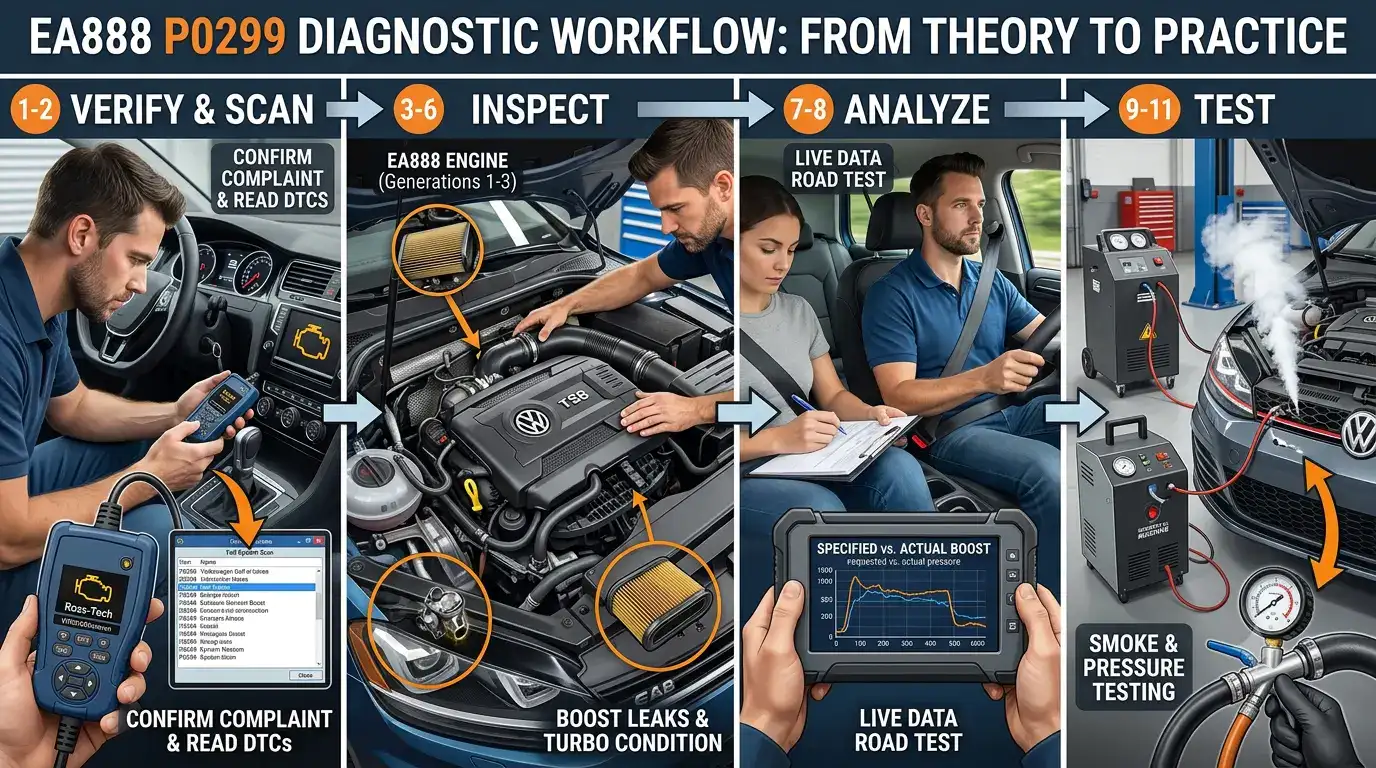
P0299 Explained: Diagnosing Turbo Underboost on Volkswagen and Audi EA888 Engines (Part 2)
In Part 1, we explained how the EA888 turbocharging system works and how the Engine Control Module (ECM) determines when to set Diagnostic Trouble Code (DTC) P0299. In this part, we’ll walk through the most common causes of turbo underboost — from boost leaks, diverter valve failures, and charge air system problems, to wastegate actuator…
Written by
P0299 Explained: Diagnosing Turbo Underboost on Volkswagen and Audi EA888 Engines (Part 1)
If you own a turbocharged Volkswagen or Audi powered by an EA888 engine, few diagnostic trouble codes are as common—or as misunderstood—as P0299: Turbocharger/Supercharger Underboost Condition. The first time this code appears, many owners assume the worst: “My turbocharger has failed.” That assumption often leads to unnecessary repairs and expensive parts replacements. In reality, a…
Written by
Part 3: P334A-Repair Procedures, Wastegate Actuator Calibration and Adaptation
After completing a systematic diagnosis, you should have a clear understanding of why your vehicle is setting Diagnostic Trouble Code (DTC) P334A – Charge Pressure Actuator Electrical Malfunction. At this stage, many owners are tempted to order parts immediately. However, replacing components without confirming the root cause often leads to repeat repairs and unnecessary expense.…
Written by