If you’re a Volkswagen or Audi owner searching for the right diagnostic scanner, you’ve likely narrowed it down to the “Ancel VD700” and “Ross-Tech VCDS”. Both tools go far beyond generic OBD2 scanners, but they target very different users and use cases. After months of real-world testing on my Volkswagen SportWagen (equipped with the EA888 Gen 3 engine and IS12 turbocharger), I can confidently say these aren’t direct competitors—they serve distinct roles.
I used both scanners extensively for routine maintenance, troubleshooting electronic faults, resetting service intervals, battery registration, steering angle calibration, and one of the most frustrating repairs I’ve tackled: an IS12 turbocharger wastegate actuator failure that triggered the EPC light and limp mode. This guide draws entirely from hands-on experience rather than spec sheets or marketing hype. By the end, you’ll know exactly which tool fits your needs, budget, and skill level.
Why Generic OBD2 Scanners Fall Short for Volkswagen Owners
Modern Volkswagens are rolling computers. Even basic maintenance now involves communicating with multiple Electronic Control Units (ECUs) across the CAN bus network. These modules manage the engine, transmission, ABS brakes, electronic parking brake, steering, airbags, HVAC, lighting, and infotainment systems. When something goes wrong, the vehicle stores manufacturer-specific Diagnostic Trouble Codes (DTCs) that generic OBD2 scanners often can’t access or interpret fully.
A generic scanner might pull a basic code like P0301 (Cylinder 1 Misfire), but it won’t reset the electronic parking brake after pad replacement, register a new battery, calibrate the steering angle sensor, or code new modules. These limitations force many owners into dealerships, where diagnostic fees alone can exceed $150–$200 before any repair begins.
In my experience, a good VAG-specific scanner quickly pays for itself. During my turbo wastegate saga, proper diagnostics prevented me from unnecessarily replacing an entire $3,500+ turbocharger assembly. Instead, I fixed the root cause—a seized wastegate pivot—saving significant money and time. Whether you’re a casual DIYer handling oil changes and brake jobs or a serious enthusiast diving into module coding and retrofits, dedicated tools transform frustrating guesswork into confident repairs.
Key Functions Missing from Generic Tools
– Electronic parking brake service mode
– Battery registration (critical for start-stop systems)
– Throttle body and steering angle adaptations
– Injector coding and long coding
– Output tests (bidirectional control)
– Advanced measuring blocks and data logging
– Module coding and retrofits
These capabilities separate tools like the Ancel VD700 and Ross-Tech VCDS from basic code readers. Choosing the right one depends on how deep you want (or need) to go.
Introducing the Ancel VD700: The Portable DIY Workhorse
The Ancel VD700 is a standalone handheld scanner built for Volkswagen Group vehicles. Plug it into the OBD2 port, turn on the ignition, and it auto-detects the vehicle via VIN. No laptop, no cables beyond the OBD connector, and no complex setup.
Its compact size means it lives in my toolbox for instant use. Over months of ownership, I relied on it for:
– Reading and clearing fault codes across all systems
– Oil service resets
– Electronic parking brake retraction
– Battery registration
– Steering angle sensor calibration
– Live sensor data
The interface is straightforward and beginner-friendly. Menus are logically organized, and the device boots quickly. Lifetime free software updates via USB connection keep it current without ongoing costs. For most everyday tasks—oil changes, brake jobs, battery swaps, or quick fault scans—the VD700 excels. It’s affordable, portable, and covers roughly 80% of what the average VW owner encounters.
Strengths for DIY Owners
– Truly plug-and-play operation
– Automatic full-system scans
– Solid coverage of common service functions
– No learning curve for basic use
– Excellent value for money – costs around $100–$150
However, it has clear boundaries. Live data is limited to common parameters without advanced graphing or extensive logging. Bidirectional controls (output tests) are restricted, and it lacks long coding, full adaptation channels, and deep Basic Settings procedures needed for complex module work.
Introducing Ross-Tech VCDS: The Professional Benchmark
Ross-Tech VCDS (VAG-COM Diagnostic System) is the gold standard for non-dealer VAG diagnostics. It consists of a HEX-V2 or HEX-NET interface cable paired with powerful Windows software. While it requires a laptop, the depth it provides is unmatched outside official dealership tools.
The interface looks technical—full of measuring blocks, adaptation channels, coding options, and output tests—but once familiar, it reveals incredible insight. VCDS accesses nearly every ECU, supports long coding, comprehensive adaptations, guided Basic Settings, data logging during test drives, and extensive bidirectional controls.
During my turbo repair, VCDS allowed me to monitor wastegate actuator position feedback, requested vs. actual boost pressure, and perform precise calibrations that restored normal operation. Features like real-time graphing, security access, and module installation support make it indispensable for serious work.


Key Advantages of Ross-Tech VCDS
– Dealer-level access to all modules
– Advanced live data with graphing and logging
– Full bidirectional output tests
– Long coding and retrofit capabilities
The trade-offs are a steeper learning curve, laptop dependency, higher cost, and less convenience for quick roadside checks.
Critical Buying Advice: VIN Limits and Clone Cables
Before you open your wallet, you need to understand two things that most reviews conveniently ignore.
VCDS Licensing: The VIN Restriction Explained
Ross-Tech offers several license tiers, and this dramatically affects the real cost:
| License Type | Approximate Price | What It Means |
| 3-VIN | ~$199 | Locks permanently to three specific vehicles. Ideal if you own one or two cars. |
| 10-VIN | ~$299 | Allows diagnostics on up to ten vehicles. Good for small families or weekend helpers. |
| Unlimited VIN | ~$449–$649 | Works on any VAG vehicle, indefinitely. Required if you flip cars or work on friends’ vehicles regularly. |
The Ancel VD700 has “no such restrictions”—it works on every VAG car you plug it into, forever. If you only own one VW, the 3-VIN VCDS is fine. But if you’re a serial repairer or community helper, the unlimited version is the only sensible choice.
The Clone Cable Trap
You’ll find “VCDS cables” on eBay, AliExpress, and even Amazon for $30–$50. These are counterfeit interfaces, and buying one is a dangerous gamble.
Why you should never buy a clone:
– They often fail mid-diagnosis, corrupting module data and potentially bricking ECUs
– Ross-Tech actively blocks clones with each software update—your cable may stop working overnight
– They lack proper electronic isolation, risking actual damage to your car’s sensitive control modules
– You get zero support or documentation
A $50 gamble that can cost you a $2,000 ECU replacement is no bargain. Buy genuine Ross-Tech or don’t buy VCDS at all. This is the single most important warning I can give you.
Hands-On Feature-by-Feature Comparison
After switching between both tools on the same vehicle for the same jobs, here’s how they stack up in practice:
| Feature | Ancel VD700 | Ross-Tech VCDS |
| Fault Code Reading & Clearing | Excellent, fast, full-system | Excellent, deeper module coverage, more detailed reports |
| Live Data Monitoring | Essential parameters (RPM, temps, fuel trims) | Dozens of measuring blocks, real-time graphing, road-logging capability |
| Service Functions | Handles all core jobs well | Handles all core jobs with extra confirmation and logging |
| Coding & Adaptations | Basic adaptations only | Full long coding, all adaptation channels |
| Output Tests (Bidirectional Control) | Limited support | Full command of actuators, pumps, fans, valves |
| Basic Settings (ECU Learning) | None | Full guided calibration routines—teaching components their physical limits |
| Portability | Pocket-sized, instant boot | Requires Windows laptop setup |
| Updates | Lifetime free via USB | Reliable, but major releases may have licensing considerations |
| Price | ~$150 | $199–$649 depending on VIN limit |
| Vehicle Restrictions | None—works on all VAG cars | 3, 10, or unlimited VIN options |
Deep Dive: Live Data and Why It Matters More Than Codes Alone
Fault codes are clues, not conclusions. A P00AF “Turbocharger Boost Control Module Performance” code doesn’t tell you “why” the issue occurred. During my repair, the VD700 quickly identified the code and freeze-frame data, pointing to the wastegate system. But diagnosing the root cause—partial seizure of the wastegate lever pivot due to corrosion—required VCDS’s superior live data.
I monitored actuator command vs. actual position, boost deviations, and adaptation values under load. This level of detail prevented misdiagnosis. VCDS’s graphing made anomalies obvious during test drives. For complex systems like turbo control, transmissions, or ABS, this capability is game-changing.
Case Study: Fixing the IS12 Turbocharger Wastegate Failure
My SportWagen suddenly entered limp mode with the EPC light on. VW dealer advice screamed “replace the turbo.” Using the VD700 first confirmed the boost control fault. It was helpful but insufficient for the full picture.
Switching to VCDS, I:
1. Logged detailed measuring blocks while driving.
2. Commanded actuator movement via output tests.
3. Observed inconsistent position feedback.
4. Performed “Basic Settings”—which is VCDS-speak for “teach the ECU the new actuator’s physical open and closed limits”—after installing a new actuator.
The repair succeeded without a full turbo replacement. This single experience highlighted the complementary strengths: VD700 for initial triage, VCDS for resolution.
Related Reads from My Repair Series
If you’re dealing with a similar issue or want to dive deeper into the IS12 turbocharger repair, check out these detailed posts from my own experience:
– How I Diagnosed and Fixed My VW SportWagen IS12 Turbocharger After an EPC Light and Limp Mode Event – The full story of my turbo failure and how I tracked down the root cause.
– Car Lost Power While Driving on Highway? From Boost to Limp Mode – Causes & Fixes – Understanding why VWs suddenly lose power and how to get back on the road.
– IS12 Wastegate Actuator Calibration and Adaptation Guide – A step-by-step walkthrough of the Basic Settings procedure that saved my turbo.
– VCDS Scanner: The Most Important Tool I Used to Fix My Volkswagen EPC Light Issue – Why VCDS became my go-to for serious diagnostics.
– Understanding the IS12 Turbocharger: Location and Component Breakdown – A visual guide to what’s actually under the hood.
– How I Saved $4,500 by DIY-ing My VW Sportwagen IS12 Turbocharger – The full cost breakdown and why doing it yourself was worth it.
Coding, Adaptations, and Basic Settings Explained
Replacing modern components often requires ECU “handshakes.” New batteries need registration to optimize charging. Steering sensors must be calibrated after alignment. Turbo actuators require learning procedures.
The VD700 manages several of these basics reliably. VCDS handles virtually everything, including long coding changes that activate hidden features or adapt replacement modules. “Basic Settings”—guided calibration routines where the ECU learns the physical limits of a new component—are a VCDS strength that ensures repairs stick and prevents recurring faults. The VD700 simply cannot perform these critical procedures.
Bidirectional Diagnostics: Testing Without Disassembly
Bidirectional control lets the scanner actively command components. Want to test the fuel pump, cycle cooling fans, or move the turbo actuator? VCDS makes it routine. The VD700 offers some service-mode functions but far less flexibility. This capability turns diagnostics from passive reading into active troubleshooting.
Where to Go for Help: The Support Ecosystem
This is an underrated factor that can make or break your experience:
| Aspect | Ancel VD700 | Ross-Tech VCDS |
| Official Support | Email support, firmware updates | Direct email/phone support, active forums |
| Community Knowledge | Virtually none for this model | Legendary Ross-Tech wiki with step-by-step guides |
| Forum Activity | Minimal | Thousands of threads, staff actively participate |
| DIY Documentation | User manual only | Extensive online resources for every fault code |
If you google “VCDS P00AF,” you’ll find dedicated threads with specific troubleshooting steps, often with direct input from Ross-Tech staff. If you google “Ancel VD700 P00AF,” you’ll find… this article. The VCDS community ecosystem is arguably its greatest strength—it turns a diagnostic tool into a complete repair support system.
Software Updates and Long-Term Ownership
Both tools stay relevant through updates. The VD700’s process is dead simple: USB to PC, run updater, done—free for life. VCDS updates come from the Ross-Tech site and integrate new models and protocols reliably. For most users, either approach works well, but the VD700 edges out on hassle-free maintenance.
Pros and Cons Summary
Ancel VD700
| Pros | Cons |
| Extremely portable and easy to use | Limited depth in coding and adaptations |
| Fast for routine maintenance tasks | Restricted bidirectional tests |
| Covers core service functions | Not suitable for advanced ECU work |
| Affordable (~$150) | Minimal community support |
| Free lifetime updates | No Basic Settings capability |
| No VIN restrictions—works on all VAG cars |
Ross-Tech VCDS
| Pros | Cons |
| Unparalleled depth and control | Requires a Windows laptop |
| Excellent for complex diagnostics | Higher cost ($199–$649) |
| Full bidirectional and coding capabilities | Steeper learning curve |
| Professional-grade data logging | VIN restrictions on lower-tier licenses |
| Legendary community wiki and forum support | Less convenient for quick checks |
| Full Basic Settings and calibration routines | Clone cables are a dangerous trap |
Final Verdict: Which Should You Buy?
There is no universal “better” tool—only the right tool for your needs.
Choose the Ancel VD700 if:
– You own one or two VAG cars and plan to keep them stock or lightly modified
– Your primary jobs are maintenance: oil changes, brake pad swaps, battery replacements, and DPF regens
– You want to read and clear codes without hauling a laptop into the driveway
– Budget is a primary concern (~$150)
– You occasionally replace sensors or simple modules without needing deep coding
The VD700 covers the vast majority of everyday Volkswagen needs at a fraction of the cost. It’s the perfect entry point.
Choose VCDS if:
A) You own multiple VAG cars or plan to heavily modify yours
B) You are swapping engines, retrofitting adaptive cruise control, or installing European-spec components that require coding
C) You regularly tackle turbo, transmission, ABS, or complex electrical system repairs
D) You value detailed data logging and graphing to diagnose intermittent issues
E) You want access to a world-class community wiki and forum for troubleshooting
F) You’re a professional mechanic or a serious home-gamer who wants dealer-level capability
For serious enthusiasts or those planning long-term ownership of VAG cars, VCDS is often worth every penny.
My Personal Recommendation
Keep both. Use the VD700 as your quick-access toolbox staple for scans, resets, and basic checks. Reserve VCDS for deep dives, adaptations, and challenging repairs. This combination delivered complete coverage in my garage and maximized value from each tool.
Quick Decision Guide
| Your Situation | Recommended Tool |
| One VW, basic maintenance only | Ancel VD700 |
| One VW, but planning retrofits | VCDS 3-VIN |
| Multiple VWs or working on friends’ cars | VCDS Unlimited VIN |
| Tight budget, just want to do brakes/battery/oil | Ancel VD700 |
| Diagnosing intermittent transmission/turbo issues | VCDS |
| Professional mechanic or serious enthusiast | VCDS Unlimited VIN |
| Need to perform Basic Settings/calibrations | VCDS |
Frequently Asked Questions
**Is the Ancel VD700 better than VCDS?**
No—they serve different tiers. VD700 is a brilliant maintenance tool; VCDS is a professional-depth diagnostic system.
**Can the VD700 perform VW coding?**
Limited basic adaptations only. No long coding or advanced retrofits like VCDS.
**Is VCDS worth the money?**
Absolutely for frequent or complex work. It prevents expensive misdiagnoses and enables repairs that would otherwise require a dealer visit.
**Can the VD700 calibrate turbo wastegate actuators?**
It can read codes but lacks the full Basic Settings and detailed controls needed for reliable calibration. VCDS is required for proper IS12-style repairs.
**Do I need a laptop for VCDS?**
Yes. It runs exclusively on Windows (including virtual machines on Mac). The HEX-NET version offers wireless connectivity, but still requires a PC to run the software.
**Which is best for beginners?**
The Ancel VD700, hands down, due to its plug-and-play simplicity.
**Can I use a cheap clone VCDS cable instead?**
Absolutely not. Clones fail, corrupt modules, and are actively blocked by Ross-Tech updates. The money saved isn’t worth the potential damage.
**What’s the real price difference?**
Ancel VD700: ~$150. VCDS: $199 (3-VIN) to $649 (Unlimited). Factor in the VIN restriction when comparing.
Final Thoughts
The Ancel VD700 vs VCDS debate ultimately comes down to your goals. The VD700 is an outstanding, affordable entry point that handles real-world maintenance brilliantly. VCDS unlocks the full potential of Volkswagen electronics for those who want (or need) dealer-level capabilities.
In my experience, understanding both tools’ strengths led to faster, cheaper, and more confident repairs. Whether you pick one or combine them, investing in proper VAG diagnostics will save you far more than it costs—especially when that EPC light comes on at an inconvenient time.
If you’re serious about maintaining your Volkswagen long-term, start with the tool that matches your current skill level and expand as your projects grow deeper. Happy diagnosing!
Recommended Resources on Akotex
If you found this comparison helpful, you might also enjoy these detailed posts from my VW repair journey:
– IS12 Turbocharger Wastegate Calibration Guide – A step-by-step walkthrough of the Basic Settings procedure.
– How I Fixed the EPC Light on My Volkswagen SportWagen – The full story of my turbo diagnosis and repair.
– VCDS Basic Settings Tutorial – Why VCDS was essential for my repair.
– EA888 Gen 3 Engine Common Issues – Understanding the heart of your VW.
– How I Saved $4,500 by DIY-ing My VW Sportwagen IS12 Turbocharger – The full cost breakdown and why DIY was worth it.
– Car Lost Power While Driving on Highway? Causes & Fixes – What to do when your VW suddenly loses power.
Disclaimer:
I’m not affiliated with Ancel or Ross-Tech. I purchased these tools with my own money and am sharing my honest experience. Prices and features may change over time—always verify current specifications before purchasing. Always exercise caution when working on your vehicle; if you’re unsure about any procedure, consult a qualified professional.
Blog
This section provides an overview of the blog, showcasing a variety of articles, insights, and resources to inform and inspire readers.
EA888 Gen 3 Water Pump Explained: How It Works, Failure Points and Diagnosis
If you own a Volkswagen or Audi with an EA888 Gen 3 1.8T or 2.0T…

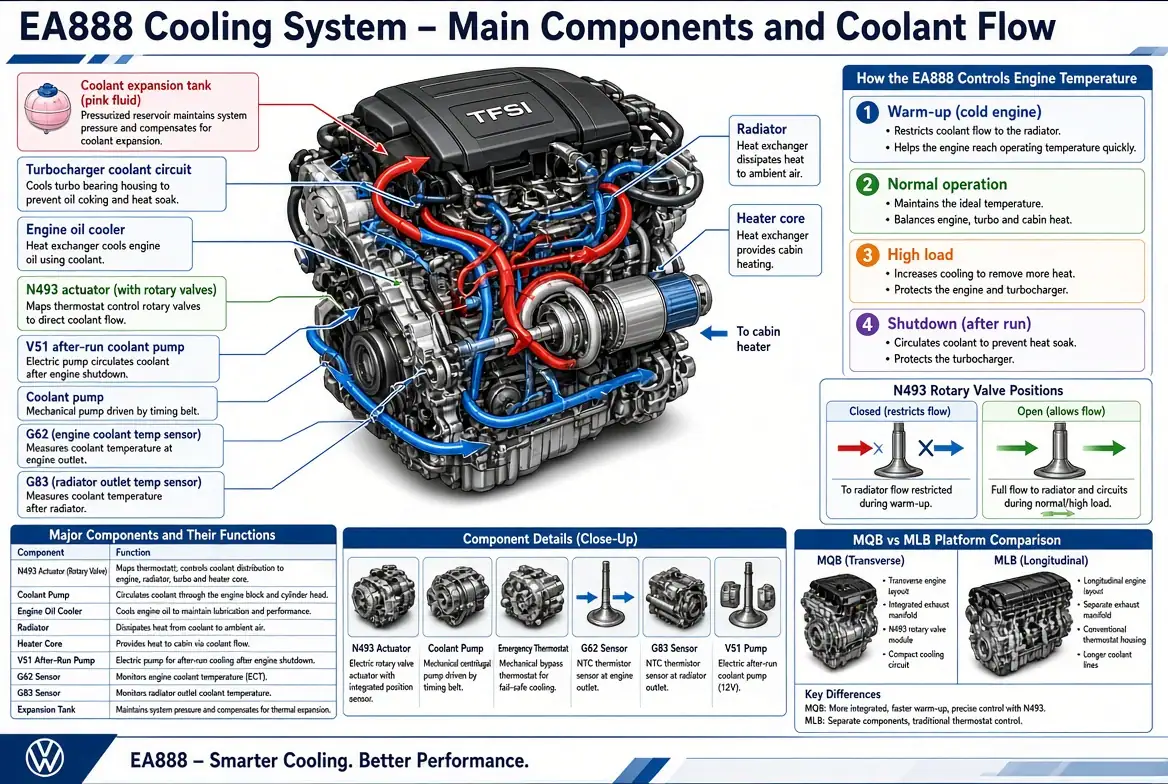

EA888 Cooling System Explained: How Volkswagen Controls Engine Temperature
Detailed technical illustration of the EA888 Gen 3 engine showing main cooling system components with…
VCDS Part 1-4: How to Perform Your First Auto-Scan on a Volkswagen or Audi
If you have completed the first three articles in this VCDS series, you now understand…


Leave a Reply